
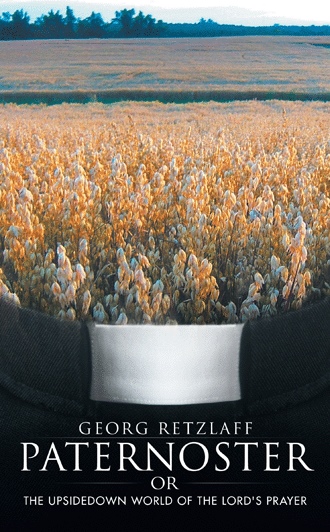
PATERNOSTER
Or: The UpsideDown World of the Lord's Prayer
by
Book Cover & Preview Text
“No one is good but God alone” (Mark 10.18), said Jesus, dropping a bombshell amid his Pharisaic audience. No one is good because his life goes well. No one is bad because he suffers. Well-being is not God's gift to the righteous anymore than pain is God's punishment for the wicked. Here is a whole new perspective: the world is amoral. Looked at from outer space there is nothing written on any deed as being good or evil. It just is. There is neither a rewarding nor a punishing power out there. All externalizations are futile because they blind us to the stark truth that good and evil are mere reflections of the human soul. Evil, far from being either a personal or impersonal force outside of us, is simply another word for human nature. In Mark 7:23, Jesus says, “All these evil things come from within, and they defile a man.” He knew what was in man's heart (John 2:25), no one needed to tell Him. What is evil is natural, normal, human, not extraterrestrial, supernatural, mysterious. It's all so easy: we do what we do because we are humans. No devil makes us do anything, unless the devil is us. The devil needs no redemption (pace Origen and his Unitarian followers), man does. Plato's parable of the “Ring of Gyges” is an appropriate example: a shepherd finds a ring which, upon turning on his finger, makes him invisible. He enters the king's palace, eats for free, steals without being recognized, beds the queen, kills the king, and takes the kingdom for himself. This is what humans do when there is neither punishment nor reward, when they are invisible. It's all inside. “The Lord of the Flies” by William Golding (1954) tells the same story, so do the large-scale city riots of the 60s and 70s when the lights went out and “good” people went looting or fornicating (after a New York City Brown Out the birth rate of children born illegitimately rose dramatically). Evil is not out there, it's in here. The devil is a useless crutch. Why look so far if the answer is so close? What we identify as evil is no more or less than the awareness of what we truly are and what we should become. “Evil” is the label we give to the gap between human and Christian nature, to life before and after baptism. Let us be clear: there is no devil, there is no evil force out there anywhere. There is only humanity in its hopelessness and corruption. Those who are “in Christ” know the difference, they suffer from their humanness, they yearn for liberation into a new life, a super-human life, a Christ-life. They see the solution not in blaming anyone or anything “out there” but in dealing with their old nature vs their baptized Christ-nature. Deliver us from evil: yes, Lord, deliver us from the notion of evil as handed down to us through generations; make us free to see us, not “it” or him” as the source of our misery and pain. This may, indeed, be the huge difference between the prayer John the Baptist taught his disciples and the Our Father. John was a fire and brimstone preacher. He expected the Son of Man to come from heaven who “will clear his threshing floor and gather his wheat into the granary but the chaff he will burn with unquenchable fire” (Mt 3:12). He thought that the world would be a better place if “every tree therefore that does not bear good fruit is cut down and thrown into the fire” (Mt 3:10). If evil people were destroyed, evil, too, would be gone. He had pinned his hopes on Jesus to be that man with the “winnowing fork” but was sorely disappointed when his erstwhile protégé ate with outcasts and healed those whose very ailments spoke of the “evil” they must have had committed (Mt 11:2-6). John's “evil” could be prevented by threat, and wiped out by killing. Jesus' “evil” is brought to awareness by truth and overcome by invitation, by love and example. His axe is not laid to other men's roots but is wielded against one's Self. At the foot of the mountain we drop this baggage and feel lighter already. We no longer blame anyone or anything. We have been delivered from great confusion and harmful religion. We move on.
Formats


Book Details
About the Book
The Our Father is so much more than a simple, rather harmless prayer, suitable for saying Grace, ending meetings, or - due to the apparent absence of recognizable Christian theology - Interfaith conferences. This book does away with this innocuous approach and examines this prayer as what it originally was: a succinct summary of the Lord’s teaching, more akin to a creed than a petition. It represents a radical break with the theology prevalent at Jesus’ time and proves thus another substantive piece of evidence why its author was accused of blasphemy and sentenced to die on the cross. Here is a book which removes the debris of centuries, digs deep to get to the Pearl and restores its glorious luster.
About the Author
Educated in Europe, with a doctoral degree in theology from the University of Bern, Switzerland, the author recently retired as rector of an Episcopal Church in South Carolina, after a distinguished career as pastor, missionary (Liberia and Tanzania), and professor at American colleges and universities (professor of homiletics at the University of the South’s School of Theology, Sewanee, Tennessee). He has a passion for teaching the gospel the way Jesus communicated it, unencumbered by the theological and historical ballast of two millenia. Together with Joy, his wife of 37 years, he enjoys reading, writing, and travelling and, above all, cherishing their children and grandchildren.