
What Jesus Taught And Why It Matters
Towards a Christianity With No Other Foundation But Christ
by
Book Cover & Preview Text
The greatest misunderstandings revolve around Jesus’ “summaries” of the Law. Most Christians presume that the essence of the gospel is enshrined in the so-called Golden Rule. But this “rule” is neither Christian (Kung Fu Tzu, some 600 years before Jesus, formulated the same idea, sometimes referred to as “Silver Rule” because it uses the negative formulation, don’t do unto others what you don’t want them to do unto you) nor radical enough to warrant the cross. In fact, this “rule” simply sums up the old religion: So whatever you wish that men would do to you, do so to them; for this is the law and the prophets (Mt 7:12). No one would have ever been delivered to the Roman authorities for stating the obvious, eternally valid ethical principle of reciprocity. Immanuel Kant, 1700 years later, rephrased the Golden Rule in his “categorical imperative”, and died peacefully after a long life in academia.
This leaves us with the Great Commandment, Mt 22:24-40: But when the Pharisees heard that he had silenced the Sadducees, they came together. And one of them, a lawyer, asked him a question, to test him. “Teacher, which is the great commandment in the law?” And he said to him, “You shall love the Lord your God with all your heart, and with all your soul, and with all your mind. This is the great and first commandment. And a second is like it, You shall love your neighbor as yourself. On these two commandments depend all the law and the prophets.”
Repeated Sunday after Sunday, at the opening of the weekly Eucharist, this text has become the embodiment of what the Gospel stands for: love of God and neighbor. That Jesus’ answer has next to nothing to do with genuine Christianity is lost on most, if not all people. A scribe asks Jesus to summarize the Old Testament law. Jesus replies with two quotes from that law: Deuteronomy 6:5 and Leviticus 19:18, doing just what the questioner had wanted: summarize the law. These rule-of-thumb pronouncements were neither original nor dangerous, they were popular with people who couldn’t find their way around the bewildering multitude of ever-increasing regulations. No one, ever, in all of human history, had himself killed for stating the obvious, the pleasant, the easy and convenient: love God and neighbor, and you are OK! How could Christianity have ever slid down this slippery slope? The vast majority of people on earth, in one way or another, love “God” (some ultimate value) and strive to be nice. Volunteerism, charitable works, care for the needy: that’s human or humanistic. Much great work is done by atheists and agnostics. If that’s what Jesus came to proclaim as Good News, we need to look for a new religion! You don’t sacrifice your life for the trite, the trivial, the undisputed. No, this is not the gospel of Jesus.
Formats




Book Details
About the Book
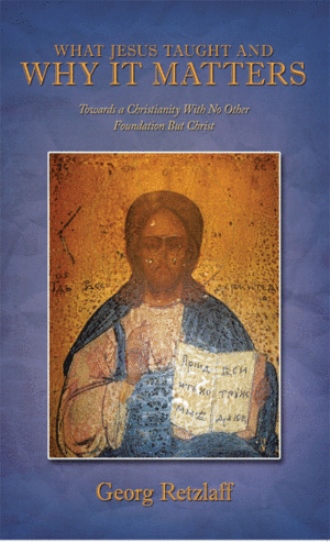
Do Jesus and His Gospel really matter? Looking at Christianity today, 2000 years later, one wonders whether what He shared with the world was quickly smothered by Old Testament legalism, Zoroastrian fantasies, Greek philosophical speculations, and Germanic folk traditions. Most Christians seem to think that their religion is about "going to heaven", eternal life after death, someone "paying the price" for our sins (to either God or the devil – an issue still not resolved). If Christianity is not first and foremost about His Words of Eternal Life, about the Gospel He preached, but rather about pre-, and preter-Christian ideologies, it has no right to call itself Christian. This book is about Jesus, and Jesus alone. No one should have laid another foundation except with His words being the cornerstone of all we are and do.
About the Author
Georg Retzlaff has been a priest and teacher in the church for almost forty years. Educated in Europe, he earned his Doctor of Theology degree in Church History from the University of Bern, Switzerland, and taught at colleges and universities in the