
The Wicked Storm
by
Book Cover & Preview Text

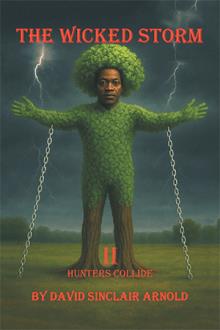
The Wicked Storm By David Sinclair ARNOLD Chapter 1 A Chilling Rain had pierced the darkness and wrapped all things it touched in its icy grip. It was the type of cold that could shatter a person’s soul. The wind cried and howled as it blew through the neighborhood. Shutters on nearby houses pounded loudly in retaliation of the storms’ assault. But all their protestations had no effect. Without mercy the storm tore the limbs from many majestic trees while leaving a slew of smaller trees hopelessly uprooted. With all their majesty most trees had little chance of surviving such an assault. As water fell from the rooftop edges to the thirsty weeds below, they devoured it. The clever weeds had been hiding deep in the frigid night. Going unnoticed they were miraculously thriving. They grabbed most of the water for themselves while robbing other plants of that precious life sustaining substance. Dr. Elias Thorne wrung his hands as he rose from his desk. He had left his window cracked open. He shivered slightly as he slid his fingers across the wet window ledge. The storm served as a vivid reminder that evil sometimes conquers good by quite a wide margin. A cold truth of our universe. A realization that serves as the foundation for the story I am about to share with you. Elias squinted as he peered through his window at the sun exploding silently on the horizon. A multitude of colors pierced the sky. They mingled and merged with the sparse clouds. It was as if the wide array of colors strove to glorify our existence despite what had occurred during the night. Awakened by twilight the birds held their usual morning symphony from the treetops that had survived the night. Elias sighed and rubbed the back of his neck while listening to their melodic sounds. He felt a sense of awe at the great power nature possesses. The power to transform our environment so swiftly and on such a massive scale in a matter of hours. Something men with all their mighty machines can’t do. As surely as the storm had come and passed; a time of great evil had come and passed. Frightful events were about to unfold in the aftermath of the storm. As he went back to sit at his desk he took in the glowing web of his family's genetic map on his laptop. His finger hovering over a cluster of distant cousins he had never met. At his university he was a respected professor of genetics, but at home he was a man obsessed, piecing together a broken history from fragments of DNA and multiple files. For years he had traced his genetic lineage through online consumer ancestry databases. The written records were sparse for generations past, but the genes, those silent, persistent whispers, told a clearer story. They led him to the sprawling tree of the Pritchard family. His ancestors, having been enslaved on the Pritchard plantation in antebellum Georgia, were ghosts in the historical record, their lives erased by a system that saw them as property. But their genes and the genes of their enslavers lived on, passed down and diluted. But still present, in the genome of every living Pritchard descendant. Elias began to track them, cross-referencing public records with the genetic data he had harvested. He had found them all: the Pritchard’s were now titans of finance, politicians, and media personalities. They lived in mansions, far removed from the dirt and blood and horror that had built their family fortune. Chapter 2 Elias remembered the first time he had ever heard the word Pritchard. He was ten years old, sitting cross-legged on the threadbare carpet of his grandmother’s parlor, the air thick with the smell of fried okra and fried chicken. The television hummed in the background, but she had muted it with a firm hand on the remote when the news anchor mentioned the name. Senator William Pritchard, rising star of the South, delivering a speech on family values. “Family values,” his grandmother muttered, her voice lined with gravel. “That family’s values were chains.” Her eyes lingered on the screen, not in admiration but in recognition, as if she were staring at a ghost dressed in modern clothing. Then she leaned close to Elias, lowering her voice until it carried the weight of a confession. “That name runs through our blood, boy. Not because we chose it. Because they owned us. The Pritchards wrote us out of their books, but they left their marks on our skin, in our bones. We’re living records, even when they tried to erase us.” Elias had not understood all of it then, but the word “owned” lodged itself in his chest like a rusted dagger. His grandmother rarely spoke of the past, but when she did, her stories were always half-shrouded, told with long pauses and sidelong glances toward the door, as if the walls themselves might carry tales back to the old masters. That night, after she went to bed, Elias found the family Bible on the shelf. Inside were names scribbled in fading ink, births and deaths spanning generations. But the record stopped abruptly in 1864, as if the family had been erased in a single stroke. He ran his small fingers over the yellowing paper, trying to imagine who was missing, and why. It was then he made a promise, childish at first, but one that grew sharp with age. If history could be burned away by fire and silence, then he would become the fire that burned back. Years later, when he earned his first research grant at the university, he returned to that Bible. He had scanned its pages into his computer, digitizing each fragile word. The gaps mocked him, taunted him with silence. He had grown into a man of science, trained to treat evidence as king, but he could not help seeing those blank spaces as crimes. The Pritchards had left their records intact, genealogies stretching back to England, while his family had been reduced to whispers. That was the injustice that turned his research into obsession. Elias built algorithms to cross-reference genetic data, drawing invisible threads between the living and the dead. Every late night in the lab was another excavation, every dataset, another shovel of dirt lifted from the graves of his ancestors. And in those late nights one memory always returned to him: his grandmother’s hand trembling as it clutched the remote and eyes narrowed at the glowing image of a Pritchard on television. “They live fat off the bones of the forgotten,” she had said. Elias, years later, believed it. And in his grandmother’s memory, he intended to do something about it. One autumn afternoon, long after his grandmother had passed, Elias found himself standing beneath a sprawling oak tree on the edge of a crumbling cemetery in rural Georgia. The branches groaned under their own weight, twisted and scarred by lightning strikes and decades of storms. Beneath its roots were unmarked graves, he knew this because his grandmother had told him so. The plantation cemetery had been divided: marble headstones for the Pritchards, rough soil and anonymity for the enslaved. He crouched, pressing his hand to the damp earth. “I will not let them erase you,” he whispered, his voice trembling between reverence and rage. The storm clouds rolled overhead as if in answer with a low rumble cracking across the horizon. Elias rose, rain striking his shoulders, and for the first time he felt not grief, but purpose. The hunt had begun.
Formats

Book Details
About the Book
Dr. Elias Thorne is both a man of science and a man deeply haunted by his family’s long-standing history of severe trauma. At a young age his grandmother tells him hushed stories about the Pritchard family. Elias' mastery of the field of genetics becomes a path to great professional success. But it also serves as a mirror of history and as a scalpel for vengeance. Detective Maya Cortez takes a heart wrenching journey with Elias as he goes about executing his plan of vengeance. Elias’s actions blur the lines between retribution, pathology, and justice. You be the judge! Disclaimer statement: This is a work of fiction. Names, characters, businesses, places, and events are the product of the author's imagination or are used fictitiously. Any resemblance to actual persons, living or dead, or actual events is purely coincidental.
About the Author
ABOUT THE AUTHOR David Sinclair Arnold, M.D., was born and raised in Brooklyn, N.Y. He is a psychiatrist. He has served as a Chief of Psychiatry for the Department of Veterans Affairs Healthcare System and as Chief of Psychiatry at a Regional Hospital. He is an Assistant Clinical Professor of Psychiatry at the University of Maryland College of Medicine. He completed his psychiatric residency training at the Albert Einstein Medical Center located in Philadelphia. Dr. Arnold was honored by former Baltimore Mayor, the Honorable Kurt L. Schmoke, with a citizen citation for: "Your Outstanding Leadership and Provision of Excellent Mental Health Services to the Community." Dr. Arnold is an entertaining and gifted speaker. Over the past forty years he has given multiple speaking engagements and lectures concerning mental health care and wellness at universities, local churches, synagogues, mosques, and schools. He has made several television appearances on programs such as the WBAL Local News and the "Café Be More" show with Frank Ski; discussing topics such as depression, children and violence, the prison industry, and the impact of mental illness on our families and our communities. He has had many radio appearances on 92Q FM, Spirit 1400 AM, Magic 95 FM, "Urban Health Beat" 1010 AM, and "The Journey towards Wholeness" WOLB. He is author of the book “The Power and Weakness Within”. Dr. Arnold holds a third-degree black belt in Kenpo Karate and has served as an instructor for children and adults. He has sat on school boards and has served as a mentor for school-aged children and adults. He is a lifetime member of Omega Psi Phi Fraternity, Inc. and as such has a lifelong commitment to community service. He is an avid Ravens fan!