
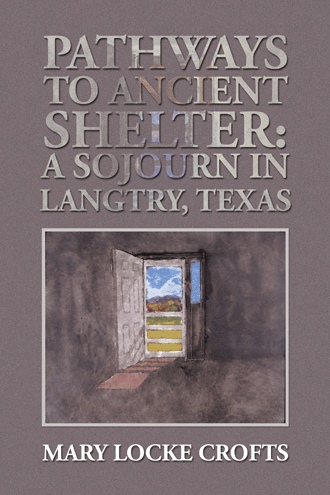
Pathways to Ancient Shelter
A Sojourn in Langtry, Texas
by
Book Cover & Preview Text
November 18, 2005 Friday
I went to bed about 9 p.m. I tried listening to Spurs basketball but even with my short-wave radio, reception was lousy so I fell asleep and dreamed a lot-something about this house coming apart.
I woke up early and decided to bundle up and go for a walk. For the first time, I went to what was once the center of town and to the canyon beyond. Looking back up the hill, I realized that particular canyon is visible from my front steps, but I had never seen it-or realized that what I was seeing was it!
Today is very cloudy and windy and coldish (only fifty but it feels colder to me). Moody weather appropriate for the Native American flute music I am listening to. Lonesome deep tones-held long, barely moving-that sound like the wind blowing over the tops of the old bottles I found yesterday.
There are more falling apart houses here than livable ones. Long after the roofs have caved in, large rectangular stones and small filler stones fall one by one-dilapidating the once proud structures. I can tell by faded signs that some were businesses-grocer, barber, ice house. Others were homes. I try to visualize what Langtry was like when it was a thriving place.
The Torres house belonged to one of the first families of Langtry. They also built a sort of stone labyrinth over by the Eagle Nest Canyon. It is about four feet high, probably a pen for sheep-I have not explored it because it looks like rattlesnake heaven. Near there are the remains of wonderful stone wall across the slope that is the entrance into the canyon. The Torres men lugged all those huge stones in there to keep the sheep from wandering to the edge and slipping over.
No Torreses here now. Buzzards are the only living thing to be seen around their old place. Time and death. Change and loss. Everywhere, of course, but so noticeable here where the land and the people now and for thousands of years have been wind brushed, sky viewed, sun cooked, and moon showered.
All Fall Down
When I first saw the old store,the roof had fallen but not all the way down. The rafters slanted
from the top of the high adobe walls to the dirt floor - at midmorning
drawing a maze of shadows over etchings made by spiders,
lizards, and snakes. Yet the front of the building stood tall,
J. P. TORRES, DRY GOODS & GROCERY bold above the old door
permanently ajar. The Torres Store was built in late
eighteen hundreds on Torres Street, the main street of Langtry, Texas,
which sits on a northern hump of the Rio Grande upriver the Big Bend,
the Gulf of Mexico far downstream. Termed "ghost town" in most books,
Langtry is in fact home for about twenty people-though numbers
matter not at all to its essence. The Torres Store is one of about
a dozen old buildings -some inhabited, some uninhabitable,
most somewhere in between, empty but not gone. The Torres place was the patriarch -
a Langtry attraction, a place of pilgrimage. Early on, the Torres men had bargained
with the Galveston, Harrisburg, and San Antonio Railway to make a
loop through town (mirroring the Rio Grande's loop north)
in trade for water for their steam engines. A deal was made and water was
pumped far up from Osman Canyon, ever after, in these parts,
called "Pump Canyon."
Enterprising folks, the Torres family
ran sheep. Still standing are two
of their pens - one a roofless labyrinthine
rock shelter and, even more impressive,
a massive rock fence built across
a cut into Eagle Nest Canyon. Part
still stands, but most of its imported boulders
lie strewn down the draw, all a testimony
to the labors of Cesario, Bernardo, and Juan,
and their mother and wives
unnamed.
The front room on Torres Street was the store,
the back room home. Built of large
adobe bricks, it seemed indestructible
here on this arid edge of the Chihuahuan Desert.
But one July
over fifteen inches of rain fell
on Langtry, rains that
had all the folks of town scurrying
to find pans and buckets to catch the leaks
from holes that may
have been there for decades -
who would have known?
have lasted for centuries, did not last the week.
One woman reported that she heard a big boom and rushed outside
to see what had happened. She thought it might be a car smash-up,
rare but not unheard of on the three streets of Langtry.
She saw nothing. Later she learned
that the back room of the Torres House
had fallen in. Long hidden by mesquite
and cacti, the room could not have been
seen accidentally and now
not even by intention.
soundlessly, the front wall and its proud J. P. TORRES fell across
Torres Street. Adobe crashed to dust, taking its Texas Historical Marker with it.
Its old door poked out from the top of the heap like parts of skeleton,
which it was.
Langtry men cleared the rubble off the street
and rescued the sign for repair-
repair and perhaps rewording:
"here stands" becomes "here once stood,"
like the Hall House across the street,
the Ice House down the block,
the cemetery, the barber shop,
the old Cantu place.
Things fall, we all know that,
they wear away, they break down.
In the abstract, "things change"
seems trite.
mountains were once as tall as the Alps. In Monument Valley,
thin red towers show the cores of mountains. Floods create new
riverbeds and rivers dry up to become rocky bush-filled arroyos.
We muse about time and finitude.
But in the concrete, in the adobe,
in Langtry, the falling of the Torres House
breaks our hearts.
Here of all places. Here where we have
found ten- thousand-year-old mammoth bones,
can still see four-thousand-year-old paintings
on shelter walls, discover frequently the stone
tools and fires of ancient hunter-gatherers.
Here we know nothing if we do not know time and change.
But the fall of the Torres Store is
hard to take, painful.
Old as it was, we took it for granted
.
Monument to our history?
Symbol of the essence of Langtry, declaring
who we have been and who we are?
communal and intensely personal. We grieve as we grieve
for ourselves, our families and the artifacts that hold our story:
here we lived, worked, raised families, suffered our daily vicissitudes,
here we prayed, watched for rain, looked out for each other.
These things matter, are of essence.
Though they do not last, they count.
Vitality gone to dust,
breath gone to wind,
that's what makes our hearts ache.
Our pain is strangely enlivening. Deep in our bodies and souls,
we know we are part of here and gone,
of time and beyond time.
Formats

Book Details
About the Book
Mary Locke Crofts graduated from Baylor University in Waco, Texas, and for several years taught English. She then completed the graduate program in myth and depth psychology at Pacifica Graduate Institute in Carpinteria, California. A storyteller, she lives in San Antonio and Langtry and has two grown children.
About the Author
Mary Locke Crofts graduated from Baylor University in Waco, Texas, and for several years taught English. She then completed the graduate program in myth and depth psychology at Pacifica Graduate Institute in Carpinteria, California. A storyteller, she lives in San Antonio and Langtry and has two grown children.