
The New Zealand Cross
The rarest bravery award in the world
by
Book Cover & Preview Text
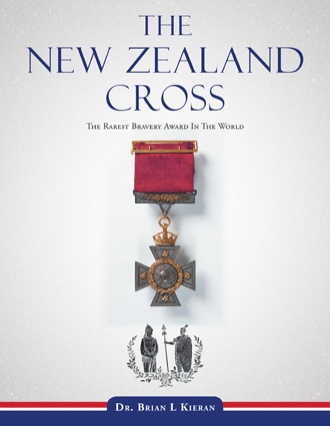
The New Zealand Cross book relates the creation and the citations of the rarest bravery award in the world. There is also an explanation of the New Zealand Wars 1860 to 1872 together with the aftermath for New Zealand, where all those who were awarded the NZC participated in bringing the conflicts to a conclusion. An example of a NZC winners participation is illustrated:- MAIR, Gilbert, Captain, New Zealand Militia In February 1870. after Te Kooti had succeeded in escaping from the pursuing column under Lieut-Colonel McDonnell at Patetere, and engaged and repulsed that under Lieut-Colonel Fraser from Tauranga, he turned to his right, to regain the protection of the Urewera Mountains by way of the friendly settlement of Rotorua, which he proposed destroying on his march. Captain Mair was at Rotorua with no troops except a handful of Arawa Natives, when one Baker a deserter from Her Majesty’s Navy, who had been residing among the Maoris, brought him intelligence of Te Kooti’s intentions. Captain Mair thereupon made every possible preparation, creating fictitious appearance of force by employing the old men and women to show themselves to represent troops. Mair attacked with his small force. Te Kooti finding the settlement apparently so strong, turned towards Kaitiriria and made off towards the Rangitaiki River. Captain Mair thereupon boldly assumed the offensive with such young men as he could get, and pursued Te Kooti’s Force, inflicting heavy loss, closing with the rearguard, and not retiring until after dark, when he was almost alone, and had driven the enemy to Fort Galatea, on the Rangiataki River, which was, unfortunately, unoccupied by troops. During this spirited engagement, which lasted many hours, Captain Mair, by personal example and devoted gallantry, inspirited his men to come to hand-to- hand conflict with Te Kooti,s rearguard, himself killing the notorious Peka McLean and driving the rest before him in disorder. Ballance/Jervois Approved in Council, July 5th 1881 Gazette No.20 of 1st April 1886 The Gilbert Mair New Zealand Cross was held at the Alexander Turnbull Library where it disappeared. This medal has not surfaced since, but in all probablity is held in some special private collection due to the way it disappeared and the assumption is it was stolen. A reward has been posted on a website. Born on 10 January 1843 at Wanganui. He was the eigth child and grew up with his 12 brothers and sisters whom Gilbert (Senior) and Elizabeth Mair bore. The family farm at Whangarei was named Deveron after the Mair home in Scotland. The local Maori gave him the name Tawatawhiti; later he was known by friends as Tawa. It was his making in connecting to Maori, he became fluent in the Maori language and the upbringing at Ahikereru. There was continually confusion between Gilbert Mair and his older brother William Gilbert Mair. Enjoyed the full rank and status of a chief of the Te Arawa. Mair’s ability reflected initiative, skill and reckless courage. Used guerrilla tactics of bush warfare as part of his unusual strategy. Died in the Bay of Plenty on 29 November 1923 aged 80 years - 1843-1923 Mair was fortunate to have been born in Whangarei and virtually immediately Ranga tira chiefs visited the home, Deveron, and gave him the name “Tawatawwhiti”.and he became known as “Tawa” after a special tree that can provide warm shelter in the bush. A further name was bestowed on him “Haerehuka Taua” by Te Kanapu, son of Haerehuka, as he lay dieing; thus began Mair’s lifelong collecting in view of the mere and other valuables he was given at that time. Gilbert Mair grew up to become such a remarkable man who made such an impact on Pakeha and Maori from the time of the New Zealand Wars in 1865 to 1923 when he died. Ron Crosby refers to him “as a man of his time” . Mair through his subsequent gifts to National Institutions reflects a significant core of Maori and their contribution to Aotearoa. Especially those gifts to Te Papa and the Auckland Museum. Mair is an icon of example to everyone. Gilbert Mair was influenced by his brother William so Mair joined 12th Regiment under Colonel Haultain as interpreter at Tauranga about November 1866. Colonel Harrington advanced from Omanawa and Mair, now 23, was mounted when he joined them. Mair went into action in 1867 when a body of 2500 Militia were raised. The work of surveyors on newly acquired Maori land was being interfered with. On January 23 1867 Mair galloped towards Maori in a whare; his horse was hit a number of times and was killed. As the horse fell it pinned Mair’s leg under it. Mair used his revolver to repel the Maori but it was wet as he had earlier ridden through a river so the revolver failed but a cartridge suddenly fired. Lt. Turner with 50 men charged to Mair’s aid and drove the Maori away This was his first experience of action. The Mair brothers were fighting together and Gilbert Mair fought under his brother William. Later Colonel Haultain (then Defence Minister) promoted Mair on the field to the rank of Lieutenant in the Auckland Militia and praised him, from personal observation, in his official despatch. Whitmore set up his HQ at the old mission house at Ahikereru which had been built by the Preece family in 1849. On 7 May 1869 the column proceeded led by the Corps of Guide’s scouts under Captain Swindley, with Maling second in command; Mair’s Te Arawa and Roberts constabulary were following. The whole event is described under Adamson’s entry and the shots from hidden foes, followed by a thunderous volley. Mair was commended by Colonel in his despatches although erroneously described as “Major” Mair. Between 1869 and 1870 Mair played a prominent part in the determined pursuit of Te Kooti in the Urewera Ranges and other localities. Te Kooti sent a letter of peace to the Arawa community at Ohinemuto; it was a ploy. Carkeek galvanised the old men, women and children to continually roam around Ohinemutu reflecting the place was well defended; meanwhile Carkeek took a message to the military post at Tapapa, 50 miles away, travelling through dangerous bush where he could have been attacked by Hauhau at any moment. There was Te Kooti’s aim to compound the position by claiming an intention to attack Tauranga. Mair left McDonnell and moved off with 250 men to reach Ohinemutu before Te Kooti. Mair was speeding towards Ohinemutu. Te Kooti’s treacherous message to Ohinemutu was delivered first by Baker McLean and on 7 February 1870 the elders acceded to his request despite the restraints passed on by Mair to Carkeek, who advised the residents of the danger. Mair rushed up to stop the party moving towards Baker McLean. Mair took the white flag they were carrying and jumped on it in rage and frustration at their actions. Te Kooti’s followers were so surprised they fled, with only 50 of them reaching his camp to join the women and children; Te Kooti retreated into the Kaingaroa Plain and the Urewera Mountains. Mair seemed to have extraordinary feats of endurance when outnumbered and in a corner. He was involved in lengthy fighting around Rotorua on 7 February 1870. As his mana was raised, Te Kooti’s declined. For his services he was promoted Captain, his commission dating from the engagement (7th February). Te Kooti, with depleted forces and warriors, never faced the colonists in open battle again. McDonnell recommended Carkeek for the New Zealand Cross. Captain Mair was awarded the new Zealand Cross.
Formats

Book Details
About the Book
The New Zealand Cross There has been no comprehensive history of the award published in one place. Dr. Kieran explores the development of the creation and inauguration of the award, a listing of all the recipients and an outline of the New Zealand Wars from 1860 to 1872. The Victoria Cross and other decorations were being awarded to Imperial troops but the settlers in the Volunteers and Militia were not being recognised for carrying out similar acts of bravery. The recognition of acts worthy of the NZC were anticipated to become well known; however, the awards spand a period to 1910 and thus the impact of the bravery leading to an award of the NZC was not achieved. Personalities like King Tawhiao, Sir George Bowen, Sir George Grey, Lt. General Cameron, Te Kooti, Titokowaru, and Major General Whitmore were involved in the conflict. A major issue leading to battles arose due to land confiscation by the settlers. The battles were mainly restricted to the North Island; Taranaki and Wanganui on the West Coast, Waikato in the Central area and on the East Coast at, Gisborne, Napier, Tauranga, and the Urewera.
About the Author
Brian Kieran – Attended St. Anselm’s School 1951 to 1955 and St. George’s College, Weybridge, Surrey, 1955 to 1959. He obtained an LL.B. (Hons), King’s College 1963, postgraduate Diploma in Air and Space Law at University College, University of London; he is a Barrister of Gray’s Inn and Attorney at Law. He began his career as a lawyer with the Inland Revenue, 1959 to 1972; he held a number of positions; inter alia, advising on Conflict of Law issues, Personal Assistant to the Controller of the Estate Duty Office and then in the Office of the Solicitor of Inland Revenue taking civil cases and conducting criminal tax prosecutions in the Courts of the United Kingdom and Northern Ireland. From 1973 to 1975 he was Legal Advisor to the Minister of Finance, Government of Jamaica, under an Overseas Aid Scheme. Between 1975-1986, he was Legal Counsel on International Taxation to Morgan Grenfell & Co Limited and he set up and became Managing Director of Morgan Grenfell (Cayman) Ltd. He advised on, set up and ran Hong Kong Bank International Trustee Ltd as Chairman and Chief Executive Officer in partnership with the Hong and Shanghai Banking Group from 1987 to 1993 in protecting their and clients assets from the takeover of Hong Kong by China in 1997; he moved the headquarter operations from Hong Kong to the Cayman Islands in 1990. The protection of assets was resolved when HSBC took over the British Midland Bank Limited in 1993. He established Kieran Associates Ltd in Hong Kong in 1994, with a branch office in Beijing and a Trust Company in Labuan, Malaysia. He retired in 1999 and has spent his time travelling the world carrying out research in Empire and Colonial Archives for his various books. He joined the Orders and Medals Research Society in 1968, was President of the Hong Kong Branch in the 1990’s and the early years of the twentyfirst century. He was awarded life membership of the Hong Kong Branch in 2007. It was through the auspices of the Anglo Zulu War Society that he attained his higher academic awards, PhD, MA. He was granted the Freedom of the City of London in 1980 and was awarded a miniature medal of the Polish Virtuti Militari, 5th Class in 1991 for assisting Colonel Wesolowski with his monumental work on the Polish Virtuti Militari.