
The Compound Model of NUCLEAR STRUCTURES
by
Book Cover & Preview Text
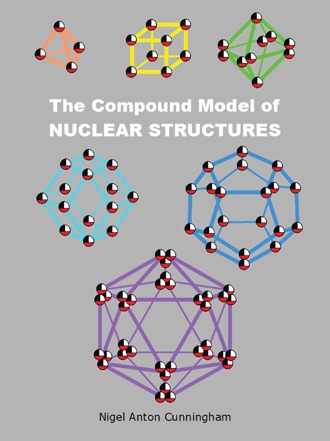
FREE Preview
Chapter 1 – Introduction
The nuclear structures appear to consist of various combinations of two types of fundamental particles, protons and neutrons. A neutron has a spin and zero electric charge. A proton has a spin and a positive electric charge. A proton also has a direction by virtue of its spin and positive charge. Thus protons can be arranged in complementary pairs with their spin directions anti-parallel. Two complementary protons each permanently united with the other and with a neutron together form one unit of matter that is stable and can grow. However, for the larger structures to be stable all bonding must be in accordance with the three rules of the compound model:
Rule 1. Each part of a single unit of matter can bond with just one other neutron thus making a maximum of three bonds.
Rule 2. A free neutron can bond with exactly one of each part of matter, also making a maximum of three bonds.
Rule 3. The shape of each stable nuclear structure must be symmetrical in three dimensions.
Initially, as a nucleus grows, its shape is determined by the number of protons and neutrons that can achieve maximum bonding. However, for larger nuclei, the symmetrical structures that are formed consist only of units of matter and free neutrons. These symmetrical structures can continue to grow within the central core similar to the manner in which small nuclei grow. The nuclear shell structures are represented graphically in Appendix A.
Each of these symmetrical, three-dimensional structures can be represented by a two-dimensional connectivity diagram. This is achieved by visualizing what each structure would look like inside when viewed through one of its faces. In the following chapters these structures are described in detail with connectivity diagrams for each stable isotope or naturally occurring radioactive isotope of each element.
Chapter 2 – Core Structures
The first few elements with atomic numbers 1 to 7 are single-core structures. The stability of these core structures is a balance between symmetry and maximum bonding, so there are generally two stable isotopes for each of these elements.
Chapter 3 – Tetra Shell
The tetra shell structures have combined central cores bonding with the shell.
Element 8 – Oxygen
The element with atomic number 8 has four units of matter that form the tetra shell, the first symmetrical shape in three dimensions, which is the tetrahedron with four faces, four vertices, and six edges.
Chapter 4 – Hexa Shell
The hexa shell structures have combined central cores bonding with the shell.
Element 16 – Sulphur
The element with atomic number 16 has eight units of matter that form the hexa shell, the second symmetrical shape in three dimensions, which is the hexahedron with six faces, eight vertices, and twelve edges.
Chapter 5 – Octa Shell
The octa shell structures have combined central cores bonding with the shell.
Element 20 – Calcium
The element with atomic number 20 has ten units of matter that form the octa shell, the third symmetrical shape in three dimensions, which is the octahedron with eight faces, six vertices, and twelve edges.
Chapter 6 – Rhombic Shell
The rhombic shell structures all have independent central cores separate from the shell. The larger shells can contain the smaller tetra shell, which can also have central cores. However, the inner shells with central cores each have only one shell arrangement, and it is saturated with free neutrons.
Element 28 – Nickel
The element with atomic number 28 has fourteen units of matter that form the rhombic shell, the fourth symmetrical shape in three dimensions, which is the rhombic dodecahedron with twelve faces, fourteen vertices, and twenty-four edges.
Chapter 7 – Dodeca Shell
The dodeca shell structures all have independent central cores separate from the shell. The larger shells can contain the three smaller shells – tetra, hexa, and octa shells – which can also have central cores. However, the inner shells with central cores each have only one shell arrangement, and it is saturated with free neutrons.
Element 40 – Zirconium
The element with atomic number 40 has twenty units of matter that form the dodeca shell, the fifth symmetrical shape in three dimensions, which is the dodecahedron with twelve faces, twenty vertices, and thirty edges.
Chapter 8 – Icosa Shell
The icosa shell structures all have independent central cores separate from the shell. The largest shell has super-saturated inner shells such that the structures become degenerative. Generally, the central cores of the inner shells are independent of the shell structure and saturated with free neutrons.
Element 72 – Hafnium
The element with atomic number 72 has thirty-six units of matter that form the icosa shell, the sixth and last symmetrical shape in three dimensions, which is the icosahedron with twenty faces, twelve vertices and thirty edges.
Formats

Book Details
About the Book
The objective of this theoretical approach to understanding the structure of the nucleus was to produce a concise model for all the elements. In particular, the focus was to determine a few simple rules that would define the precise structure of every stable isotope. After several years of research and analysis, a concise model of just three rules has been achieved. This model has exact correlations with the current experimental data for all the stable isotopes.
About the Author
He has always been interested in physics. Since obtaining his BSc degree in mathematics and physics, he has maintained an active interest in theoretical physics with various ideas and research. He has worked on a concept of nuclear structure for a number of years, but family responsibilities have limited the progress. Now that his five children have grown up, he has found time to successfully complete his nuclear model.