
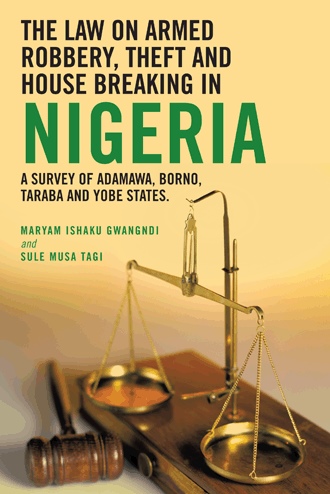
THE LAW ON ARMED ROBBERY, THEFT AND HOUSE BREAKING IN NIGERIA
A SURVEY OF ADAMAWA, BORNO, TARABA AND YOBE STATES.
by
Book Cover & Preview Text
The security of a nation should not be negotiable. Every government, regardless of its political ideology, has an inherent duty to ensure the safety of every life and property within its territory and jurisdiction. To this end, there must be ways and means of checking and controlling both internal and external elements and factors that could endanger and disrupt the national as well as individual welfare. In this regard therefore protective laws of some form become indispensable. Chapter IV of the Constitution of the Federal Republic of Nigeria 1999, guarantee virtually every form of fundamental human right known to the Nigerian society. In addition, Nigeria is a member state of the Organisation of African Unity, ECOWAS and the United Nations. She is therefore bound by international conventions amongst nations eg the Universal Declaration of Human Rights adopted by the General Assembly of the United Nations on December 10, 1948. The next most important duty any nation has is to ensure the basic human rights and freedom of the members of the society within its international boundaries. These include the right to life and property, human dignity and liberty, fair hearing, freedom of thought, conscience and religion, freedom of expression and the press, right to assembly and association, movement, non-discrimination and privacy . Article 1 of the Universal Declaration of Human rights declares: “All human beings are born free and equal in dignity and rights. They are endowed with reason and conscience and should act towards one another in a spirit of brotherhood.” Fundamental human rights can only be meaningful when there is reciprocity of the rights with duties by members of the society. Absolute freedom according to Dr. A.O.P. Okumu is synonymous with anarchy. The absence of “acting towards one another in a spirit of brotherhood” is terrorism whether at national or International level. In the G.R.A. in Maiduguri today, some residents are barricaded like maximum security jail houses because of the most dangerous criminal elements of our society. And yet the people who live in those barricaded houses are some of the most harmless members of the society, e.g. University Lecturers, Judges, civil servants etc. The barricades are evidence of the fact that there are members of the Nigerian society who strongly believe that they are free to take away the lives and properties belonging to others in the dead of the night by using dangerous weapons as even when their victims are neither armed nor resistant. The rest of us are today being held at ransom by small but highly dangerous and destructive members of the society. No life, no property, no place in the present day Nigerian society can be said to be either safe or secure. Even those of us who know Chapter IV of the Nigerian Constitution in detail and are consulted on the Universal Declaration of Human Rights as adopted by the United Nations, live in fear for our lives and properties as if these sacred enactments have been abrogated .
Formats

Book Details
About the Book
The Law on Armed Robbery, Theft, and Housebreaking in Nigeria: a Survey of Adamawa, Borno, Taraba, and Yobe States presents the first comprehensive material on the area in practical terms where the law relating to the offences was highlighted and the statistics of the rate of the commission of the crimes brought out.
About the Author
The authors are lecturers in the Department of Public Law, University of Maiduguri. They have also been engaged in active law practice. Their combined efforts have brought out the law relating to armed robbery, theft, and housebreaking in Nigeria with particular emphasis on the commission of these crimes in Adamawa, Borno, Taraba, and Yobe States. They have also endeavoured to highlight the relevance of criminal statistics.