
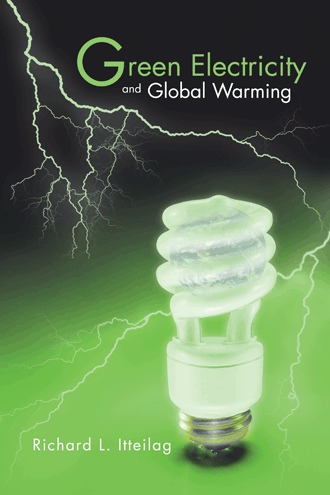
Green Electricity and Global Warming
by
Book Cover & Preview Text
Climate Change (0ct. 2010) Candidates in 2010 who assume that Tea Party supporters and independents will respond to the same messages on climate and clean energy issues appear to be mistaken, according to a major new survey of more than 1,000 Americans conducted by Opinion Research Corporation for the nonprofit and nonpartisan Civil Society Institute (CSI). Further, while the views of Americans on climate science issues are now divided sharply along partisan lines, there remains strong support for "concrete" action focused on protecting clean air and clean water. This poll provides one more data point that while independents have swung largely to supporting Republicans in the November 2 elections, they are not following tea party activists in lockstep. One of the key Republican messages of the current campaign has been a theme opposing any new federal regulations, such as those which could reduce greenhouse gas emissions. One of the largest funders of attack ads against Democrats this year has been the U.S. Chamber of Commerce, a highly pro-business group which opposes climate legislation. Although enactment of legislation to curb the emissions that cause climate change has been a top priority for President Obama, Congress has failed to send him a bill to sign. The House approved cap-and-trade legislation in the summer of 2009, but a similar measure stalled in the Senate, failing to capture any GOP support. Key findings of the new CSI poll include the following: •2 percent of Americans say they are "an active member of the Tea Party movement," 23 percent support the Tea Party, 36 percent have no view about the Tea Party, and 28 percent oppose the Tea Party. •Independents are more than twice as likely as Tea Party supporters (62 percent versus 27 percent) to see global warming as a problem in need of a solution, compared to 39 percent of Republicans and 82 percent of Democrats. Overall, more than three out of five Americans agree that "(g)lobal warming and climate change are already a big problem and we should be leading the world in solutions," compared to about a quarter (27 percent) who think "(g)lobal warming may or may not be happening. We should let other countries act first while the science sorts itself out." •Tea Party supporters are more than twice as likely as Independents (34 percent versus 15 percent) to see no need for leadership on global warming, compared to 29 percent of Republicans and 8 percent of Democrats. Overall, only 17 percent of Americans see no need for "national OR grassroots leadership on global warming." Another 12 percent think no federal leadership on energy policy is needed "since some grassroots officials are taking actions," compared to 61 percent who think "(w)e need leadership on energy policy from Washington, D.C., because it is a national problem that will require national solutions." •However, the partisan divide is far less sharp when the discussion turns to specifics. Just over three out of four (76 percent) Americans think that -- when it comes to energy sources, such as natural gas, coal, tar sands, nuclear and biofuels, requiring a high amount of water for production purposes -- "(w)ater shortages and clean drinking water are real concerns. America should put the emphasis on first developing new energy sources that require the least water and have minimal water pollution." Only 13 percent agreed with this statement: "Energy supply needs should override concerns about water shortages and water pollution. America should proceed first with developing energy sources even if they may have significant water pollution and water shortage downsides." Supporters of putting the primary emphasis on clean water include 68 percent of Republicans, 80 percent of independents, 81 percent of Democrats and 60 percent of Tea Party supporters. "These findings point to a greater diversity of views among Tea Party supporters and independents than is widely assumed to be the case, and this has major implications for the 2010 elections and future elections," says Opinion Research Corporation senior researcher Graham Hueber. "What we are seeing here is a common mistake with which pollsters are all too familiar: the tendency on the part of the media and others to simplify the story by lumping together groups rather than being careful to parse out the specific points on which they actually differ and sometimes quite dramatically so."
Formats


Book Details
About the Book
Electricity capacity in the Unitrd Global Warming States (U. S.) Is severely constrained. And that constraint is exacerbated by global warming concerns. In order to alleviate that constraint, new, high effi ciency technology must be utilized primarily in commercial and industrial applications. These technologies would replace a 'cap and trade' tax policy that would be an onerous taxingn action to reduce the global warming problem. Ultimately, innovation would free-up additional electric capacity.
About the Author
RICHARD L. ITTEILAG Retired Vice President of Marketing & Sales for three regulated and unregulated energy companies, Aquila (UtiliCorp Energy Services), Columbia Energy Services, PowerTrust.com, and a trade association, American Gas Association, spanning nearly 30 years. Principal responsibilities included unregulated electricity/natural gas sales to commercial accounts and managed a large national salesforce. Authored hundreds of energy economics articles, keynote speaker at multiple energy forums and conferences worldwide and published a book on natural gas/electricity marketing with Prentice-Hall. Taught a course for five years in conjunction with professional activities to energy professionals sponsored by the Association of Energy Engineers (AEE) on the economics of natural gas and electric air conditioning. Also taught a course on creating a successful energy services company through the AEE. Currently, writing an energy book on the load-leveling techniques to offset electricity capacity shortfalls in the U.S. Received a B.A. from Manhattan College in New York, an M.A. from New York University in New York and completed the course work for a Ph.D. from Georgetown University in Washington, D.C., all in economics. As an avocation, owns and rents real estate in New York, Florida and Virginia. Currently resides in Palm Beach County, Florida.