
Sud Dulhan
Tale of Robbery, murder and self-sacrifice by a young bride Legend of Jatheri at Gagret
by
Book Cover & Preview Text
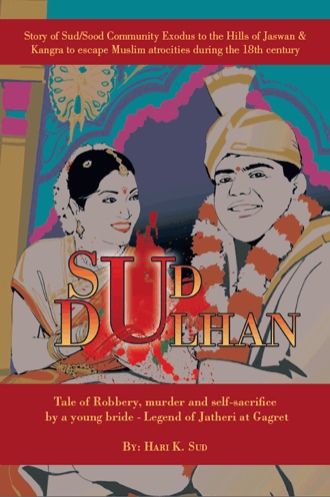
In small villages of Pirsaluhi, Pragpur, Girli and others in Kangra district of India, a group of “Sud/Sood(s)” arrived from the farther plains of Punjab in about AD 1765-71. They were saving themselves from the turmoil imposed by Afghanistani ruler Ahmad Shah Abdali, who had invaded Punjab seven times earlier, in search of loot and plunder and was threatening again. It was an era when Guru Gobind Singh and Banda Bahadur had galvanized the populace into offering active resistance to tyranny. Next 50 years after Banda Bahadur`s death were tumultuous. Central authority and law and order had broken down. This had resulted in greater insecurity for the people. Some had abandoned their homes in Sirhind , a town midway between Ludhiana & Ambala in Punjab and sought safety in the hills. Sirhind at that time was headquarter of Eastern Punjab and was ruled by a Mogul military governor or Faujdar. As Ahmad Shah Abdali`s next invasion became apparent, Hindus, especially the wealthy merchant class, with Suds/Soods among them, decided to evacuate Sirhind. There is no recorded history of the movement of “Sud or Sood” families from Sirhind. Whether this exodus was one bunch or multiple bunches, over a period of time, one does not know. It is recorded in the history that Ahmad Shah Abdali in his seventh and final campaign passed thru Sirhind in about 1760-61 AD. Four years later Sikh Army under Jassa Singh Ahluwalia sacked Sirhind to avenge destruction of Golden Temple at Amritsar ealier by Abdali. Although Sikhs spared the Suds/Soods, yet they devastated rest of Sirhind. Fed up with invasions and counter invasions, a group of Sud/Sood families headed towards the kingdom of Kangra and its sister kingdom of Jaswan for safety. The temporary home of all Suds/Soods arriving in Jaswan was the town of Gagret. Among the arriving families there was a smallish clan of Chubb/Mariya(s). From Gagret, the Suds/Soods dispersed to many small villages and towns, which are still inhabited by them today. Most of the new immigrants to Jaswan spent first few years at Gagret where an unfortunate end of life of a young bride and bridegroom, returning home after their wedding, forced them to abandon this place. They moved farther into hills to escape the terror. This final move took Chubbs to “Pirsaluhi” & Mariyas to “Pragpur”. Pragpur is the principal town of Sud/Sood residency in the hills. Before they left, they erected a memorial (Jatheri) to the two young lives lost to greed and terror. This memorial is a place of pilgrimage for all young brides of the Chubb/Mariya clan. Other clans erected their own Jatheri(s) as they settled down in the interior villages. The Jatheri commemorates a significant contribution by the women for the survival of the society. The benevolent King of Jaswan directed the escaping Chubbs to an area known as Pirsaluhi. This is a dirt-poor place, on a hilltop besides river Beas, where the river emerges from the snowy mountains. The Rajput landowners of Pirsaluhi welcomed this mercantile community. The King handed them a perpetual land grant. Hence, Chubb-Suds decided to make this place as their new home. The year was about 1771AD and Chubb's other clansmen, Mariyas chose Pragpur instead of Pirsaluhi. At Pragpur other Suds/Soods had already settled, aided Mariya resettlement. A Muslim Sufi saint, “Pir” had already arrived at Pirsaluhi a generation or two earlier. His intent was to convert local population into Muslim faith. This, the King feared, would upset the local ethnic balance. Poverty was the main reason for easy conversion. The King wished the Chubb Suds/Soods to improve the economic lot of the people and prevent mass conversion. Pirsaluhi is a picturesque location with mighty river Beas meandering below in the valley and the famous Jawalamukhi Temple just across the valley. At this new location, a clear water spring supplied potable water. The Sufi saint had selected this spot for himself. The king advised Chubbs to build homestead away from the spring on the hilltop clearing. This ridge on the hilltop, after about 500 feet climb, is about two miles long and at best 500 yards wide. This land was given to Chubbs, as theirs to keep. The Suds/Soods are money managers & financiers and they excel in this line of work. When they left Sirhind, they had left their immovable property behind but brought with them their movable holdings of gold, silver and other valuables. With the forgoing capital money they made a head start. Local population of Rajputs, Dogras, Brahmins, sharecroppers, Muslims and other groups became their clients. Suds/Soods and prosperity go hand in hand . In next three or four decades, they became prosperous. By about AD1800, Suds were building stone houses at their settlements and fortifying them for safety. In their short existence in these areas, another bunch of plunderers appeared on the scene. This was the bunch, left over of the Khalsa Army of Guru Gobind Singh and Banda Bahadur. They were looking for money to continue their crusade to oust the Muslims from power. They found Sud/Sood villages in the hills as an easy target. Hence plundering began afresh . It was the arrival of Maharaja Ranjit Singh at Lahore in 1801 that this plundering ended. As Suds/Soods multiplied in Pirsaluhi, Pragpur and other villages, by about 1816 AD they began their search to expand their businesses. At about that time the British had defeated the Gorkhas of Nepal and annexed Shymla , a small picturesque clearing in the cooler Shivalik hills about 100 miles from Ambala. This place’s scenery and its climate appealed to the British. They decided to set up rest & recreation headquarters for their servicemen. This village had been named after the patron Goddess Shyamla. She still graces the town in a more majestic location as Goddess Kali, about a mile from the original location. Shyamla or Simla or Shimla, at that time, could be reached by a dirt road on a horseback. The journey took several days. To make British servicemen stay at Shimla more relaxing, the British looked for a local mercantile community, who would keep them supplied with goods and services. They had to look no further, as in Jaswan State they had found a highly mercantile community of Suds/Soods, who were willing to relocate to Shimla. Realizing a good match, the British around 1830-40 invited Suds/Soods of Girli-Pragpur to set up shops in Shimla. Tax grants were offered as a favour. For Suds/Soods, it was a commercial dream come true.
Formats

Book Details
About the Book
This book is a suspense thriller of a historical event where the reader stays glued to the book to see what comes next. The happenings described in the book are real, events related are real, only a story has been tailored to make the forgoing more interesting. It is story of 50 wealthy families who dare the odds and leave their familiar surroundings after repeated Muslim invasions of their hometown, during 1730-1760 AD period, after the collapse of the Moghul Empire in India. They migrate to the Hills of Punjab, now Himachal Pradesh in search of safety and security. They travel 130 miles to another kingdom with their bag and baggage. Secure in their new surroundings, they prosper again. Within a few years after their arrival they are wealthy but their prosperity became a thorn to the local unsavoury people. They conspired to grab some of their money. The conspiracy they hatch was to rob a returning wedding party fully laden with gold & silver and decamp with the money and jewellery. They succeed in their conspiracy but unfortunately kill the groom in the process. Heartbroken, the bride, only 17 years of age, jumps into her husband's funeral pyre. The book in two parts, covers both their travel while braving the elements as well as danger of wayside marauders and the growing up of a young accomplished girl during these unsettled times. Finally she is married and on her wedding day finds her husband dead, a victim of robbery. The place where all the forgoing happened is a place of worship and pilgrimage to her descendants. The site is marked by a century old stone structure and is visited by the family to remember her supreme sacrifice.
About the Author
Hari K. Sud is a well-known writer who has been writing in newspapers & magazines for the last seven years. His work has been translated into different languages all over the world. Born in Village of Pirsaluhi, Himachal Pradesh, India, he relates a fascinating account of events happened during 1764-1771 AD "exodus" of Sud/Sood families to the hills. He resides in Canada for the last thirty seven years and have had the opportunity to work for multinationals in various management capacities. He holds a Master's Degree in Engineering and a Bachelor's Degree in Science. .