
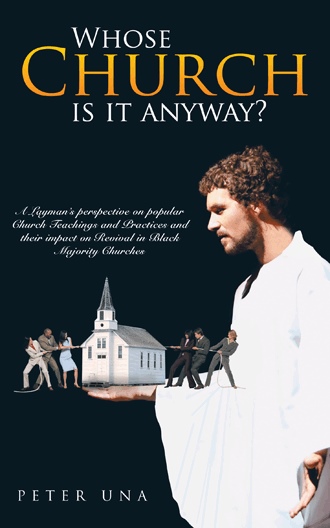
Whose Church is it anyway?
A layman’s perspective on popular Church teachings and practices and their impact on Revival in Black Majority Churches.
by
Book Cover & Preview Text
Jesus, Our firm foundation What happens if a Church is built on the wrong kinds of foundation? I guess it is the difference between building your house on sand or on solid rock. The Church which is built on sand will be overpowered by the wind and other elements of nature. It will not stand the test of time. It is no surprise to anyone that a lot of the issues and challenges surrounding the role of the Church in society come from the fact that a lot of Churches are not built on the right biblical foundation. A lot of us including myself go on and on about the constantly decreasing role, influence and impact of the Church of Jesus Christ in our society today. However, what we see and complain about are the surface issues. We need to go back to the foundation to truly understand and address the root cause of the problem. I believe one of the challenges and struggles of the Church today is trying to address that age old question. What biblical foundational teachings and practises should we focus on? Which teachings should be at the heart of the Church? Do we focus more on the Old Testament or New Testament teachings? Do we focus more on the teachings of the Apostles or the teachings of Jesus Christ? As a lay member of the Church, I definitely do not have the answers to these questions. Personally, I do not think we are ever going to agree on the answer. This is why there are so many Church denominations, Christian factions and groups out there today. Does it really matter to God what teachings we follow after? I believe it does. The Apostle Paul give us an answer to these questions in his letter to the Ephesians, it says, “Now, therefore, you are no longer strangers and foreigners, but fellow citizens with the saints and members of the household of God, having been built on the foundation of the apostles and prophets, Jesus Christ Himself being the chief cornerstone, in whom the whole building, being fitted together, grows into a holy temple in the Lord, in whom you also are being built together for a dwelling place of God in the Spirit.” Eph 2:19-22 To me this describes Jesus as the chief corner stone or central building block to any foundation. In lay man's term, I believe this also means that the words and lifestyle of Jesus Christ carries more weight than every other in scripture. This is very important especially in times when there appear to be a contradiction in the bible about a particular way of living or principle or doctrine, specifically when biblical passages and references are taken out of context. Usually if the whole passage is used, there will be no disparity between the words of Christ and the words of the apostles. They tend to complement each other. The great thing about the bible is that it is based on the lives and experiences of real people. It describes the lives of patriarchs such as Abraham, Isaac and Jacobs, prophets like Samuel and Elijah; kings like David and Solomon; and apostles like Peter, Paul, James and John. The bible shows us the lives of these people, highlighting their successes and mistakes, strengths and weaknesses, triumphs and challenges, and joys and disappointments. I say this because you often see some Church teachings and practises based on some of the mistakes of King David or other prophets in the Old Testament. For example, references are made of the way King David prayed against his enemies in the Psalms or the way the prophet Elisha called down curses on a group of boys who insulted him. Some believe these examples give us Christians the right to freely send fire and destruction on those who mean us evil. However, when Jesus came he spoke strongly against such practises as “an eye for an eye” or calling down fire to devour our enemies (Matt 5:38-39), (Luke 9:53-56). We seem to believe that as long as a practise is in the scriptures, no matter the context, we are free to use it as we please. We must remember that we longer live in the dispensation of the Laws of Moses. We no longer need to stone people or wish their death because they are involved in witchcraft, the occult or idolatry. Jesus came as the Son of God to show us what it really means to be a child of God. He came to usher in the dispensation of grace. He came to become our ultimate example, to enable us push beyond the boundaries of godliness or religion. In describing Jesus' role in the context of the Old Testament, a commentary in the New Spirit Filled Life Bible described Jesus “as coming to bring to completion the partial revelations of the law and prophets, to bring to pass its messianic predictions and to give true interpretation to its moral precept”. Jesus says to the religious rulers of his day, “I desire obedience and mercy more than sacrifice”, and to the rich young man who desired to be good, “give up all you have and come after me”. He says to all, “deny yourself, take up your cross and follow after me”. “Those who seek to save their lives will lose it and those who lose their lives for my sake will save it”. Jesus' words help focus us more on having a deep relationship with God rather than on the acts and deeds of religion. So, it is not enough for our Church teachings or practises to simply be in the scriptures, they also need to align with and adhere closely to the teachings of Jesus and the Apostles. This I believe is the “litmus test” which we should use to determine the right foundational teachings, doctrines and practises to build upon.
Formats

Book Details
About the Book
Whose Church is it Anyway? A layman’s perspective on popular church teachings and practices and their impact on revival in black majority churches This book looks at the role recent and emerging Biblical teachings have in shaping the church as it moves forward in its role as the Bride of Christ. It also sheds some insight into revival. How they come about, the qualities of the people God uses to bring revival to a nation and the impact of revival in our lives, the church and community. “Whose Church is it Anyway” boldly addresses several issues that the average Christian shies away from, in particular, obedience to God and motives for doing what we do. This book has been written for both lay members and church leaders in a none threatening friendly way and is easy to read. It will challenge and inspire you as you read through its pages. Pastor Roland Henshaw — Word of Life Church, London, England I picked up this book to read and could not put it down. Peter Una has written straight from his heart with passion, fervour and deep cutting honesty. The contents of these pages will challenge your life and drive you to your knees. The truth outlined here will annoy church-goers but bless followers of Jesus Christ. This compelling book will help you build God’s Kingdom, de-clutter for destiny and stand ready for eternity. Dr. Jonathan Oloyede — Convener of Global Day of Prayer, London, England
About the Author
Peter Una is a lay member of his church. He has a strong apostolic and evangelistic gifting and a pastoral heart. He currently leads a non-denominational prayer and intercessory fellowship group whose main heart and passion is to pray to see revival in individual lives, churches, communities and nations. He works as an IT Consultant, is married with two children and lives in the United Kingdom.