
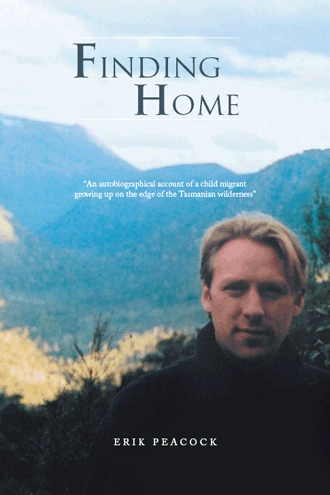
Finding Home
“An autobiographical account of a child migrant growing up on the edge of the Tasmanian wilderness”
by
Book Cover & Preview Text
“I forget when it was that Dad decided we needed a deep water hole, but it was around the time his parents decided to visit from England. These two events converged on a sunny summer’s day filled with the excitement of seeing grandparents from a far off land. Blasting a water hole was far preferable to digging one, and in those days, before terrorism and gun control, gelignite could be bought over the counter at hardware stores. It was decided to pick up some explosive on the way to the airport, pick up Nan and Pop, and head back to the land. We all piled into our grey kombi with flowers on it for the long drive down from Osterley to Hobart and out to the airport. We dropped by the hardware, bought a number of long cylindrical gelignite sticks, fuses and detonator caps, and sat them on the floor of the kombi in a brown paper bag. Gelignite is a very stable explosive and will not readily detonate. Nevertheless, Dad felt it important to do the right thing at the airport and attach explosive signs to the front and rear window. These were hand written on cardboard and stuck on with blu-tac. As an additional courtesy we parked on an open grassy space away from the car park and headed for airport arrivals. As always when they visited we would crowd against the airport glass and watch the passengers descend the portable airport staircase to the tarmac. It was a year or two since we had seen them, a long time in a child’s life, and the excitement was mutual. They would turn up and talk excitedly with their strange but oddly familiar accents. Both were bespectacled. Pop in English style, usually wore shorts, socks and sandals, and Nan would arrive with a hat and thin summer dress. We were all a-chatter on the way back to the car but the two federal police officers surrounding the van were less talkative. They were clearly unimpressed, and it didn’t help that Pop, his watchmaker instinct kicking in, developed a sudden fascination for the mechanism on the policeman’s gun. He had probably never seen one before. Dad confirmed that he was the owner of the vehicle, it did contain explosives, and gave his reasons for parking it away from the car park. The police officer straightened up and pointed over his left shoulder. With great restraint he said ‘Ten yards over there is three million gallons of aviation fuel. If that goes up, so does Hobart’. We quietly hopped into the van and headed off. Nobody seemed to want to nurse the gelignite so it rattled around on the floor until we got home. Dad was fined twenty five dollars by the Feds and told not to do it again! Back at the land it was time to start digging and blasting, and being more fun than fire crackers the neighbours got in on the act. Kerry wouldn’t have missed a chance at playing with gelignite for the world and turned up to help dig. The site selected was in a natural sink, off in the trees some way above the house site. The basic technique was to drill a narrow hole as deep as possible with a crowbar, and then use a broom handle to shove a stick of ‘jelly’ to the bottom. First though the top of each gelignite stick was cut open revealing what looked like closely packed fertilizer. A small silver tube about half the size of a cigarette was inserted into the end. This was the detonator. Into one end of the detonator a thick yellow cord had already been pushed and then crimped in place with pliers. The yellow cord burns at a set rate. You cut off the desired length of yellow cord, light it and run. The first big bang made something of a hollow in the ground. More holes were rammed and more gelignite packed in. Pretty soon the hollow became a hole. The yellow cord would writhe and hiss as it was consumed, men would run, an explosion, and then lumps of clay would shoot up into the air. Pretty soon the hole was deep enough to jump down into. Lumps of clay the size of soccer balls were shooting forty metres up into the tree tops only to come thudding down again. Some were caught in their earthward descent to remain suspended in the branches, a hanging menace against possum shooters. The process would then be repeated as the hole became deeper with each successive blast. We sheltered behind trees at a distance and ignored the big lumps of clay splatting into the ground around us. Finally it was time for the last blasting effort. Dad and Pop jumped down into the hole. The last of the explosives were rammed home, the cord was lit. Dad and Pop looked up from the bottom of a large round pit, perhaps twelve feet deep, sides blasted smooth as plaster. The cord hissed towards its inevitable demise at their feet. Everyone froze. Time slowed. Motivation is an amazing thing. Pop climbed up on Dad’s back, reached up for helping hands and was hauled over the edge. Dad was left alone at the bottom of the pit. After a moment he seemed to levitate in an almost mystical way, defying gravity and reason with sheer will power. The explosives went off. Clay shot out of the hole like grapeshot from a gun barrel. There was a pause as lumps of earth reached equilibrium between velocity and gravity, turned earthwards once more and thudded into the ground. The smell of cordite wafted through the bracken. We had a waterhole.”
Formats

Book Details
About the Book
“At four years of age Erik emigrated from Britain to the island State of Tasmania with his non-conforming family. After living in the woods the family continued to home educate, helping to pioneer the home education movement in Australia. What followed was a long personal journey to find a place in a society undergoing rapid change. Intense religious experiences and hard edged political activism play out against a backdrop of ongoing conflict over the preservation and destruction of wilderness in one of the world’s special places. This gives a unique insider perspective on alternative education, nature and spirituality, social activism, and national identity. Often humorous, sometimes tragic, this is a very personal story of engaging with public life, about finding the divine in odd places, about social conflict, and about finding in the end those things that hold us together. It is about the strange ways that love finds us. It is a story of finding home.”
About the Author
“At four years of age Erik emigrated from Britain to the island State of Tasmania with his non-conforming family. The family lived in the woods for a time then continued to home educate, helping to pioneer the home education movement in Australia. At fourteen Erik transitioned to formal education in years eleven and twelve before leaving home to attend University, where he became an environmental activist. This, coupled with an early conversion to Christianity, gave him a unique perspective on religion, environmentalism, identity and spirituality. Erik is a full time public servant working for Fair Trading. He lives in Tasmania with his wife Jennifer and two young children. His many interests include a home orchard, bushwalking and writing.”