
What is Life and Who am I?
Fundamental principles of the Primordian Philosophy
by
Book Cover & Preview Text
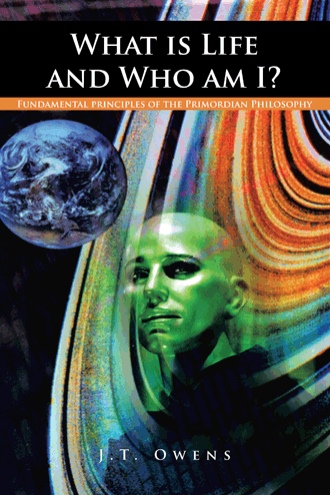
Foreword We live in a time largely defined by science and religion. On the one hand, science is wholly focused on fact- believing in that which can be observed, demonstrated and proven. On the other hand, religion is wholly focused on faith- believing in that which cannot always be observed, demonstrated or proven. This fundamental difference in mindset has resulted in a rift between the two entities since their inception. This leaves the individual with the unenviable task of having to choose between a mindset based on fact or one based on faith. This is where philosophy fits in. Philosophy is the art of taking fact and faith and combining them into a new element- truth. It takes the facts which can be seen and proven, and postulates them into the unseen, unprovable levels of life- creating faith from fact. This alchemical process of taking two seemingly opposite concepts and creating a third is what restores balance and harmony to the human mind. Science and religion could not have survived their epic struggle for control if both fact and faith did not prove equally important to the human soul. Thus, philosophy does not intend to take sides, but rather to resolve the conflict by restoring the opposites to harmonious coexistence. This book is an attempt to restore philosophy to its place and give the reader the choice of embracing both fact and faith, and in the process, to discover their truth. What Is Life and Who Am I? “What is life?”, and “Who am I?” are two of the most basic, yet most profound questions ever asked since the dawn of time. In fact, when one considers all of the sacred texts in the world, from the Bible to the Quran, from the Vedic texts to the Popol Vuh, it is clear that they all attempt to answer these very questions. Each different creation myth tries to explain the origins and mechanics of life, while humanity is defined by the trials and triumphs that it faces in the myths and legends recorded in these works. Even though the specific answers given differ from book to book, it is the same questions that are being answered. Across the globe, and across the span of thousands of years, humanity has risen to its highest potential when it has grappled with these fundamental questions of life. One could argue that what makes the sacred texts of the world sacred aren't the answers that they provide, but the struggle faced by so many in the quest to discover those answers. So why are these questions so significant? What difference does it make whether or not we ever find the answers? Simply put, this is one of the most fundamental ways in which humanity differs from the rest of nature. Mankind, and mankind alone, has the capability of not only being a part of life, but of also having a clear understanding of life and what our place in life is. We alone search for meaning in life. We alone search for some higher purpose to make our lives more than just mundane. It is the quest for knowledge which sets humanity apart from every other species on this planet. And that quest must necessarily begin with the most basic concepts of life and identity. Once we understand what life is, and who we are, then we are free to be able to affect the life that we live, both as individuals and as a collective whole. This understanding of life and identity is in essence the very soul of knowledge. All technology and human achievement is for nothing if it doesn't enhance our understanding of what life is and who we are. And yet the technology and human achievements of today paint an all too negative picture of the human condition. We spend countless amounts of money to build weapons whose sole purpose is to cause death and destruction to mankind itself. We have become self destructive, both to our species and to the very planet on which we live - a planet which we are necessarily dependent upon. The quest for knowledge and technology, therefore, is not enough unto itself. Unless it is tempered with a knowledge of life and human identity, these aspects of human achievement become monstrous and terrifying. Our knowledge has lost its soul. Our drive has lost its meaning. It's time to search once again for that soul and that meaning, and hopefully restore some sense of balance within life, both on the individual level and on the collective level. It's time to rediscover what life is, and who we are. Causality When one takes the time to contemplate active life, in all its forms and functions, one might imagine that there must be a rather complex set of rules and laws to keep everything from falling into complete and total chaos. After all, society itself is but one entity within the grand scope of active life, and it is filled with countless rules, regulations and laws which barely keep things in some semblance of order. How much more, then, would the whole of active life rely on a similar set of rules and regulations in order to maintain what could be called the natural order of things? How complex would these laws be? And how many laws and rules are needed to keep this sense of natural order? The number must be unimaginable. Yet, truth be told, the number of laws and rules governing active life is actually one - just one. One single, solitary law keeps this whole big physical universe in perfect balance and order: the law of causality. Otherwise known as cause and effect, causality is the simple yet profound law that says that for every action there is a consequence. That is the fundamental truth which all of active life is based on. In fact, life itself is the consequence of action. Whether you go back to the action of procreation, or you go back to the creative processes which brought life to this planet in the first place, all life is the consequence of some action. Every action that has occurred, from the most recent to those from the primordial origins of the universe, has led to the consequence of life as we know it. This very day is built upon every cycle of cause and effect since time began. It is like looking at the layers of rock on the side of a cliff. Each strata of rock is built upon the last. Causality is exactly the same. It is the cycle of events from the beginning of time to the very present. And what we do today provides the foundation for the consequence of tomorrow. It is important to reiterate that causality is indeed a cycle. Most people look upon cause and effect as a self contained phenomenon, a one-off as it were. The truth of the matter, however, is that causality is a continuous phenomenon. Cause leads to effect, but then that effect in itself becomes the cause of the next action. Thus, the cycle is born. Perhaps the best example of this is a fight. Most fights start off as an exchange of insults. One person calls another person a derogatory name. That is the cause. The result is that the other person responds with an insult of their own. This, then, becomes the cause for the first person to become physically violent. This action, although the result of the previous action, becomes the cause of the second person to fight back. So it is that each action leads to a consequence, which in turn becomes the cause for the next action. Left alone, this cycle of cause and effect will simply escalate from one level to the next, engendering greater and greater levels of violence and conflict. In the end, the only way such a cycle ends is either when it is exhausted from within- either one person wins the fight, or both parties simply stop fighting, or when it is interrupted from without- police intervention, for example. Otherwise, true to the nature of a cycle, it could be endlessly self perpetuating. The Creation of Man In the beginning there was darkness. Then God commanded there to be light. And there was light. Then God separated the light from the dark, calling the light
Formats

Book Details
About the Book
Humanity's pursuit of the origin of life, its meaning and its purpose, has gone a long way. Any single truth which the world would agree on remains to be found. Mankind uses knowledge to explore the possibilities of life, but as life evolves, more questions arise, making life appear more and more complicated. The truth is that while life may be complex, it is in fact not complicated. WHAT IS LIFE AND WHO AM I: fundamental principles of the Primordian Philosophy walks the reader through the basic fundamentals of existence. It attempts to unravel the mysteries of life by presenting life in its basic form, thus providing the reader with a fresh and uncomplicated perspective of what life really is. By understanding the mechanics of life and the true essence of identity, the reader will regain a more active control over the direction which their life takes. This book also attempts to restore a sense of purpose and of beauty to the life we live and the universe we live in. While life can often seem chaotic and uncertain, in truth it is really quite marvelous and wonderful. In our day to day lives we can lose sight of this fact. This book seeks to restore life to its true wonder by reminding the reader that we are all a living part of a living universe, and that the meaning of life comes down to one simple axiom – find your truth, live your truth.
About the Author
J. T. Owens earned his bachelor's degree in Archaeology and Religion at Lycoming College, Pennsylvania, in 1992. He currently resides in Dawsonville, Ga., where, when not working at his day job or writing philosophy, he spends his time with his wonderful wife and three awesome cats- Rio, Merlin and Samos Aristotle Stephanpopodopolous. WWW.FACEBOOK.COM/WILAWAI