
Reflections on Big Spring
A History of Pittsford, NY and the Genesee River Valley
by
Book Cover & Preview Text
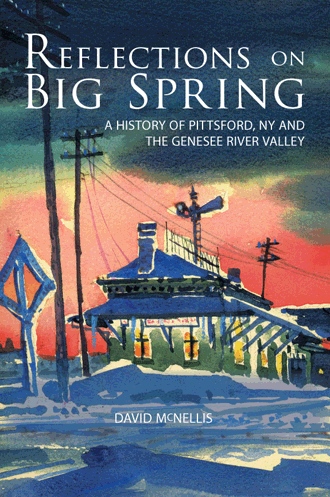
Reflections on Big Spring
The naming rights to an area legitimately belong to those who reside in the region over the most extended period of time. “Genesee” translates from the Seneca language to “Pleasant Valley” and was the name ascribed by the indigenous Seneca Tribe to the Genesee River Valley during the five hundred years they called it their home. By this standard, the village of Pittsford, New York could be forever known as “Big Spring”; the name used by the Seneca to describe its plentiful supply of clean, fresh water ascending from its substantial natural spring.
The defining topographical features of the area are the parallel riparian corridors formed by the Genesee River and Irondequoit Creek. Both are contrarian; flowing south to north before entering Lake Ontario. The independent-minded pioneers that settled Pleasant Valley also refused to be bound by tradition. They departed the relative safety of New England to take on substantial risk and uncertainty to start a new life on America's western frontier. These pioneers were by nature, strong-willed risk-takers who were seeking the well-publicized “agricultural el dorado” that awaited them in the Genesee Valley.
Their arrival was greeted with predictable trepidation by the equally proud and independent Seneca Nation; the elite fighting force of the mighty Iroquois Confederacy. The capital of their sovereign nation was located at or near present-day Pittsford. Among the remarkable tribal chiefs who resided here was Red Jacket, one of the most gifted orators of the 19th century. Despite having no formal classroom education, his speeches inspired both his constituents and recent immigrants from New England. In response to his “white brothers” urging that his people reject the Iroquois' Great Spirit and embrace Christianity, he stated:
"Brother, the Great Spirit has made us all, but He has made a great difference between His white and His red children. Since He has made so great a difference between us in other things, why may we not conclude that He has given us a different religion according to our understanding? … He knows what is best for His children; we are satisfied. Brother, we do not wish to destroy your religion or take it from you. We only want to enjoy our own… We understand that your religion is written in a Book. If it was intended for us, as well as you, why has not the Great Spirit given to us, and… to our forefathers the knowledge of that Book, with the means of understanding it rightly. We only know what you tell us about it… If there is but one religion, why do you white people differ so much about it? Why not all agreed, as you can all read the Book?”
Among the colorful early 19
Reflections on Big Spring follows the lives of resident humanitarians Frederick Douglas and Susan B. Anthony as their inspired civil rights efforts make history. Consider the courage displayed by lesser-known local heroes who farmed, taught school or ran stores during the day and became “conductors” on the area's Underground Railroad after dark. Oral histories of secret passages, tunnels, caverns and hidden rooms take readers on the “last 100 miles to freedom” ride. The area's long and impressive history of innovation and entrepreneurship suggests that earlier generations of business leaders may have had substantial influence on those who followed. Kodak's George Eastman and Xerox's Joseph Wilson both led efforts to greatly improve existing imaging processes in order to make them commercially viable. Both protected the resultant proprietary technologies with inventive, tightly written patents. Both engineered innovative pricing strategies to allow their technologies to be affordable to the masses; Eastman's $1 Brownie and Wilson's five cent pay-by-the-copy system. Eastman and Wilson were not just gifted entrepreneurs, they were revolutionary humanitarians that were likely influenced by Frederick Douglass and Booker T. Washington. Eastman donated a large part of his fortune to colleges that served Black students. Joe Wilson created innovative programs that ultimately provided a blueprint for taking the first steps towards eliminating institutional racism. He mandated practices to bring equal opportunities to minorities and women decades before “diversity” initiatives became popular in corporate America. He forced a seismic shift in Xerox's corporate culture that allowed Ursula Burns to excel in her career and ultimately become the first African American woman CEO of a Fortune 500 company. Seamlessly woven throughout the text are fascinating facts that define the uniqueness of the Genesee River Valley. While closely tied to its agricultural roots, the area is home to several of the world's most prestigious business enterprises and was the birthplace of a wide variety of revolutionary technologies, business strategies and labor-management practices. Discover how Genesee Valley residents shared amateur photography, xerography, the UPC label, self-service groceries, white hots and cream style mustard with the world. This fascinating history of the Genesee River Valley and Pittsford, New York begins with its remarkable earliest residents. From these sturdy gene pools emerged brave war heroes, inspirational politicians, compassionate humanitarians, civil rights leaders, creative inventors, and revolutionary entrepreneurs. Their influence has been substantial not just locally but throughout the state, the country and the world.
Formats

Book Details
About the Book
Reflections on Big Spring is a thoughtfully researched, highly readable celebration of the rich heritage of the
The Seneca Tribe who lived in the
New Englanders immigrated to the great frontier of western
Follow the lives of resident humanitarians Frederick Douglas and Susan B. Anthony as their inspired civil rights efforts make history. Consider the courage displayed by lesser-known local heroes who farmed, taught school or ran stores during the day and became “conductors” on the area's Underground Railroad after dark. Oral histories of secret passages, tunnels, caverns and hidden rooms take readers on the “last 100 miles to freedom” ride.
Seamlessly woven throughout the text are fascinating facts that define the uniqueness of the
About the Author
David McNellis was born in
Since earning a B. S. degree from