
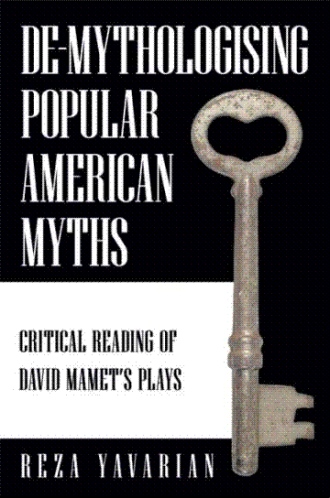
De-Mythologising Popular American Myths
Critical Reading of David Mamet's Plays
by
Book Cover & Preview Text
In a drama the fact that something is `true' is irrelevant. The power of the dramatist resides in the ability to state the problem
David Alan Mamet
A Hollywood blockbuster commercial movie, Mr & Mrs Smith (2005), starts with a documentary-like scene, in which Mr and Mrs Smith (Brad Pitt and Angelina Jolie, the latest sex models of Hollywood) are seeing a marriage consultant and asked when and where they first met each other:
MR SMITH. Five years ago in Bogotá, Colombia.
MRS SMITH. Six years ago.
And there is a flashback with a subtitle: BOGOTA, COLOMBIA, FIVE OR SIX YEARS AGO. And their `(hi)story' begins with “action, blood, a social theme, some girl” (Speed-the-Plow, 13) and with many so-called `postmodern' pastiching moments of the action films. The film `conveys' that we know `there is no fixed reality. The reality is that which is always represented and may be not what we are being told,' but `Hey, Enjoy' the film. It was a box office hit. Whereas the twentieth-century dominant cultural and social forces, like Hollywood, were making reality and realism a surface and hollowed one, which is being inscribed and repudiated by postmodernists like David Mamet, they can, now, in the twenty-first century, do it with even postmodernism if it sells. Hollywood might easily make it serve the purpose of commerce. Those cultural forces are always fashionable and follow the latest trends and can now reproduce `postmodern' films - `fashion-plate films' putting the words of Fredric Jameson (Hutcheon, 2002, 200). It is the medium and not the postmodern that gives the illusion of a “perpetual present interminably recycled” (Friedberg, 427). The dominant forces are popularising and naturalising it, and then hollowing its meaning, as they did it with American myths. They had been creating the fake reals, myths, they can now create fake myths, fake postmodernity. Nevertheless, it is again postmodernism because, as Fredric Jameson argues in “Postmodernism, or The Cultural Logic of Late Capitalism,” it mirrors the unending commodity circulation of an absolutely extensive capitalism.
The story of deception and fakery from that of Devil and Eve to today's stories is all a part of what George Steiner in After Babel calls the anti-matter of language. By that he means its power of seduction and deception, of alternate inventions, and its `counter-factual pull.' However, performative pleasures of language always lead us to submit willingly to that language, in whose “creative function non-truth or less-than-truth is [. . .] a primary device” (Steiner, 229). We go to theatre and cinema to be deceived by the story-tellers. And David Mamet knows all that and puts forward the world of theatre stripped and exposed. The world of his plays is that of story-telling; one is telling the story and the other is listening like Devil and Eve, Eve and Adam. Most of his plays always set two people on the stage, a set of speaker and listener. And they are performing the function of language: deception and manipulation. Teach and Don, Don and Bob in American Buffalo; John and Carol in Oleanna; Karol and Gould, Gould and Fox in Speed-the-Plow; Roma and Lingk, Levene and Williamson, Moss and Aaronow in Glengarry Glen Ross; Story-teller and Listener in Prairie du Chien; Nick and Ruth in The Woods; Bernie and Don, Joan and Debbie in Sexual Perversity in Chicago; Fred and Dale, Joe and Stan, Joe and Dale in Lakeboat; Edmond and B-girl in Edmond, Gross and Lang in The water Engine, John and Miss A in The Shawl, Donny and John in The Cryptogram all are scheming the manipulative relationships, the relationship which never works and creates a world of estrangement, deceit, and self-concern. It becomes a world where the truth and reality are lost, because the language they are using is not for that purpose. Mamet's characters deploy a language which does not carry literal meaning. It is all drained of its senses of reality. The language in Mamet's plays is for the characters' existence. They exist simply because their language lets them do. It creates their world, their fantasies, their dreams, their fear, their loss, their needs and their defensive aggression. It creates their `reality.' There is no other way around. The audience has to accept what their language creates as the only `reality,' while at the same time they do know that it must not be the `reality.' That is why David Mamet is called a Postmodernist. As the playwright has himself observed, his “premise is that things do mean things, that there is a way that things are irrespective of the way we say things are, and if there isn't, we might as well act as if there were” (Mamet, 1987, 68). His plays inscribe the self-reflexive language of modernism and `reality' of realism, and concomitantly overturn them. His work is the manifestation of what Hutcheon, describing one way of postmodern deconstruction, calls “clashing of various possible discourses of narrative representation” (Hutcheon, 53). They do not try to give a prescription. They only exhibit them. The plays simply divulge the shortcomings of both representations in getting us to the `reality,' if any. David Mamet lets us realise that what we are given is only the language, and the myth as a type of language, which is naturalised and mythologised as `reality,' as `truth,' using the potential capability of the signs. His realism is anti-realist insisting that knowledge is made valid not by its relation to its objects, but by its relations to our pragmatic interests, our communal perspectives, our needs, our rhetoric, and so no. Since there is no other way of representation, and its fakery, to represent what one has in mind but the representation itself, the artist and here the playwright employs a form of ironic representation - parody. The double-coded politics of the parody is the only way to stay honest in order to be able `to state the problem', as Umberto eco calls, in the era of the lost innocence: “it both legitimises and subverts that which it parodies” (Hutcheon, 101).
Formats

Book Details
About the Book
THE BOOK ATTEMPTS TO TAKE A DISTINCTIVE LOOK ON THE WOLRD CRTEATED BY DAVID MAMET IN HIS DRAMATURGY. THE WORLD, AND PARTICULARLY AMERICA, CREATED BY MAMET IS PORTRAYING A DENATURALISED ONE IN WHICH THE POPULAR MYTHS CONSUMED BY THE PEOPLE ARE DECONSTRUCTIVELY STRIPPED - IN OTHER WORDS - DEMYTHOLOGISED.
About the Author
REZA YAVARIAN, AN ASSISTANT PROFESSOR OF ENGLISH LITERATURE FROM IRAN, HAS DONE HIS MASTER AND PHD STUDIES BOTH ON AMERICAN DRAMA. HE HAS BEEN STUDYING AND TEACHING AMERICAN DRAMA AS WELL AS BRITISH AND AMERICAN LITERATURE FOR MORE THAN TEN YEARS AT IRANIAN UNIVERSITIES. HE HAS PARTICULARLY WORKED ON THE WORKS OF DAVID MAMET AS HIS MAIN INTEREST.