
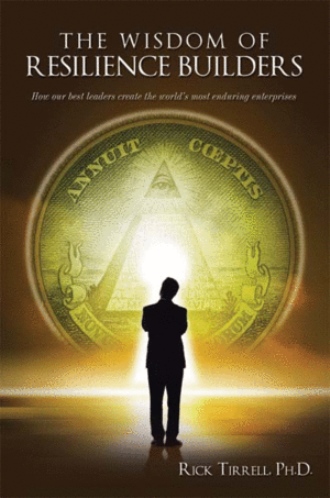
The Wisdom of Resilience Builders
How our best leaders create the world’s most enduring enterprises
by
Book Cover & Preview Text
The Essential Elements of Resilience
Resilient companies are crafted by Resilience Builders. We know their names because they are the legends of prosperity; Thomas Watson at IBM, Kiichiro Toyoda at
What is it about Resilience Builders that enables them to create firms that prosper and endure? Did Microsoft become the dominant software company in the world because of Bill Gates’ talent as a programmer? Not likely, because Digital Equipment, Altair, Commodore, Wang, and Compaq all had intelligent programmers and those firms are gone.
Was it Meg Whitman’s brilliant intellect and Harvard MBA that allowed her to grow the first virtual community and ensure e-Bay’s survival after the dot com crash? No. Although some Harvard MBA alums have generated great prosperity, others have generated great failures. Some have even gone to jail. Having a great education does not guarantee that the leader will become a Resilience Builder.
Proctor and Gamble CEO, A.G. Lafley is credited with restoring worldwide growth during his tenure from 2000 to 2009. Could it have been the facts that he rose through the ranks at P&G, and once headed its Asian operations? No. His predecessor, Durk Jaeger rose through the ranks and headed the Asian operations too, but disrupted the company and resigned after only 18 months as CEO. A leader’s career path does not make him a Resilience Builder.
Was it the smart strategy of building a discount airline in the face of the stodgy legacy airlines that made Southwest Airline’s CEO Herb Kelleher a Resilience Builder? After all, he had the ability to lower his competitors’ prices when he pulled into an airport for the first time and to repeat this over and over again for many years. Again, no. There have been many discount airline start-ups, and nearly all are gone. Simply choosing and executing the right strategy does not make a leader a Resilience Builder.
So, what do these people know, and what do they do that makes them Resilience Builders?
Our heroes can be demystified and their methods understood. Building resilience is not the product of magic, chance, or mystery. The events in our world are organized in a logical, understandable manner which gives order to our observations of resilience and explains how some achieve it and others do not. They achieve resilience not because of who they are, nor of some God-given talent, but because of what they do, and how well they do it. They all have achieved resilience by having the wisdom to understand, manage, or maneuver four variables and to know how these variables interplay with each other. These variables are what this book calls the essential elements of resilience. They are: competitive platform, developmental frame, culture, and strategy.
Competitive Platforms
Resilient companies have a clear identity; a strong and well-defined personality. We encounter this when we get a long workout on our insurance company’s voice menu, then hold for the next available agent. We experience it when a bridal shop spends more time interviewing a young woman than selling to her. We see it when our cell phone obsoletes almost overnight. And we know it when our soft drink is supposed to make us young again. Most successful insurance companies operate on an Efficient Platform. The best bridal shops are built on a Relationship Platform. Technology companies build their fortunes on the Creative Platform. And soft drink manufacturers are established on the Marketing Platform. Within each industry, those companies which have achieved resilience have done so by carefully choosing their own competitive platform, communicating it clearly to their employees, suppliers, and customers, and living according to the doctrine of this competitive platform. For them, this is more than just a business model. It is a religion.
There are four competitive platforms: Efficient Platform, Relationship Platform, Creative Platform, and Marketing Platform. There is also a fifth possibility, a Hybrid Platform, which is a combination of two or more competitive platforms. As various industries have progressively become more complex, successful Hybrid Platforms are now seen more often. Effective execution of a Hybrid Platform can powerfully enhance resilience.
This book proposes that there is a distinct set of skills and competencies associated with each of these platforms, and resilient companies specialize in a specific competitive platform. Once a Resilience Builder selects a platform and dials this platform up to extreme heights, the very nature of the organization becomes clear. Each platform has its own set of defining characteristics, relationship with money, motive, and method of growth. Each also has a unique relationship with its suppliers, employees, and customers. Each has a unique set of marketing skills. This means that it is quite different to lead, manage, sell to, or work for an Efficient Platform company than it is to do so for a Relationship Platform, Creative Platform, or Marketing Platform company. In resilient companies, everybody knows upon which competitive platform the company is built.
Formats

Book Details
About the Book
What wisdom do Resilience Builders have that gives their enterprises the ability to grow, survive hardships, and return to growth? How do they build their organizations on competitive platforms that give their companies a strong and well-defined identity to suppliers, employees, and customers? How do they alter those platforms as their industries are impacted by predictable and unpredictable changes?
Resilience Builders create lasting prosperity for those around them despite the shocks that come their way. These great leaders are members of a unique breed. Their stories are told and their methods examined in this pioneering book.
This work proposes four essential elements of resilience and it shows how Resilience Builders masterfully use these elements to build firms that are impact-resistant growth generators.
Neither stunning profits nor a huge market cap are needed in order to be resilient. Fame is not needed, nor is a celebrity CEO. To achieve resilience all that is needed is the ability to create healthy growth and to return to growth, despite adversities.
In The Wisdom of Resilience Builders Rick Tirrell, Ph.D., reveals the skills of these remarkable leaders and shows how they build the world’s most durable organizations. Their unique abilities can be imitated by all who have enough curiosity to read this book and the patience to guide their firms carefully.
You can gain the wisdom of Resilience Builders; know what they know, and do what they do.
About the Author
Frederick “Rick” Tirrell, Ph.D., builds organizational effectiveness for small, mid-sized, and large companies. He founded Navigator Group Professional Association in 1998 as a network of specialized professionals capable of addressing a wide range of business needs including strategy, culture, and competitive platforms. His insights come from the corner office as well as the front lines of the business world. His guidance about how to strengthen enterprise resilience is straightforward, informative, and encouraging.
Learn more about Navigator Group, PA, and contact Rick at www.navigatorgroupinc.com.