
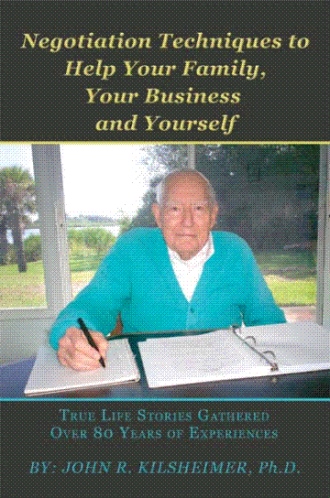
Negotiation Techniques to Help Your Family, Your Business and Yourself
True Life Stories Gathered Over 80 Years of Experiences
by
Book Cover & Preview Text
Chapter Thirteen
Two “Bad” Words
There are two words which I try to avoid or at least use very seldom in any negotiation. The first often gives something away without obtaining anything in return. The second is a turn-off and tends to make the other side defensive and sets a bad tone for further discussion.
As examples, how many of us have faced one or more of the following questions:
1) Dad, can I borrow the car this afternoon?
2) Do I really have to finish all my food?
3) Is there going to be a layoff at our company?
4) Will I get a raise this year on my anniversary?
5) Don’t you think our proposal is reasonable?
An answer of yes or no to any of these typical questions can be troublesome.
Question 1 - If you don’t want them to have the car, rather than say “no,” give a reason such as you plan on using it yourself or someone else has an urgent trip to make. It is hard to argue too much with these types of responses. Whereas an answer of “no” to the request for the car would probably just lead to further unwanted discussions. If you have no objection to the borrowing of the car, then don’t just say “yes.” The use of the car is an asset and you could easily obtain a favor, such as picking up a shirt from the cleaners or picking up a few items at the grocery store on the way home. A young person’s desire for a car is usually strong enough to accept a few conditions. At least for safety’s sake and peace of mind find out where they plan to go, and what time you should expect them to be home.
Question 2 - When I was a youngster, the noon meal on Saturday was always beans and franks. I loved the franks, but not the dreaded beans. My father used to do all the serving and always insisted that we waste nothing as people were starving in
Question 3 - A layoff is always a worry in any cyclical industry and especially so in slow times. As a supervisor you want to keep morale and productivity high, so you don’t want workers to be “on edge.” If you say “yes” to any inquiry about any possible future layoff, the word will quickly pass around and productivity will take a nosedive. If you say “no” and it happens, even several months in the future, your workers will remember that you said “no” and their trust in you will be damaged. Unless a shutdown is imminent, it is best to indicate that you have not heard of any scheduled layoffs, and the company values the work ethic of all its employees and appreciates their contributions to the success of the company.
Question 4 - As to getting a raise, this sounds like Dagwood in the Blondie comic strip where the only time the boss said “yes” was on the first day of April. Unless you are the senior person who can absolutely make it happen, the answer can never be “yes.” If the situation looks promising then you can mention that everyone will be reviewed carefully prior to their anniversary date. If the person is a marginal employee, then it is better to suggest that they try to improve their productivity and increase their value to the company.
Question 5 - In most negotiations the initial proposal by the other party is usually quite favorable to themselves. No matter how preposterous an initial proposal might seem, I would find it difficult to give a blanket “no.” I would rather let them know that our company has a proposal which we believe is fair to both sides and that all points of view will be given full consideration. When the differences are significant, the first meeting of the two parties should be as brief as possible. Bad vibes can endanger success and a cooling off period is generally beneficial. The best approach is to seek areas where the differences are small and try to get a few early positive results. It is better to build on small successes then go “hammer and tongs” on the more divisive issues. In any difficult situation you need to plan on spending many hours. Always be prepared to have a back-up proposal but don’t ever indicate early that one exists. However, even if their proposal is reasonable, do not accept it initially but have discussions and try to get a last minute “gimmie” clause (see previous chapter).
Yes or no can blow the show.
Formats

Book Details
About the Book
Negotiation Techniques to Help Your Family, Your Business and Yourself contains thirty chapters of true-life stories involving negotiations with parents, children, bosses, and employees. The author took an active part in the majority of the events. Several of the business negotiations involved both the purchase and sale of technologly with more than twenty companies located in the
This book is to acquaint one and all that every day everyone negotiates in some form or another. It was written to assist teenagers and both college and graduate students as they seek new opportunities and form their life values and goals. It is also beneficial for adults to help them perfect their interpersonal relationships.
These true-life stories with their lifelong truisms will enable people of all ages to learn the techniques that lead to success in everyday negotiations with their families, their businesses, and themselves.
About the Author
John Kilsheimer grew up in a family with two brothers and two sisters, and with his wife had six daughters. Thus, his introduction to negotiation started at an early age. Negotiations within his family and in his early naval career afforded excellent training.
After serving in WWII with the amphibious forces, he took advantage of the GI Bill and obtained his Ph.D. in organic chemistry. He then worked for thirty-two years in the chemical industry with four Fortune 500 companies. He started his career as a bench chemist and retired as a Senior Vice President of The Scotts Company in charge of manufacturing, distribution, research and development. Throughout his career he had many opportunities to negotiate contracts both within the
In the research area, he authored twenty-four
With his wife, Betts, they had six daughters, all of whom are in the education profession. At last count, they have eleven grandchildren and five great-grandchildren.