
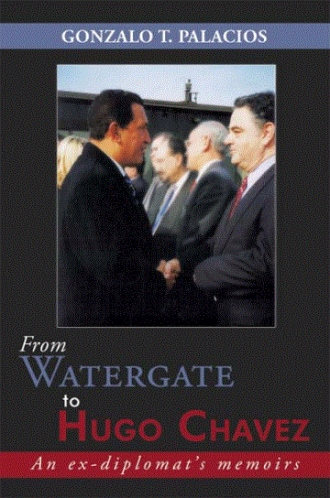
From Watergate to Hugo Chavez
An ex-diplomat’s memoirs
by
Book Cover & Preview Text
FROM WATERGATE TO HUGO CHAVEZ (Excerpt): The driver arrived promptly at the hour we had agreed; a Barry Fitzgerald look-alike except more distinguished in his stride as he came to open the back seat door for me. He did not say another word after barely whispering “Good Morning, Sir.” And so it was that a week after the Shah’s last birthday celebration in Washington, a beautiful early November day, I found myself entering Behzad Farahani’s home, one of those unique mansions built on the edge of Washington’s famous Park. The house was hidden from the road by large evergreens and azalea bushes. I was ushered into a semi-circular area with large windows overseeing the beautifully manicured front yard. A 6 foot in diameter round table covered with white laced tablecloth was set for two, opposite each other. The white porcelain plates were gold rimmed, the silverware was gold, as were the demitasse cup holders: no detail was overseen, even the flowers that served as centerpiece were short stemmed, so the two of us would have no difficulty studying one another. It is well known that diplomatic social events, small and intimate or large and impersonal, all have the same objective: to gain information on how other governments wield power, political and economic, domestically and internationally. My new friend arrived as I was approaching the Farahani family’s breakfast nook. “Dr. Palacios, welcome to my home,” he said stretching out his hand, “how is it that you say in Spanish? ‘Mi casa is su casa’, is that right?” I shook my colleague’s hand and a waiter pulled my chair out. We sat down, an aromatic coffee was poured immediately in our cups and we both tasted the exquisite brew. It was more like Venezuelan coffee than others I had tasted from that side of the world. He began the conversation by asking how many Venezuelans were studying in the United States that year, ending his query with “We have 12 or 13 thousand, you know.” “Well,” said, “We have a similar number, maybe closer to 15 thousand.” The breakfast was typical of what one would find in an American coffee shop; scrambled eggs, bacon – yes, bacon – toast, butter, and jam. We described each other’s way of dealing with such large numbers of students. He also told me he had total control of the Iranian Scholarships in the United States. “Aren’t you worried?” I asked my host. For the previous months, since the beginning of the Fall semester, hundreds of Iranian students would parade every day in front of the Embassy of Venezuela, along Massachusetts Avenue, on the way to theirs. Covering their faces with paper bags, they were protesting the cruelty of the Shah’s totalitarian rule and the demise of the few democratic institutions in Iran. Behzad Farahani offered me a Cuban cigar, which I readily accepted, and we both lit up as we began our last cup of coffee. “They are bound to go back to Iran and cause trouble.” I tried to find out more about the political stability in Iran. “No, no, my friend,” he exclaimed, exhaling the delicious aroma of the Cohiba cigar, “We know exactly who they are: all of them are here on our scholarships. Their parents work for the Shah. Protesting is peculiar to their age, not to their political beliefs.” He took another drag from the cigar and got up: breakfast was over. What I had asked might have ended the conversation, but as I was leaving, he insisted that there was nothing to worry. “Don’t forget, Dr. Palacios,” he told me, “the Shah’s government is older and more stable than Venezuela’s.” Farahani’s wife was not present at the breakfast and he had not bothered to excuse her absence, so I simply thanked him and left. On our way back to my office, the driver had to wait two light changes for the Iranian protestors to go by in order to make a left turn into California Street. Two months later, on the 11th of February, 1979, His Imperial Majesty Mohammad Reza Shah Pahlavi, was deposed: the protagonists of the Iranian revolution were upper middle class students who received their instruction from Paris by way of audio cassettes: the voice was that of an unknown elderly Islamic fundamentalist, the Ayatollah Khoumeni.
Formats

Book Details
About the Book
FROM WATERGATE TO HUGO CHAVEZ, AN EX-DIPLOMAT'S MEMOIRS consists of a selection of experiences beautifully written by their protagonist, Dr. Gonzalo T. Palacios. The stories illustrate what went on behind the diplomatic activities from 1974 until Hugo Chavez's rise to power in Caracas. Dr. Palacios' use of Machiavelli's quotes may help explain his own longevity as a diplomat in Washington, DC.
About the Author
Gonzalo T. Palacios was born in Maracay, Venezuela (1938). He studied architecture (Catholic University of America in Washington DC and Universidad Central in Caracas). He received his MA in Philosophy from the Gregorian University (Rome) and his Ph.D. from the Catholic University of America. During his 25 years as an accredited diplomat to the White House, Dr. Palacios founded the Association of Iberoamerican Cultural Attaches. Presently he teaches philosophy at Prince George's Community College and presides over the Erasmus Group, dedicated to the discussion of issues such as darwinian evolution and free will.