
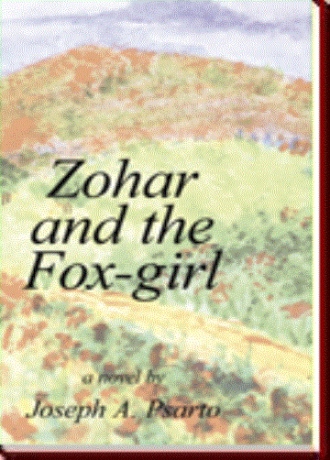
Zohar and the Fox-girl
by
Book Cover & Preview Text
Artists, especially writers, can time-travel. Sometimes it happens suddenly, haphazardly and without the writer's initiation. When the traveler goes into the past he must be sure to do everything the same way again. Otherwise, everything, everyone, everywhere, will change a little. Or a lot. God does not like that. But at times God himself might order a change because - perhaps - something went against his plan the first time around. It is a touchy problem involving free will and the distinguishing between good and evil spirits.
- Ancient Korean Mythology. (Circa: Time and Times ago.)
It went the same way almost every morning. We met at a small café and drank strong coffee and talked about the past and our lives as young men and how we thought everything was black or white in those days, but we talked mostly about novels, our own and others. He an old Jew, as tough as nails, I an old Italian-American, as blockheaded as ever. But we liked many of the same writers and poets, and baseball and jazz in between. We read each others' novels and were critical almost to the point of violence. At those moments he seemed to hate me more than he hated the pretenders who reviewed his books. But he would listen to me and I saw in his eyes that he really loved me and wanted to hear what I had to say. He may have liked my writing, too, but I am not sure about that for he would never say so with an assurance that pleased me. He had high interest in what I wrote. And for me that had to do.
His name was Richard Sefer Zohar. I called him Zohar. That was it. Never Richard. Certainly never Dick. He told me once or twice that "Sefer" and "Zohar" meant things in Hebrew, but he didn't offer definitions.
We fought and agreed, discussed and argued, and generally had a good time. Art, history, literature, writers, philosophy, women, we covered everything. Our battles over religion were classic, he a self-proclaimed atheist who sounded like he hated God in spite of not believing in him, and from time to time hating humanity too, but at the same time loving or perhaps pitying - everyone, including God; and I, desperately clinging to my Catholicism in spite of a life spent chasing women and booze and having been a spy for my government and having broken laws both legal and moral for my country's advantage and sometimes my own. I loved or cursed my country depending on who was in charge at any given moment. That was the past. That was history. For now I just wrote, but not about that, not my espionage, but about what I had seen and felt beyond my own adventures. I placed my tales in different places, different circumstances. I became an observer of myself, separate, as though I were a character in a story. But the feelings were there, they were authentic, I knew they were mine, just exiled to more acceptable literary locations, dangerous but safer locations, safer because not mine. That is what I attempted to communicate in my stories. Tolstoy would have been pleased with my desire if not my results. Communication was his definition of art. As it became mine.
Zohar accused me of cloaking my own sins in my stories and in my defense I imputed the same to him. When I told him he was nuts he simply said, "But you're the Catholic, not me, you're the one who needs the confessional. I am a simple wandering Jew. Damn it, damn you! If I confess it won't be in front of you. You dumb bastard."
Sometimes he switched sides. That was his way. He moved in and out of things with a skill that scared me. Zohar was at his best even when discussing matters outside his own belief system. He was especially skillful at those times. He had a knack for it. He said it was because of his perfect detachment, but I think it was simply his lifetime of reading and studying everything under the sun and his feline curiosity about everything existing within the universe, for things merely under the sun were not enough for him. If I turned our discussion to Roman Catholic philosophy he handled it easily, roaming around to and fro, working all sorts of angles, whatever he wanted, into his response, for instance art and literature, and the publishing world, anything. Perhaps something like this -
"Original Sin, yes, I understand it. It's a gift from your Catholic God. You are free because of your imperfections.
Don't you see it? Absolute, immaculate knowledge would extinguish freedom because perfect knowledge ends choice, except for the insane. Now that might be a hope for you, insanity a step up. But to make up for the loss of freedom in your Catholic heaven Beauty must be offered, perfect Beauty. I hope you make it there, to your heaven. It will be a new sort of freedom for you, this Beauty. Better than the old. But for now the old kind will have to do, it's all you have. As for me, the only thing I believe in, it's called Art, and that's what a writer should set about to do, creating it as best he can. It's a real damn shame he is also expected to entertain."
Zohar's mind mixed together things other people thought incompatible. He professed not to believe in God, but always used the G in upper case, and he refused to accept death as the end of life. He accepted the soul - especially his own - as immortal, but didn't know where it came from. He said it was most preposterous and difficult to give credence to an end of consciousness. And he had a weird theory that stupid people have less of a soul than the brilliant. His biggest enigma was wondering where he had been before he was born. He couldn't imagine nothingness or emptiness in either direction. Once he said to me, "Atheism, not my kind but the other one, is a bigger leap of faith than any damn Catholic can make." He didn't say what the "other one" was. I am not sure, but I believe he accepted magic, faeries, devils and angels. He always spelled it "f-a-e-r-i-e," said it deserved that spelling but never
Formats

Book Details
About the Book
"Zohar and the Fox-girl" is the story of a young American intelligence officer who is forced to make a decision during the Korean war that will follow him for the rest of his life. But it is not a war story, for the war is only the stage in which the tale is set. Love is the theme. But love can come in different forms that might conflict with each other.
The story has fantasy but is not science fiction, for its magical metaphors are literary devices within a tale of love and sadness. With a little reimagination the reader might see some of his or her own conflicts. All the while, lurking behind the scenes, are the Korean god, Hanunim, and the Korean devil, the Magwee. They have made a Jobian bet on what Zohar might do if given a second chance.
A magic mountain, a god, a devil, and a fierce love affair are mixed with history and myth. In the Hebrew language Sefer Zohar means "Book of Splendor" and that translation fits well for our protagonist is a writer. The novel opens with two old men fighting over anything and everything that comes along. But it is soon apparent that they are the best of friends. And by the end of the story their friendship is brought full circle by the telling of Zohar's story. For Sefer Zohar wants all the world to hear of his sadness and his love. The Fox-girl's story must not simply go away. But Zohar cannot bear to write it himself, so his old friend sets out to tell of Zohar and the Fox-girl within a book of splendor.
About the Author
Joe Psarto was born in 1931 in
For most of his life Joe has read over fifty books a year, mostly novels, but also biography, history and poetry. He considers fiction to be capable of greater truth than nonfiction. For instance, what gives a closer picture of the evils brought on by the industrial revolution in
Joe considers the novel to be the greatest art form of all because of its ability to extend beyond time and space, for time and space may be exploited as the author sees fit. A split second may take five pages and a century but a sentence. Metaphor may be used to describe a character, a place or a situation as fully as the author wishes. On the other hand, a painter freezes but a moment in time, and that, too, may be great art, but it cannot be as expansive as literary fiction, nor as capable of presenting the many faces of reality.
Literary fiction gives a reader the ability to reimagine the story being told and to enter into it seeking a solution for a personal dilemma. (The reply might be that there is no solution.) And a book can be picked up or put down at any time, its story paused, the universe suspended, and then brought back to existence.