
Common Sense Tax Reform
by
Book Cover & Preview Text
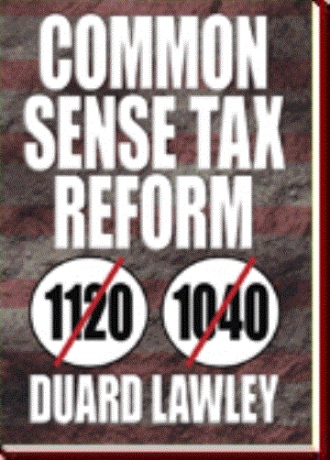
Foreword
The graduated income tax didn’t really come into play as a device of re-distribution of wealth until after World War II. It had been in force for a number years but didn’t sound like a bad idea to most of
In the fifty-odd years since World War II, however, the graduated income tax has become the master plank in the platform of the Liberal/Socialists who desperately desire the transformation of
The graduated income tax is a perfect tool for Socialism in all its disguised forms. As a tool for re-distribution of wealth, it, along with an estate (death) tax reduces initiative and restricts savings. Worst of all, personal and financial privacy, a basic tenet of freedom, is also restricted, almost to the point of invisibility.
In the writing of this book a number of questions came to mind and I wondered why they haven’t impinged on the minds of taxpayers in a more prominent way over the years. I have prepared or overseen thousands of tax returns and few people have seemingly ever raised the obvious question, “Why?” I suppose they trust the American way and assume that a graduated income tax has been around a long time and must be part of the American dream.
Actually, the tax has been around a long time but has never been questioned, mainly because the backers have enticingly played upon the greed (or ignorance) of voters who yearn for the “pie-in-the-sky” solutions promised. Many voters blindly follow leaders who have no solutions, only defamatory speeches and oratory.
I have endeavored to lay out a tax plan that will once again set us back on the right course to follow the American dream, a tax plan that will broaden the tax base, lower the rate of tax and put the tax on a pay-as-you-spend, rather than the horrible mess we have today. The Universal Transaction tax is a tax for the twenty-first century, not a carryover from the late nineteenth or early twentieth century. It is a tax easily understood and best of all, it is not collected by force and there are no returns to fill out.
I would like to introduce to you a tax based on common sense, not a tax of definition. I hope you agree with me after reading the book. Let’s modernize and simplify our tax system. Save our
Formats

Book Details
About the Book
Get rid of the graduated income tax!
Adopt a tax on spending!
No deductions, no exemptions!
No returns to file!
Protect personal privacy!
With a 1% rate of tax on all transactions the Treasury would have au the money needed to replace the graduated income tax, the alternative minimum tax, the estate (death) tax and many other smaller nuisance tax levies.
All collection of the Universal Transaction Tax (UTT) would be made by taxpayers and deposited directly into the U.S. Treasury’s account within just a few days. The government would be on a cash basis immediately and would not have to wait up to eighteen months or more for the arrival of tax money to pay bills.
The UTT tax would apply to all transactions and would be taxable to the “buyer” in each transaction, the “buyer” being the party who pays the money. The Federal and state governments would not be taxable. There would be two types of bank accounts, commercial and personal. Personal accounts would not be affected by the tax. A much fairer, simpler and more foolproof system than we have today.
No withholding tax from paychecks, no 1099s to trap taxpayers, no estate tax debacles. Thousands of trees would not have to be cut to provide paper to print millions of tax forms and instructions booklets that taxpayers don’t understand!
It is estimated that it costs the American taxpayers almost 350 BILLION dollars a year just to keep records and file graduated income tax returns! It is also estimated that we lose at least 350 BILLION dollars a year through tax cheating, non-filing tax protesters, and fraudulent tax schemes. Let’s save this three-quarters of a TRILLION dollars and do it the easy way!
About the Author
Duard Lawley is a certified public accountant (Retired), a licensed CPA in the state of
Duard opened his first tax preparation business in the filing season of 1950 when he was in his senior year of college at
After his Navy service, Duard moved to
After being engaged in life insurance sales for a period of time Duard returned to accounting and tax return preparation in 1959 and operated as a public accountant until qualifying for his CPA certificate in 1960. He was in practice as a sole practitioner until 1974, merging then with another firm in
Duard retired from the firm in 1975 due to health problems and spent the next few years as a part-time tax and business consultant and investor in real estate. He opened another small office in 1988 and operated it until 2004.