
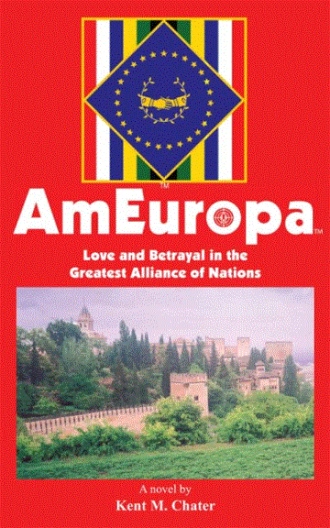
AmEuropa
Love and Betrayal in the Greatest Alliance of Nations
by
Book Cover & Preview Text
THE CASTLE ALCÁZAR
(40 Miles outside
Nestled on a sheer and rocky crag, rising high above a perilous cliff, the towering Alcázar de Segovia commanded a majestic view over the hinterland of
The massive impenetrable towers and walls of the Alcázar allowed entrance only on one side by a bridge over a deep perilous moat, impeding undesirable entry to intruders when the castle bridges were raised. Despite daunting exterior walls and a fearsome moat, romance had been known to permeate the air of this enchanting castle as this had been the site of the first rendezvous between Isabella, the Queen of Castile, and her future consort Ferdinand, the King of Aragon.
As both a fortress and a historical site of great cultural importance, the Alcázar was a highly secure site for unlawful exploits. Who would suspect that a historical edifice protected by the Spanish government would fall into the hands of criminals? So thought those occupying this cultural wonder.
Nevertheless, the AmEuropean Secret Intelligence Agency and the twenty-seven national secret services of the Alliance of AmEuropa, working in close cooperation with each other, suspected the castle had fallen into the hands of criminals, who were using it as a facility for the illicit production of Ecstasy. But one thing was missing—the evidence.
Known for its stimulant, hallucinogenic, and euphoria-inducing properties, Ecstasy—also called “E,” “X,” or “XTC” in the English-speaking world, “extase” in the French-speaking, and “éxtasis” in the Spanish-speaking world—had become, without regard to national borders, the fastest growing illicit drug in AmEuropa.
¨ ¨ ¨
On a dark and quiet night during the month of June with only a quarter-moon manifesting itself above the lofty medieval castle, two middle-aged thugs loaded six wooden crates marked CAFÉ DE GRANO ENTERO, WHOLE BEAN COFFEE into a small truck parked inside the castle courtyard. Without an utterance the two men entered the truck—one, on the driver’s side, the other, on the passenger’s side—and drove away. As the small truck drove past the imposing sixteenth-century Catedral de Segovia, the last Gothic cathedral built in
A black Porsche Carrera S pulled out from alongside the cathedral and proceeded to follow the truck. At the legendary town square, La Plaza Mayor, where Isabel I was proclaimed queen of Castile in the Romanesque San Miguel Church, the black sports car discontinued following the truck, quickly turning left, then right, down la Calle de Colón, Columbus Street. The black Porsche picked up speed as it headed down the narrow cobblestone street toward the ancient Roman Aqueduct. On a dime, it swung back around, passing underneath one of the hundred eight granite arches of the two-thousand-year-old Roman architectural marvel, and stopped. The black Porsche turned off its headlights and waited at the mouth of the Calle Cervantes, the street down which the smuggling suspects were traveling. The stealthy black sports car could no longer be seen in the dark of night.
The tinted passenger-side window of the black sports car descended. A carbine with a laser scope extended out of the window held by black leather gloves. A woman in her mid-twenties with long, straight chestnut brown hair took careful aim and waited. As the truck approached the mouth of the Calle Cervantes, the headlights of the black Carrera flashed on, blinding the two men. Before the eyes of the truck driver could acclimate to the headlights, the awaiting young woman pulled the trigger, firing a bullet through the truck’s left front tire.
Out of control in the narrow Spanish street, the truck rammed into the sixteenth-century wall, bearing intricate patterns of ornamental graphite, killing the two men instantly.
From the driver’s side of the black Porsche Carrera, a fair-haired man in his early thirties, wearing a black suit and tie, stepped out of the sports car with a crowbar clutched in his right hand. First he looked to see what condition the two men were in. Seeing they were dead, he proceeded to the rear of the truck and opened the back doors. Six wooden crates filled the truck. He pried open a crate marked WHOLE BEAN COFFEE to inspect the validity of its contents: the crate was full of darkly roasted whole bean coffee. He opened another crate. It was the same: nothing but darkly roasted coffee beans. He took out a white handkerchief from his breast pocket, neatly set two coffee beans in it, folded the handkerchief, and put it back into his jacket pocket.
He returned to his black Carrera and got in without saying a word.
“Well, what have you found?” the young woman in black asked.
“Nothing,” the young man replied.
“What do you mean ‘nothing’?”
“Nothing but coffee beans.”
The yo
Formats


Book Details
About the Book
The
International espionage, culture, love affairs, and betrayal fill this intriguing and introspective thriller set among the cultural wonders of
About the Author
Born in