
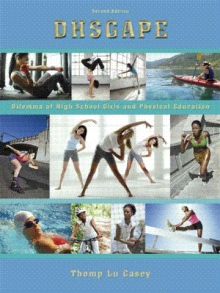
DHSGAPE
Dilemma of High School Girls and Physical Education
by
Book Cover & Preview Text

Chapter One
High School Girls and Physical Activity
A physically active lifestyle has become one of the primary marks of a physically educated citizen. Required physical education programs are the official social mechanisms through which students should receive the information, skills, and values to choose a physically active lifestyle. But not all citizens choose to incorporate available information into their life choices. Given the weight of the evidence in favor of choosing activity, and the apparent patterns identifiable in people who choose inactivity, a study of these choices is warranted. Prior to proposing a specific study, however, it is necessary to describe some of the context within which these choices are made.
In the following section, evidence will be presented to describe some of the differential patterns regarding physical activity. These patterns are discussed relative to international, national, and state profiles. Specific physical education curricular innovations are discussed at the national and state levels. The last section provides a theoretical perspective through which lifestyle choices regarding physical activity might be considered.
Differential Patterns of Physical Activity
Low fitness levels and increasing health problems of both boys and girls, during the adolescent years, have generated a great deal of concern in the
It is estimated that approximately 80% of the adults and 50% of the children in the
Moreover, a report from the Surgeon General (United States Department of Health and Human Services, 1996) states that about one-half of the young people in America (ages 12-21 years) do not participate regularly in vigorous physical activity and one-fourth report no vigorous physical activity. High school boys were 40% more vigorously active than girls (Sallis, Zakarian, Hovell, & Hofstetter, 1996). Among high school girls, fewer black females (49.5%) were vigorously physically active than white females (28.0%) (Gordon-Larsen, McMurray, & Popkin, 1999). Andersen, Crespo, Bartlett, Cheskin and Pratt (1988) found ethnic minority children to be less active than European American children. Among high school students, enrollment in physical education has declined from approximately 42% to 25% in the 1990s. Only 19% of high school students reported being physically active for twenty minutes or more in daily physical education classes (United States Department of Health and Human Services, 1996).
The major official social mechanism charged with providing the information, teaching the skills and values thought necessary for leading a physically active lifestyle is becoming less accessible to students. The decline in program enrollment appears to correlate with increasing levels of inactivity.
Formats

Book Details
About the Book
Research study examines what effect the removal of physical education as a four year academic requirement on high school girls……….
The recent national alert by medical clinicians addresses the issue of obesity and the lack of physical activity. This book provides some insight into answering this question.
About the Author
A Dream True
Having graduated cum laude from a
Mathematics had always been her idea of challenge. Therefore, she chose a research dissertation project that would utilize her math skills and address the needs of her country, her culture, her sex, and her grand-children from the advantage she received being a physical education instructor in the Upstate of South Carolina. She believes that Mathematics is not only a science but is a language as well. As one browses through the tables, one can see through numbers and percentages the mind set that is indicative of so many physical education programs. They are stuck in a mode that excludes from and dissuades a lot of students from taking elective physical education.