
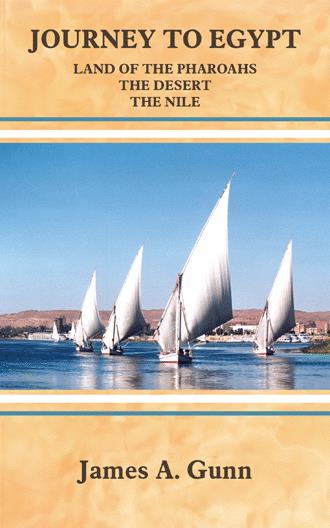
Journey to Egypt
Land of the Pharoahs - The Desert - The Nile
by
Book Cover & Preview Text
Chapter 6
MYSTERY OF THE SPHINX
“Man fears time, But time fears the Sphinx.” Arab Proverb
“Sphinx, mythological creature with a lion’s body and a human head The earliest and most famous example in art is the colossal recumbent Sphinx at iza,
Encyclopedia Britannica
“Dating from the 4th dynasty”—Well maybe. “Known to be a portrait statue of the King” Well maybe.
The huge stone colossus rests on its belly waiting patiently. Its paws are outstretched before it and you can readily imagine its tail switching back and forth slowly in that side-to-side motion of a cat as it waits for its prey. Waiting, staring undistracted toward the distant horizon, waiting, always waiting. Some say it is waiting for the sun, for the bright golden orb to again chase away the darkness, waiting to greeting it each new day, waiting to start a new cycle of life.
Some say that the Sphinx is waiting for the god Re-Harakhte.
Waiting for the Sun God.
Waiting for RA!
Sixty-six feet high, the height of a modern six-story building, and two hundred forty feet long, it is one solid block carved from living limestone bedrock. With the yellowish body of a lion and an enigmatic face, the Great Sphinx seems to be reposed, but alert, in wait, staring expectantly to the east—always to the east. Its composure is serene, and to me, it does not seem to be a guard—as some experts say, protecting the pyramids to its rear—but instead, a sentinel expectantly looking to the east—waiting, forever patient. The lips are slightly pursed and the eyes are opened wide, staring toward the horizon.
Why is it there? No one really knows.
What does it represent? All answers are conjecture.
What or for whom is the colossus supposed to be waiting?
And why the east?
Yes. Egyptian experts—some—say it is waiting for Ra to awaken each morning, to bring new life to the land of the people of the desert, of the Nile River, of the Nile River delta. Legends have it that The Great Sphinx insures that the Sun God will chase away the demons of the night, the frightful sounds so dreaded by peoples who have only fire to hold back the darkness, the night demons. But, even after 4,000 years of study, no one really knows . . . there are just hypothesis, theories, and guesses . . . enigmas.
The massive statue has been a mystery throughout the centuries to many different peoples from the ancient Egyptian invaders Hyksos in 1720 BC to the Mamluks in the tenth century, through the Libyans, the Arabs, the French, and the British, all have wondered at the Great Sphinx. The mythical beast has been discovered, lost and forgotten, and rediscovered by different peoples separated in time by millenniums. The Mystery of the Great Sphinx—a recent television documentary narrated by Charlton Heston—stresses the fact that the Sphinx has titillated mankind’s curiosity for several thousand years—as many as ten thousand years.
The age of the Great Sphinx has long been accepted by the majority of Egyptologists as approximately 4,500 years; most stating it was built about the same age as the Great Pyramid of Cheops and built by the same people.
However, as experts will do, there is disagreement with this date. John A. West, an Egyptian historian, and Robert Schoch, a geologist and expert in rock erosion, have proposed a new theory that places the age of the creation of the Great Sphinx at 9,000 to 10,000 years.
These two professional’s estimate is based on the erosion of the Sphinx and the surrounding rock walls. According to West and Schoch, the limestone layers of the statue exhibit round, undulating profiles and creases indicative of water erosion, the type of weathering caused by rainfall over a long period of time, not wind as commonly accepted.
Formats

Book Details
About the Book
The ancient Egyptians developed an extraordinary culture that produced some of the world’s most outstanding art and architecture. Because of its location, it has long been a crossroads between
About the Author
James A. Gunn is an ex-marine who, after 27 years as an anthropology professor, presently teaches anthropology aboard the U.S. Navy’s nuclear aircraft carriers as they travel the globe. He has worked as a foreign correspondent for SacraMetro News, taught at