
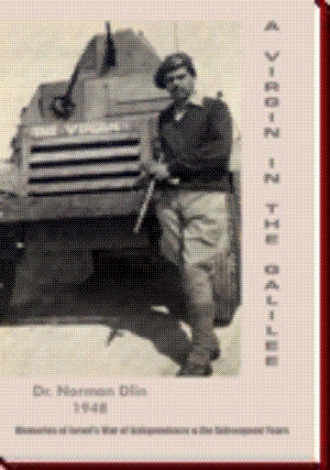
A Virgin in the Galilee
Memories of Israel's War of Independence & the Subsequent Years
by
Book Cover & Preview Text
If our travels up to this point were not excitement enough, our introduction to a DP camp was a major shock. There were, I’m sure, a few of us who had seen some of the horrors of war but the majority of us were not prepared to deal with life as it existed there. The camp was very large and divided by fences into compounds that housed DPs from all over
In our own time we located the building that contained the communal washstands and toilets which one could smell before entering the place. The washstands were all in a row against one wall. Opposite them were the toilets, holes in the cement floor with footprints to indicate where one placed one’s feet before squatting over the hole in order to take a crap. There were no doors to shut for privacy and only the presence of sidewalls prevented one from seeing who was occupying the compartments on either side. There was also no toilet paper available. We later learned that, as soon as toilet paper was put out it was removed by persons unknown so the powers that be had ceased giving it out. The result was the walls on either side of the toilets were marked by feces where people had wiped off their fingers in an attempt to clean their rear ends. Like all the rest of our group, I was disgusted and nauseated by what I saw and smelled. I immediately concluded that these Jews we were living among were less than civilized. Then on second thought it occurred to me that they had suffered at the hands of the Nazis and had lived for years like animals yet had somehow survived the horrors of the concentration camps, so what could one expect from them? The following day, after talking over the problem, we formed a work party and obtained some cleaning materials from the compound officials. The stinking mess inside the building was scrubbed away and the whole place disinfected until it was so clean one could almost visualize having a meal there. It looked and smelled great! But by evening it was as smelly and messy as it had been before. As a result, from that time until we left the camp for our next destination all our personal washing and our toilet needs were done in an open field.
During our stay in this camp we had reports of murders occurring each night within the various compounds. But, far more worrying to us was the scale of the theft there. In their long years in Nazi concentration camps, these people had also learned to steal anything that might improve their chances of survival, so theft had become a way of life to them. As a result, our luggage had to be guarded night and day.
Formats

Book Details
About the Book
This memoir details the author’s childhood, school years as well as his experiences in the Canadian Army. It goes on to relate his recruitment in 1948 to the Haganah,
He describes the twelve day journey it took to sail across the
The central focus of his memoir deals with his experiences in the Israeli army and life in that country as a Ph.D. candidate in Geography at The Hebrew University of Jerusalem as well as his visits to the country in subsequent years.
About the Author
Aside from serving as a volunteer in
Dr. Dlin has given many talks on
He has resided with his wife Deborah in