On the return journey, Tom Johnston dined us at the Station Hotel at Glasgow, and I set next to Harry Hopkins, an unkempt figure. After a time he got up and, turning to the P.M., said: “I suppose you wish to know what I am going to say to President Roosevelt on my return. Well, I’m going to quote you one verse from that Book of Books in the truth of which Mr. Johnston’s mother and my own Scottish mother were brought up: ‘Whither thou goest, I will go; and where thou lodgest, I will lodge; thy people shall be my people, and thy God my God.”’ Then he added very quietly, “Even to the end.” I was surprised to find the P.M. in tears. He knew what it meant.
Churchill and Hopkins arrived back in London on Saturday, January 18, in a snowstorm. The tireless Churchill and his gritty American guest immediately departed for Chequers, the prime minister’s official country residence, for the weekend. Hopkins met most of those closest to Churchill. Even before he had arrived at No. 10 Downing Street, he had made a courtesy call at the Foreign Office to meet Lord Halifax and Anthony Eden. At Ditchley Hopkins had met Professor Lindemann, Churchill’s interpreter of all technical matters, whether scientific or economic, who was as close to Churchill as anyone outside his family. On the train from London to northern Scotland Hopkins had traveled with General Sir Hastings Ismay, universally known as Pug, who was, throughout the war, the main channel of communication between Churchill and the chiefs of staff. The guests at Chequers on Saturday, January 18, and Sunday, January 19, included Admiral of the Fleet Sir Dudley Pound, Air Marshal Sholto Douglas, as well as Ismay and Lindemann.
Churchill clearly wanted Hopkins to meet those admirals and generals who directed the war effort, but he also wanted Hopkins to know his family, especially his wife, Clementine. She had been with Hopkins at Ditchley the previous weekend. They had journeyed together to Scapa Flow. She was Hopkins’ hostess his first weekend at Chequers where he also met two of the Churchill children, Randolph and Mary. Eric Seal, who was the duty private secretary at Chequers for the weekend, wrote of Hopkins, “He is really a very charming and interesting man.” After the war Robert Sherwood described Hopkins’ lasting impression of Clementine Churchill, “In Hopkins’ opinion, there was no doubt that the most charming and entertaining of all the people he met on those weekends was Mrs. Churchill.”
During his stay in Britain, Hopkins spent one weekend with Churchill at Ditchley and three weekends with him at Chequers. Of the first fourteen nights in Britain he had spent twelve of them with the prime minister. At least one memorable evening was spent without Churchill. On Wednesday, January 22, Lord Beaverbrook, the press baron and Minister of Aircraft Production, gave a dinner for Hopkins at Claridge’s. The guests were newspaper editors, writers, and managers. One of them left the following account:
We were all tired men, suffering from a succession of long nights, during which London had been bombed by explosives and incendiaries, and during which the difficulties of newspaper production had been extreme. But on that midwinter evening in the peak period of the first series of London blitzes we were also intensely curious men—which is the happiest and healthiest state for a journalist in any clime or circumstance. All of us were wondering as our cars advanced cautiously through the blackout toward Claridge’s…what Hopkins would have to say to us…
When the waiters had cleared the tables, the doors were closed, and Beaverbrook stood up, smiling. He addressed himself not to us, but to Harry Hopkins. For days, he said, Hopkins had been talking to members of the Government. But tonight was a yet more important occasion, for those present were “the masters of the Government” the leaders of the British Press. And so he invited Mr. Hopkins to speak to us.
Hopkins rose, looking lean, shy, and untidy, grasping the back of his chair, and he continued to look shy throughout his speech.
His words were private, so no notes were taken. But if it had been possible to record the sentences that came quietly and diffidently from the lips of Harry Hopkins, they would have compared well for nobility of expression with the splendid oration which Mr. Roosevelt had delivered two days earlier when he was sworn in for the third time as President of the United States.
Not that Hopkins repeated or even echoed the President’s speech. He talked in more intimate terms. Where the President had spoken of
Formats
Softcover
£8.99
£8.50
Softcover
£8.50
Book Details
Language :
English
Publication Date :
18/01/2005
Format :
Softcover
Dimensions :
6x9
Page Count :
104
ISBN :
9781418432164
About the Book
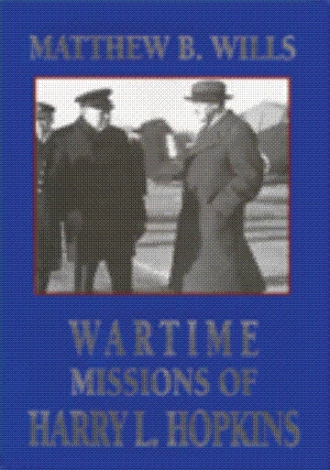
Wartime Missions of Harry L.
Hopkins describes two missions to see Churchill and two missions to see
Stalin.There are two unique features of
this book.It highlights the close,
personal relationship between Hopkins and Churchill, which all too often has
been overlooked and it examines the declining relationship that Hopkins had
with Stalin which began with such high hopes.
About the Author
The author did his undergraduate
work at Vanderbilt University.He
received his legal education at the University of Virginia and the University
of Colorado.After practicing law in
Colorado Springs for 32 years, he decided to devote his time and energy to
writing modern history.His first book, Wartime
Missions of Harry L. Hopkins was published initially in 1996.His second book A Diminished President,
F.D.R. in 1944 was published in 2003.He is currently working on a new book to be entitled, The Ambassador
and the Airman, the Roles of Joseph P. Kennedy and Charles A. Lindbergh
in the Munich Crisis of 1938.He and
his wife, Julia, reside in Colorado Springs.