
ANATOMY OF COMMUNICATION
by
Book Cover & Preview Text
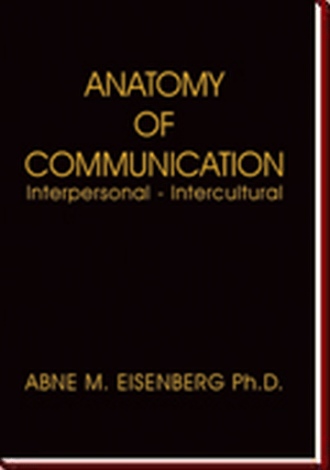
The cornerstone of this book
derives from the principle that people cannot NOT communicate. Whether it is
negative or positive, everything is a message, Ideas have also been voiced in these
pages that whether one is dealing with communication interpersonally or interculturally,
certain human traits are universal.
While these traits may be ameliorated or modified by certain cultural practices,
members of the human race share more similarities than differences. It is the similarities that should be afforded
a higher priority than the differences.
Formats

Book Details
About the Book
ANATOMY OF COMMUNICATION reveals
the fascinating details of how we use our minds, emotions, voices, eyes, facial
muscles, body gestures, dress, life style – in short, everything we are – to send
and receive hundreds of messages every day. We have evolved so many subtle techniques
for exchanging messages that we are seldom aware of them. This book shows how a
thorough knowledge of these techniques not only improves our ability to project
our own ideas, feelings and intentions, but our skill at Interpreting and
handling the messages beamed at us.
ANATOMY OF COMMUNICATION shows
you how to: compromise with a minimal amount of pain and maximum of success;
use your outer self to convey your Inner self; open new avenues of communication,
mend lines that have broken down, end cut off ones that only threaten disaster;
disagree without being disagreeable; use body language to state or reinforce
your meaning; put forth your own views in small groups; and cope with real one
from the various types of people; plus scores of other practical ways to
implement your day-to-day communication.
Designed so that you can note
your own experiences and reactions as you read, this exciting book also sets up
sample simulations with which you can practice the suggestions offered throughout.
Written with warmth and wit, it is a living example of the power of everything
within its covers.
About the Author
Having served on the faculty of
several universities for decades, Professor Eisenberg’s academic persona was
best captured by one book reviewer: “Eisenberg is not dull.” Eisenberg strongly
contends that what makes a textbook readable and comprehensible to students is
more a matter of
writing style than actual
content.
Professor Eisenberg sees himself as a teacher who writes,
rather than a writer who teaches. At
the heart of his teaching philosophy is the axiom: “Students are lamps to be
lit, not vessels to be filled.” In this
work, he successfully makes a
smooth transition from theory to
practice and, by so doing, fulfills the
prophecy that ideas do have consequences.
Likening communication to spokes on a
wheel, the professor seeks to gently rotate the reader’s mind from
spoke to spoke and make the anatomy of communication a dynamic and meaningful
interpersonal and intercultural tool.
Lastly, the author insists that knowing and doing speak
two different languages; knowing the alphabet doesn’t mean that people can spell, nor does having a
million-word vocabulary mean that they can
write an essay. Hence, the author offers up the contents of this book as a toolbox containing the means
with which to bridge the communication
gap that persistently threatens the
quality of life on this planet.