
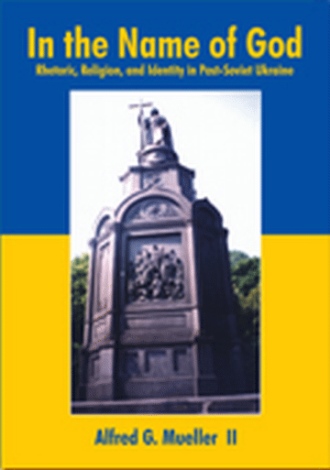
In the Name of God
Rhetoric, Religion, and Identity in Post-Soviet Ukraine
by
Book Cover & Preview Text
In May 1986, the number four
reactor at the
Still, what roused the Ukrainians’
indignation was not so much the accident as
What Ukrainian Communists had
become concretely and painfully cognizant of was, to paraphrase Marilyn Young,
“an omnipresent silent killer,”3 not the radioactive dust that Young
refers to, but the simple fact that Ukraine did not occupy a credible position
in the eyes of the Kremlin. As reports suggest, the Kremlin believed that
Ukrainians were not on a need-to-know basis, even though it was the Ukrainian
people who were facing radiation poisoning. This awareness spread over the next
five years among the Ukrainian people and led ultimately to a vote for
independence in December 1991. But before the vote was cast,
Formats

Book Details
About the Book
Focusing attention on Ukrainians’
quest for credibility in the post-Soviet era, In the Name of God takes readers on a journey through everyday life
in
Using interviews, on-the-ground
observations, and current events, Dr. Alfred Mueller establishes a solid grasp
of the issues facing Uniate Catholics as they
struggled against the Orthodox Church to establish themselves as a credible
community of believers. He plumbs
founding documents, oral histories, contemporary accounts, and popular lore
from both faiths to uncover the source of the rhetorical strategies each faith
is using to construct a particular ethos in Ukrainian society. His studies also enable him to explain why,
as we enter the 21st century, Uniate
Catholics seem to be in a better position than the Orthodox to vie for the
limited resources of the Ukrainian state.
The result is a fascinating study of the religio-political
nexus that has existed in
About the Author
Alfred G. Mueller II (Ph.D.,