
The Stronghold of Grace
Rethinking Spiritual Warfare in the Light of Grace
by
Book Cover & Preview Text
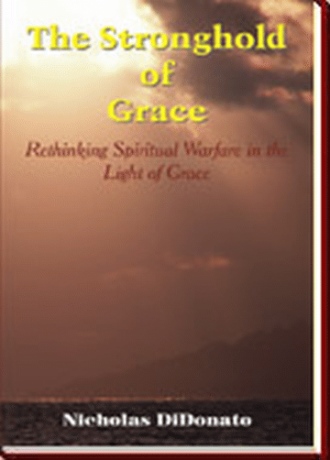
(Excerpt from the book): Spiritual warfare writers (e.g., Ed Murphy) acknowledge that a hedge (Job 1), the angels of God, and the shield of faith (Ephesians 6) do surround and protect believers. They conclude, however, that these levels of protection are dependent upon the spiritual and emotional health of those seeking safety…
One of the most significant implications of this teaching is that it paints the picture of a God who abandons those who are weak and downtrodden. If this is true, then at my weakest moment and my darkest hour, when I may lack emotional and spiritual maturity, God lifts His protection…
Scripture, however, presents God in a much different light. Psalm 34:18 teaches that “the LORD is close to the brokenhearted and saves those who are crushed in spirit.” God remains close to us when we are crushed and broken… Paul stated that Christ’s power is made perfect in weakness (II Corinthians 12:9). Christ comes into our suffering, anguish and distress, bringing comfort. He suffers with us…
In II Corinthians 1:8-9, Paul wrote:
“We were under great pressure, far beyond our ability to endure, so that we despaired [literally, to be utterly at a loss] even of life. Indeed, in our hearts we felt the sentence of death. But this happened that we might not rely on ourselves but on God.”
Paul was under such pressure that he, the apostle, was beyond what he could endure and despaired of life itself. When we despair, when we are pushed beyond what we can endure, when we come to the end of ourselves, God becomes our rock and our support... He does not just abandon us and remove his protection – even when we are emotionally distraught and spiritually feeble. When we walk through the valley of the shadow of death, we will fear no evil because God is with us (Psalms 23:4)…
(Excerpt from the book): It is important to note that in different cultures spirits are driven out by a variety of methods and practices. Hindu exorcism techniques include: blowing the smoke of cow dung on the possessed person, burning pig feces, pulling the victim’s hair, and pressing rock salt between their fingers. Jewish culture offers its own unique approaches. For example, first century rabbinical literature attributes mental disturbances and personality changes to demon (termed a dybbuk) possession. And what was the remedy for such spirit possession? A Jewish rabbi would expel such dybbuks through the victim’s small toe. Spitting on the victim was also a popular Jewish approach…
A crucial point to keep in mind is that whether we are talking about evil spirits such as pepos or dybbuks, possession or psychic attacks, exorcism through a small toe or dispelling spirits with cow dung, victims recover from their illnesses – even with psychic surgery!
(Excerpt from the book): God alone is the source of light. We have been delivered from the domain of Satan’s darkness…
We have met the enemy. He is real but he is not omnipotent, omniscient nor omnipresent. Let us make every effort not to exalt him or overestimate his powers, attributing to him what has already been taken from him. Let us understand what he really is - a defeated foe, a parasite that depends on God for his very existence. He is not God and is no match for God…
Through Christ’s grace, we are protected even at our weakest moments and in our darkest hours. The stronghold of Christ’s grace permeates all of our sin, even that sin hidden from our awareness. The stronghold of Christ’s grace intercedes on our behalf protecting us from Satan’s hand except when God, in His divine sovereignty, seeks to use the work of the enemy for holy purposes.
Even when we inadvertently do the devil’s work for him (e.g., Peter) and even when we fail miserably in sin (e.g., Paul in Romans 7), Jesus remains our stronghold of grace… It is the cross of Christ that makes all the difference: His shed blood covers us and His cross empowers us to stand up to the face of evil and triumph.
Formats

Book Details
About the Book
Many Christians believe that Satan can easily implant evil thoughts in their minds and will capitalize on every opportunity to harm them. Eight five per cent of the Christian community is said to be under direct satanic bondage with only those who are spiritually and emotionally healthy being able to ward off the devil.
But, is this really the case? Can demons implant thoughts and otherwise control Christians? Does God lift his protection when we are emotionally or spiritually unhealthy? In addition, are demons passed down from one generation to another? Can personal experiences of demonization be explained in other ways – such as Multiple Personality Disorder? What role might suggestion play? Most importantly, what difference does the cross and the blood of Christ make?
The Stronghold of Grace takes readers on a tour of spiritual warfare that includes a study of Scripture, experience, reason and tradition. It proposes that the predominant stronghold in our life is that bestowed by Jesus Himself - our stronghold of grace.
About the Author
Nicholas DiDonato holds an MA in Clinical Psychology from