
The Influence of American Crime and Violence on Colleges, Universities and Schools
by
Book Cover & Preview Text
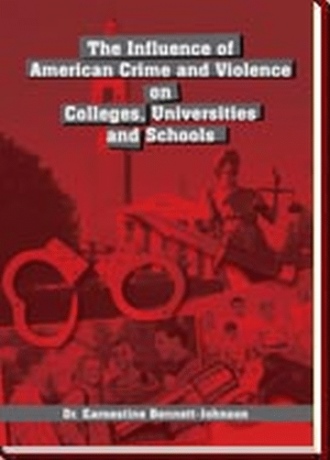
Crime in the United States began with the first European explorers and settlers to the new world. The rapes, thefts, assaults, vandalism, and murders of America are beginning to spill over onto the college/university and school campuses within the nation (Pessa & Bellotti, 1995). “Criminal victimization estimates in 2001 are the lowest since 1973; but campuses around the country still experience various types of crimes and violence. (Bureau of Justice Statistics [BJS]. September 2002. Criminal Victimization 2001: Changes 2001 01 with Trends 1993 2001. Washington, DC: U.S. Department of Justice.)” The United States Justice Department stated that violent crimes in America rose from 5.6% to 10.9 million (Bureau for Justice Statistics, 1994a). For violent crimes, that number appears to be on the decrease, although crimes in general are on the increase; especially within the inner city. Research suggests that crime, violence, delinquency and antisocial behaviors are not new. Statistically, however, it is on the increase in both the largest and smallest cities, in the suburbs as well as the rural areas. Young people are being arrested in ever increasing numbers (Cohen, 1977). Within those students attending the campus setting, are beliefs, attitudes and behaviors which may "predispose, enable, and reinforce violence" (Pezza & Bellotti,1995) (Bennett-Johnson, 2003). There are several major theories suggesting the cause of deviant behaviors. Theories suggest that antisocial behaviors are within the individual and are a matter of "free will"; on to theories indicating biological factors. Other theories suggest that antisocial and criminal behaviors may be caused by the person's immediate environment. It is also suggested that a childhood history of physical abuse predisposes the survivor to violence in later years. Victims of neglect are also more likely to develop later criminal violent behavior as well (Olsen & Widom, 1993).
Whatever the cause of these behaviors, they must be analyzed, and those with such behaviors must be counseled. There must be also be prevention, so these antisocial behaviors may decrease and diminish. The extinction of these antisocial behaviors is necessary. The terms within this book include: (1) crime, an act forbidden by law; (2) antisocial behavior, a way of acting which is opposed to the good of "society"; (3) violence, considered physical force usually resulting in harm; (4) deviance which "departs" or varies from what is considered unusual or normal; and (5) delinquent (usually associated with juveniles up to age 18) which is a person who breaks the law repeatedly or habitually. There are varying terms and degrees of what are considered negative behaviors. The antisocial behaviors discussed will be what society considers as crimes. These will include aggravated assault, robbery, vandalism, rape, theft, murder, etc.
The Bureau of Justice (1997) stated in its 1996 report, that persons between ages 12 and 15 and between 16 and 19 had higher rates of violent crime victimization that those older. The increase is continuing. What is even more astonishing is the number and types of crimes committed by those under the age of 12. Children under age 12 committed 1.6% of the nation’s crimes of violence (1997). In 1994, United States residents age 12 or older experienced 10.9 million crimes of violence as victims (Bureau of Justice Statistics, 1994a).
Fifty-seven percent of public elementary and secondary school principals reported one or more incidents of crime including murder, rape or some form of sexual battery, suicide, robbery, or physical attack with a weapon. Forty-five percent of elementary schools reported one or more violent incidents compared with 74% of middle and 77% of high schools. According to the National Center for Education Statistics (1998), schools which reported serious discipline problems were more likely to have incidents of crime and violence. The evidence of an increase in crime within the college age group of those 16-26 and those slightly younger adolescents nearing that age is overwhelming (Office of Juvenile Justice and Delinquency Prevention, 1996). In 1997, the Campus Crime Report indicated that some institutions reported large numbers of property crimes per student. For the 1996 Report on Crime to the Nation, colleges/universities reported 102,081 property crimes which included larceny-theft, motor vehicle theft and burglary.
Approximately one dozen colleges and universities reported more than 1,000 crimes during 1996, with the University of Michigan (Ann Arbor) reporting 2,002 property crimes. Crime exists on campuses and is an undeniable problem nation-wide. The study of American crime/violence is a significant one due to the nation’s violent crimes appearing at colleges/universities, and senior/junior high and elementary schools. It is also important due to the increase of juvenile crime. Because campuses are located within communities, crimes within those communities may “overflow” onto the college/university campus. Behavior which is either desirable or undesirable does not just happen. It occurs in response to some form of internal/external stimulation (Hall, 1951; Tolman, 1932).
Lederman stated that national crime data shows young people are becoming more violent and are increasingly likely to be involved in crime (Lederman, 1995). In the same article, Mr. Lizotte, professor of Criminal Justice was quoted as saying, “If you have people in high school who are doing drugs and carrying guns, some of those students are bound to end up attending college” (Lederman, 1995). Pezza and Bellotti (1995) suggested that if there is an increase in the number of those students, there may be an increase of criminal, violent, antisocial and deviant behaviors they will bring to the college and university campus environment (Pezza and Bellotti,1995).
Formats

Book Details
About the Book
“The Influence of America Crime and Violence on Colleges, Universities and Schools”, written by Dr Earnestine Bennett – Johnson, is a vast collection of research, statistics sand information concerning the history of America and College/University crime; theories of behavior; theories of crime; crime factor analyses; counseling approaches, and suggestive preventive plans for institutions. Companies can tailor these to make their workplace a safer and more productive environment.
About the Author
Dr. Earnestine Bennett-Johnson Bennett_Johnson@hotmail.com 8/11 – 9/11 Jefferson State Comm. College Birmingham, AL Instructor – Adult Education Program/GED Collaborative - State of Alabama Pardons & Paroles Division (Birmingham, AL) 9/05 – 05/11 Birmingham City Schools Birmingham, AL Case Manager, Special Populations (Mild/Moderate) 8/03 - 8/05 Orleans Parish School Board New Orleans, LA Instructor - Mildly/Moderately Disabled Students 8/01 – 05/03 Southern Univ. at New Orleans New Orleans, LA Interim Praxis & NTE Coordinator/Instructor 8/00 – 08/01 Univ. of Phoenix (Metairie Campus) Metairie/New Orleans, LA Instructor – Human Motivation Course 8/00 - 5/01 Orleans Parish School Board New Orleans, LA External Consultant Education Programs 8/94 - 12/99 Grambling State University Grambling, LA Graduate Teaching Assistant 1/77 - 8/94 Orleans Parish School Board New Orleans, LA Elementary, Middle School, High School, and Special Education (certified) Teacher 1/82 - 8/89 United States Army New Orleans/Baton Rouge, LA Intelligence Analyst