
Don't Just Stand There - Sell Something
by
Book Cover & Preview Text
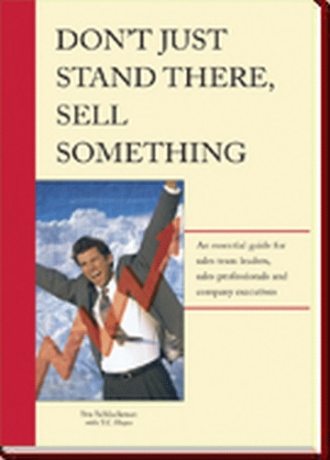
I remember a time in the not-too-distant past when many sales managers in high-tech industries had an easy job just tracking sales, updating forecasts and giving out awards to their overachieving sales reps. Many technology markets were new and the demand was much greater than the supply. Those were times when sales people could earn a living picking up purchase orders every week without really having to sell.
Perhaps times like those will roll around again – but don’t bank on it. In most industries today, competition is fiercer than ever, and customers are more knowledgeable and more demanding. Sales people need to be credible, convincing and capable. Sales managers need to be effective coaches, strong leaders, and competent managers. They need to understand the challenges faced by their sales teams and be there to help them succeed. There is no room for passengers, or for klinks.
A klink is an inept manager with limited management skills, no leadership talent, and the ability to get almost everything exactly wrong. Klinks have always been with us, but in today’s highly competitive environment they are more of a liability than ever before.
No one has to be a klink. Sales managers and team leaders can choose to be SMART instead. People can choose to do better – but only if they know that there is a better way, and if they know the traps to avoid. I wrote this book to try to help corporate sales managers who want to lead successful teams, sales reps who aspire to be sales managers, and executives who are responsible for recruiting sales managers.
Everything in this book is based on my years of experience as a sales rep, as a sales team leader, and as a sales trainer in the world of telecommunications and computer software, hardware and services. But the messages are relevant to anyone who is involved in business-to-business technology or solution sales at any level and in any industry. I started out as an engineer, not as a sales person, and I admit that at first I didn’t really appreciate how vital a role sales people played. As a sales person, I soon found out that being in sales was more challenging and frustrating than I had imagined. But I also learned that sales can be exciting, interesting and worthwhile.
To be successful, businesses need effective sales people. To be effective, sales people must have good leaders. What qualities does a good sales team leader need today? Having toiled over twenty years as a sales professional, I believe I have some answers to that question. And that’s why I wrote this book.
Stu Schlackman, July, 2004
* * *
Being SMART in Sales Management
Not all managers are klinks. Some are SMART. I use the acronym ‘SMART’ for the five areas in which people need to excel to become outstanding sales team leaders:
- Skills: being expert in the skills that your team needs to sell successfully, and being able to coach your team in those skills.
- Motivational Management: directing and controlling day-to-day activities of the team, and motivating them to perform their best.
- Attitude: bringing a positive, supportive and success-oriented leadership approach that stimulates and motivates team members.
- Relationships: building sustainable, trust-based relationships with team members, customers and business partners.
- Thinking: applying brain cells to the planning and organizing the team and its work.
Skills, Motivational Management, Attitude, Relationships, Thinking: get all five right, and you’ve got what it takes to become a SMART sales manager or sales team leader.
Each one of these topics is discussed in a separate chapter later in this book. Naturally, life is not always as convenient and nicely packaged as we sometimes hope, and I’ve chosen to present the chapters in a more logical order: Attitude, Skills, Relationships, Thinking and Management. This spells ASRTM. Please don’t look it up. It’s not a word.
Attitude and Skills provide the foundation for all sales activities. Those need to be in place to provide a foundation for building Relationships, which lies at the heart of the business. Thinking and Managing go together – broadly this is about planning, then doing, preferably in that order.
Sales is not an easy profession to succeed in. Being a sales manager is every bit as challenging and demanding as being a sales person in the field. (Sales managers have one big advantage over sales reps: a sales manager finds it easier to blame other people when things go wrong.)
But as in so many other walks of life, when you make it as a SMART sales manager, it’s exhilarating, rewarding, and worth the struggle. In this book I aim to give you insights into SMART behavior and attitudes, so you and your team can do more things better. At the same time I’d like to warn you against the sort of behaviors and attitudes that characterize the klinks among us.
Formats

Book Details
About the Book
Don’t Just Stand There - Sell Something is a thought-provoking and fun guide to sales and sales management. In his twenty-plus years in sales Stu Schlackman has worked with some of the best, and worst, sales managers around. In Don’t Just Stand There - Sell Something, Stu draws on this experience to review the state of sales management today and applies his own critical perspective to the business of selling to businesses.
Stu introduces SMART, five focus areas for every sales manager: Selling Skills, Motivational Management, Attitude, Relationships and Thinking. Stu relates opinions, facts, stories and sound advice as he explains what works and what doesn’t work; when to act, and when to stay out of the way; and how to build a team where everyone succeeds.
Along the way, Stu takes an amicable swipe at the type of sales manager who exhibits the worst characteristics of the profession - the ‘klink’. Klinks are sales managers who range in capability from inept to dangerous. They are useful – as a warning to others.
The book is filled with to-the-point practical advice and insights aimed at everyone involved in business-to-business technology or solution sales at any level and in any industry.
About the Author
Stu Schlackman has been in sales, sales management, and sales training for more than twenty years. Stu has a degree in Mechanical Engineering from Rensselaer Polytechnic Institute and an MBA from