
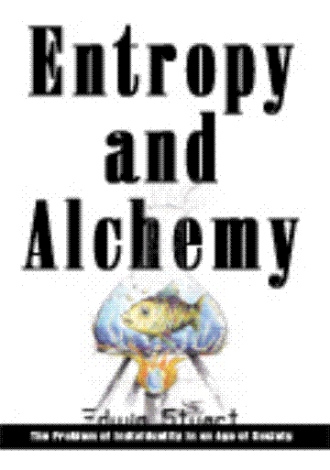
Entropy and Alchemy
The Problem of Individuality in an Age of Society
by
Book Cover & Preview Text
Chapter
One: The Decline of Individuality
1. Water Bearer on the Bridge
The freeway is choked with
stop-and-go commuter traffic, and there I am, praying for deliverance from this
daily dread, this gnashing of teeth and mashing on the pedals, this wear and
tear and swearing in vain. It doesn’t
help that many of the other drivers look fairly comfortable in their
climate-controlled compartments, listening to soothing music, when those of us
in the older cars must listen to the noise and smell the fumes. How sweet it is. As we creep forward, my gaze is fastened on the brake lights in
front of me, but suddenly I am distracted by a young man on the pedestrian
overpass just ahead. He is leaning
against the screen and urinating an impressive stream down onto the fast
lane. I stop praying for deliverance
and start praying for a gun. Then I
think: Wait a minute. Maybe he’s trying
to tell us something, something we should know?
I’ve had a frustrating day at
work, swallowing my pride and suppressing anger at my boss who is a fool. I give in to the temptation to wait out the
rush hour and relax with a few drinks at a nearby bar. On the way home, I'm pulled over by the police
for having a cracked windshield. (The
state police were asked to patrol the city expressways, after several incidents
where a stopped motorist was robbed or raped, and of course they immediately
started giving out many tickets for minor traffic infractions.) In the glare of their spotlights and
flashing red lights, I produce various documents, have my breath analyzed by a
device which determines me to be "under the influence", and suddenly
I'm a criminal. I try to console
myself: Well, if society says that I'm a criminal, what does that say about
society?
One morning I'm running on
Detroit's Belle Isle and I notice the island is swarming with police. At a certain location I've passed once
already, one of them tells me to stop and turn around. When I approach to ask him what is going on,
he pushes me roughly against a car and frisks me, even though I'm wearing
shorts and a T-shirt. I find out later
from another policeman that they’re using the public park for a terrorist
training exercise, and I could have been one of the "terrorists"
disguised as a jogger. That makes me
wonder: What if real terrorists had been trying to take over the park for some
insidious purpose? How would the rude
officer have dealt with me in that situation?
I move to Fort Wayne, Indiana,
which I figure will be a low-keyed, easygoing place to live. Shortly after my wife starts waitressing at
a new restaurant in town, I receive a call one morning from the restaurant to
find out if she can come in and get-- what sounds like--
"zonned". I tell the young
woman that my wife isn't home and then add, "You want her to get
what?" She nonchalantly explains,
"It's this lie detector thing we have here." I express doubts as to whether such a
procedure is completely legal, and she assures me that its legality has been
verified and that it's not compulsory.
When my wife comes home I give her the message, but she doesn't seem
very concerned. I decide to call the
Indianapolis office of the ACLU, since there is no local branch, but the person
who answers informs me that they're all in a meeting and she doesn't think they
would be able to help me anyway. I
start asking myself: If the ACLU doesn't care, if my wife doesn't care, why
should I care?
I'm going to describe the direction I think society
is headed in, based on such glimpses as the above incidents provide (the second
of which did not really happen to me), and if I exaggerate to a certain degree,
you'll have to excuse me. I'd rather
cry "wolf", even though it may only be the sheep dog, rather than see
us meekly herded to some purpose or destination we're not fully aware of. To start off, the little preceding sketches
might be interpreted by captions that would go something as follows:
1. There are
too many commuters, too many cars, too many of everything, and too little
room. Everyday we see all these people
whom we know nothing about and they know nothing about us. We may not even pay any attention to them,
unless they get in our way or do something else to make us notice them. We think of ourselves as individuals and
each of them as just one more nameless face in the crowd, but to them, it's the
other way around.
2. We have
certain social problems that are often misdiagnosed and treated as criminal
problems. In the case of drinking and
driving, for example, we single out as the culprit the condition of having a
certain percentage of alcohol in one's blood, something which is neither a
necessary nor sufficient condition of hurting someone with a car, and worse--
is not even overt behavior.
3.& 4. Our huge, anonymous society has a high rate of crime in which the criminals come in so many shapes, sizes, and guises that all of us must be watched, checked out, and regarded suspiciously. The worst is terrorist type crime,
Formats



Book Details
About the Book
The Age of Pisces is dying, and the figure of Jesus
no longer serves as an example on how to lead our lives. We are in the early stages of Aquarius and
still trying to figure out what it all means.
Philosophically these are hard times, sort of like the saying, “Brother,
can you spare a paradigm.”
The Astrological Ages always involve a polarity
between opposite signs-- in this case, Aquarius and Leo. “Entropy” is a metaphor for the lower side
of The Age of Society (Aquarius), while alchemy is our collective
progress. The past few centuries have
seen the great social and technological advances that are the hallmark of
Aquarius, but they have been accompanied by cultural decay and a loss of
symbolic meaning and true individuality.
Instead we see a near obsession with superficial
forms of self-expression (the lower side of Leo), which may be a reaction to
the increasing uniformity and pervasive organization of Aquarius. Other cultures react against the impersonal,
secular modernity of Aquarius with a fervent religious fundamentalism or blind
loyalty to an undemocratic Leo-like leader; but in either case, resolving this
dichotomy between Aquarius and Leo, society and the individual, is one of the
keys to civilization’s future.
About the Author
Edwin Stuart lives in Eugene, Oregon.