
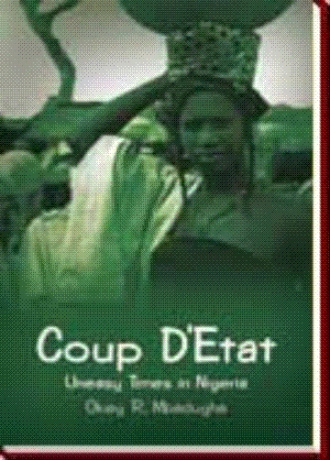
Coup D'Etat
Uneasy Times in Nigeria
by
Book Cover & Preview Text
The politicians had absolutely no sense of
discipline; neither in financial matters nor in personal conducts. The Nigerian
politicians began to express their independence by reaching out to other
countries including China and the Soviet bloc countries. Such a fine woven mutually interdependent
economic arrangement thwarted by a few upstart politicians with questionable
credentials from American universities.
Who is to say what will happen there next?
Whatever develops in Nigeria were of interest to
certain powerful business interests in London. These business interests were
determined not to sit idly by while their former colonial outpost became the
hunting grounds for such upstart nations like South Korea. Pressure was therefore brought to bear on
the Foreign Minister to see to it that the British grip on Nigeria was not
lost.
“What will all this lead to?” questioned Lord
Timothy in a House private session with the Foreign Ministry staff. It was learned that Nigeria had signed a
defense pact with a certain Asian Islamic Republic without consultations with
the British Foreign Ministry. “At least for the sake of decency and as an act
of friendship to us, considering that we were gracious enough to bestow
independence on them without rancor.
Surely, they must understand that we have their best interests at
heart.”
“You may be expecting too much from these people”,
retorted Lord Fisher, one of the oldest members of the Lords. “We should have better prepared them for our
own system of government. You cannot
expect them to be able to operate a parliamentary system of government from a
background of colonial tutelage. These things take time. Besides, they are
entitled to associate with whomever they wish to associate with. It is their prerogative, certainly.”
Lord Timothy had already fallen asleep and all the
persuasive logic of Lord Fisher was lost on him. He took no further interest in the proceedings and there the
matter rested It was the consensus of
the general House that the matter be looked into by Lord Lindsey Happleworth,
who was expected to intervene in the matter and take any appropriate actions
needed to redirect the polity of Nigeria towards the British fold. Coming to the Colony Club to meet the Nigerian
group this afternoon was part of the facts finding mission and Lord Happleworth
made it quite clear that he would rather be somewhere else.
“We have, my lord, squid marinated in parsley and
onion soup; choice steak of swordfish barbecued in charcoal; a choice of fresh
home grown vegetables; and buttered potato pudding,” announced the butler,
hoping that Lord Happleworth was impressed with the austerity of the luncheon
served at the club. It was generally known that Lindsey Happleworth was not one
of your ferocious feeders. He ate right and rarely touched alcoholic beverage;
which is why he was not shown the wine list.
Besides, it was the policy of the club not to serve alcoholic beverages
except in rare festive occasions.
Announcing the menu for the afternoon was mostly a
matter of formality. The club chef had
obtained the menu from Lord Happleworth’s personal cook. Food was very
important to the Lord and he was not very fond of surprises. He and Lady Sarah Happleworth were known to
send their choice of meals ahead to any affair they were expected to attend in
where food was part of the agenda.
To day, lunch would be served at one o’clock
sharp. Lord Happleworth arrived half an
hour early in order to read the profiles of the men he was going to eat lunch
with. He reached into his briefcase and
produced a manila envelope enclosing the briefing, which the staff at the
foreign office had prepared for him. He was scheduled to meet and eat lunch
with the Honorable William W. Wilberforce, Minister for foreign affairs, Alhaji
Sarkin Yaki, the premier of Northern Nigeria, Chief Afolobi Adisa, premier of
Western Nigeria, and Chief Nathaniel Obi, the premier of Eastern Nigeria. An
asterisk was placed after the name of the premier of Eastern Nigeria as a
warning that he was the troublesome lot.
Formats


Book Details
About the Book
Coup D’Etat is a work of fiction based on real
events that actually took place during the turbulent years after independence
to the complete break down of law and order in Nigeria. These events took place
from the years 1960 when Nigeria obtained independence from Britain to 1966
when law and order broke down in many parts of Nigeria.
The journey towards chaos in Nigeria resulted from
power struggles between the regions as existed at the time. This book attempts
to capture some of the behind-the-scenes maneuvers of the various actors
including the British Government, the erstwhile colonial power in Nigeria.
This book has a very powerful historical
significance. To really understand the root causes of the past and present
problems of the Nigerian polity, this book is a must read.
About the Author
Okey R. Mbadugha was born in Calabar, in Eastern
Nigeria. He lived in Kano, Northern Nigeria and attended primary schools in
both places. He finished his secondary education in Onitsha, in the then
Eastern Nigeria. He worked briefly for the National Library of Nigeria in Lagos
before leaving Nigeria for further studies overseas. He obtained the Bachelor
of Arts degree in Economics and Mathematics from Cuttington College, Liberia
and a Doctorate in Management Science from the University of California,
Irvine, California, USA.
Okey Mbadugha taught Management at the universities
of Dar Es Salaam, Tanzania, East Africa and Nigeria, Enugu Campus, Nigeria, and
at the New York Institute of Technology as Adjunct Professor in the School of
Management. He has lived in the Ivory
Coast, Sierra Leone, and traveled extensively in East and West Africa.