
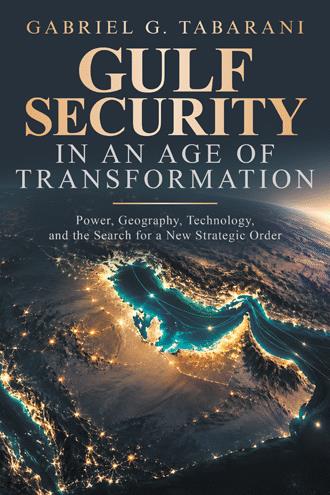
GULF SECURITY IN AN AGE OF TRANSFORMATION
Power, Geography, Technology, and the Search for a New Strategic Order
by
Book Cover & Preview Text
When Protection Is No Longer Enough For decades, the strategic geography of the Gulf appeared deceptively simple. Oil flowed outward, military protection flowed inward, and between the two stood a security system whose ultimate guarantor was the United States. The arrangement survived revolution in Iran, an eight-year Iran-Iraq War, Saddam Hussein's invasion of Kuwait, two American wars in Iraq, jihadist terrorism, the Arab uprisings, and repeated crises over the Strait of Hormuz. It was imperfect, frequently contested, and extraordinarily expensive. But judged by its most basic purpose—the survival of the Gulf states and the uninterrupted integration of their energy into the world economy—it worked.¹The problem is that the Gulf it was designed to protect no longer exists.The skylines provide the most visible evidence. Cities once known internationally for oil terminals and government compounds have become centres of aviation, finance, logistics, tourism, advanced industry, digital infrastructure and global investment. Saudi Arabia is undertaking one of the most ambitious economic transformations in its modern history. The United Arab Emirates has turned connectivity itself into a source of national power. Qatar has converted energy wealth into financial, diplomatic and political reach disproportionate to its size. Across the Gulf, governments are investing in artificial intelligence, data centres, advanced manufacturing, new energy systems, ports, airlines, defence industries and cities designed to compete globally for capital and talent.²This transformation has made the Gulf wealthier, more capable and more consequential. It has also changed what it means to defend it.A modern Gulf state can preserve its borders, government and armed forces and still suffer a strategic blow. Electricity can be interrupted. Desalination plants can stop. Ports can be paralysed. Financial networks can be attacked. Airports can close. Submarine cables can be severed. Oil may remain safely underground while the systems required to process, transport, insure, finance or export it cease to function.This is the central paradox of Gulf modernization: the same connectivity that creates power also creates vulnerability.The attack on Saudi Arabia's Abqaiq and Khurais facilities in September 2019 offered an early glimpse of this new strategic reality. No army crossed the Saudi border. No city fell. No territory changed hands. Yet drones and cruise missiles temporarily removed roughly half of Saudi oil production and about 5 per cent of global supply. The physical damage mattered, but the strategic message mattered more. A relatively limited strike against carefully selected infrastructure could produce consequences extending from an industrial facility in eastern Saudi Arabia to energy markets around the world.³There was another lesson, however, that received less attention. Saudi production recovered with remarkable speed.⁴That mattered because it revealed the other half of the security equation. Vulnerability alone does not determine strategic weakness. What matters is whether disruption can be converted into paralysis—and whether paralysis can then be converted into political coercion.That distinction lies at the heart of this book.For most of the twentieth century, Gulf security was conceived primarily in territorial terms. Armies defended borders. Air forces protected airspace. Navies secured sea lanes. Alliances deterred invasion. The underlying question was straightforward: Who can prevent an adversary from conquering or coercing the state?That question has not disappeared. But another has been added to it:Who can keep the state functioning when deterrence fails?The distinction between territorial security and functional security is more than semantic. Territorial security protects the physical state. Functional security protects the systems that allow the state and society to continue operating. The two increasingly overlap, but they are not identical. A missile intercepted over a city is a success of territorial defence. A power network designed so that one successful missile cannot shut down an entire metropolitan area is an achievement of functional security. One seeks to prevent the blow. The other seeks to deny the attacker its intended consequences.For the Gulf states, this changes the meaning of national power.It also changes the meaning of dependence.The Gulf's dependence on external protection did not arise from strategic naïveté. It was a rational response to an extraordinary imbalance between wealth, population, geography and military power.Britain had provided the external framework for Gulf security for generations. When London announced its withdrawal from east of Suez, the United States gradually inherited a strategic environment in which the security of energy flows became inseparable from American interests. The Iranian Revolution of 1979, the Soviet invasion of Afghanistan, the Iran-Iraq War and, above all, Iraq's invasion of Kuwait in 1990 progressively transformed that strategic interest into an enduring military architecture.⁵The bargain suited both sides. The United States acquired access, bases and influence at the centre of the world's energy system. Gulf monarchies obtained something their demography and geography made extraordinarily difficult to generate independently: an external military power capable of deterring or defeating much larger adversaries.⁶For decades, therefore, the defining question of Gulf security was essentially a question about America: Would Washington come when it was needed?The answer was sufficiently credible to become one of the foundations upon which Gulf prosperity was built. That architecture remains indispensable. No other external power presently possesses the combination of military capabilities, intelligence, logistics, command structures, bases, naval reach and political relationships necessary to reproduce the American security role in the Gulf.⁷But indispensable is not the same as sufficient.
Formats

Book Details
About the Book
Who would protect the Gulf? For generations, the security of the Arabian Gulf was defined by the power of others. The region was threatened by one state, protected by another, and repeatedly reshaped by conflicts whose consequences extended far beyond its shores. Today, the Gulf is different. The Gulf states have accumulated extraordinary economic resources, built world-class infrastructure, expanded their military capabilities, invested in technology and connected themselves to the world through energy, finance, trade, aviation and logistics. Their diplomatic reach has widened, and their influence now extends far beyond the region. Gulf Security in an Age of Transformation examines how security in the Gulf should be understood in this new era - an era defined not only by traditional military threats, but also by critical infrastructure, technology, economic interdependence, strategic geography, external partnerships and a changing regional order. Drawing on five decades of experience as a journalist and analyst, Gabriel G. Tabarani offers a clear-eyed and authoritative analysis of the opportunities and vulnerabilities that shape the Gulf’s future. He shows how the states of the region are moving from a reliance on external protection towards greater strategic agency - seeking not only to defend themselves, but also to shape their own destiny in a more complex and uncertain world. The age of protection is not over. But protection is no longer enough.
About the Author
Gabriel G. Tabarani is a journalist, editor and author who has spent more than five decades observing, reporting on and analysing the political and strategic affairs of the Middle East and North Africa. He studied Political and Economic Sciences at Saint Joseph University in Beirut and began his journalistic career in 1973 with the pan-Arab magazine Al-Hawadess in Lebanon, later becoming its Washington, D.C. correspondent. After moving to London in 1979, he joined Al-Majallah as Deputy Managing Editor. In 1984, he became Managing Editor of Assayad and later its Editor-in-Chief. In 1990, he joined Al-Wasat, part of the Dar Al-Hayat Group, as Managing Editor. He subsequently became Editor-in-Chief of Miraat el-Khaleej (Gulf Mirror) and, in 2012, Editor-in-Chief of Asswak Al-Arab (Arab Markets). During a career spanning Beirut, Washington and London, Tabarani has followed many of the events that transformed the modern Middle East: the Lebanese conflict, the Iranian Revolution, the Iran-Iraq War, the Gulf wars, the Israeli-Palestinian conflict, the rise of political Islam, the post-9/11 period, the Arab uprisings, and the emergence of the Gulf states as increasingly influential regional and international actors. His work has brought him into contact with political leaders from the Middle East and beyond, including U.S. President Bill Clinton, British Prime Minister Margaret Thatcher, King Hassan II of Morocco, King Hussein of Jordan, Sheikh Zayed bin Sultan Al Nahyan of the United Arab Emirates, Yasser Arafat, Rafic Hariri and other political figures. In 1992, he wrote and serialised the memoirs of former U.S. National Security Adviser Robert McFarlane in Al-Wasat over fourteen instalments. McFarlane subsequently published his memoir, Special Trust, in 1994. Tabarani has written thousands of articles, most of them in Arabic, on Middle Eastern politics and international affairs. He is the author of five previous books: • The Tears of the Horizon; • The Winter of Discontent in the Gulf (1991), examining the Gulf crisis and war following Saddam Hussein’s invasion of Kuwait; • Israeli-Palestinian Conflict: From Balfour Promise to Bush Declaration: The Complications and the Road to a Lasting Peace (2008); • How Iran Plans to Fight America and Dominate the Middle East (2008); and • Jihad’s New Heartlands: Why the West Has Failed to Contain Islamic Fundamentalism (2011). His professional experience has given him a perspective on the Gulf that extends across more than half a century of political and strategic change. He observed a period in which the Gulf states depended heavily on external protection and has followed their transformation into states possessing far greater economic resources, infrastructure, military capabilities, technological ambitions, diplomatic reach and international influence. Gulf Security in an Age of Transformation draws upon that long engagement with the region while addressing a fundamentally contemporary question: how should Gulf security be understood when the states themselves—and the sources of both their power and their vulnerability—have changed so profoundly? The book brings together Tabarani’s experience of the region with extensive research into military security, critical infrastructure, technology, economic interdependence, strategic geography, external partnerships and regional order. It reflects a conviction formed over decades of observing Middle Eastern politics: power is most meaningful when it preserves a state’s capacity to make its own choices under pressure.