
The Little Bones Women
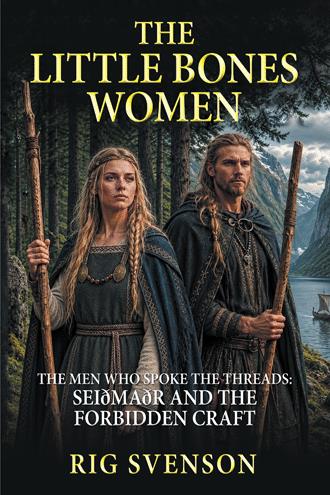
The Men Who Spoke the Threads: Seiðmaðr and the Forbidden Craft
by
Book Cover & Preview Text
The Origins of the term “Dark Seiðr” For transparency, the expression “dark seiðr” is not an Old Norse term and cannot presently be traced to Viking-Age speech, poetry, law or ritual vocabulary. It is essentially a modern English rendering of the Swedish scholar Dag Strömbäck’s svart sejd or “black seiðr.” Strömbäck introduced the distinction systematically in his influential 1935 doctoral dissertation, Sejd: Textstudier i nordisk religionshistoria. One section was explicitly entitled “Vit och svart sejd”—“White and Black Seiðr”—and occupied pages 142–159. He described divinatory seiðr as vit sejd, “white seiðr,” in contrast with den förgörande “svarta” sejden: the destructive or annihilating “black” seiðr. According to Strömbäck’s classification: 1. White seiðr was primarily divinatory. It uncovered concealed matters, investigated the future and provided knowledge concerning harvests, famine, weather, personal fortunes and approaching events. 2. Black seiðr was directed towards interference and destruction. It could cause fear, mental confusion, longing, melancholy, madness, bodily illness, misfortune and death. It could distort perception, weaken an opponent, damage prosperity or attack the victim through an externalized magical agency. Swedish lexicographical tradition subsequently adopted this distinction, defining vit sejd as seiðr performed for prophecy and svart sejd as seiðr intended to injure or destroy. However, Strömbäck did not recover two named Viking-Age schools of magic. He created a scholarly classification through which a scattered and contradictory body of saga material could be organized. Neither hvítr seiðr nor svartr seiðr appears as a clearly established technical category in the medieval sources. Modern scholarship consequently warns that the sharp division between “black” and “white” magic represents an analytical framework imposed upon the evidence rather than an actual Norse system of classification. The distinction also reflects the intellectual environment in which Strömbäck worked. Early twentieth-century scholars frequently divided magical and shamanic practices into “white” and “black” forms: beneficial or socially approved activity on one side, harmful and antisocial sorcery on the other. More recent researchers regard this binary division as potentially misleading because the same practitioner, method or ritual power might be used to discover the future, protect a household, curse an enemy or influence a battle according to circumstance. Neil Price later argued that the aggressive dimension of seiðr extended considerably beyond Strömbäck’s simple division. The surviving material includes not merely private cursing but the deliberate creation of terror, confusion and immobility among enemies; attacks upon weapons and amour; supernatural combat; protection against hostile sorcerers; and magical participation in organized warfare. Price therefore described a field of violent and military sorcery that went “far beyond” the older black-and-white classification. Thus, for historical accuracy, the preferred statement would be: “Dark seiðr,” more accurately Strömbäck’s “black seiðr,” is a modern scholarly category first systematically developed in 1935 to describe the destructive, coercive and psychologically aggressive operations attributed to seiðr in the medieval sources. It was not a name used by Viking-Age practitioners themselves. The term remains useful, but only when clearly labelled as Strömbäck’s interpretive classification, not as recovered tenth-century terminology.
Formats


Book Details
About the Book
The Men Who Spoke the Threads: Seiðmaðr and the Forbidden Craft explores the neglected role of male practitioners within the complex and often dangerous world of early Scandinavian seiðr. Moving beyond modern romanticism and simplified interpretations of the Eddas, Rig Svenson examines saga evidence, folklore, archaeology and ritual tradition to recover the seiðmaðr as prophet, sorcerer, healer and worker of war-magic.The book investigates forbidden rites, ritual platforms, staffs, chants, spirit-working and the manipulation of fate, while challenging the assumption that seiðr belonged exclusively to women. Dark, provocative and rigorously argued, it presents a forgotten tradition in which knowledge carried power, social danger and sometimes deadly consequences.
About the Author
Rig Svenson is an independent researcher and author exploring the neglected traditions of early Scandinavian magic. Drawing on saga literature, folklore, archaeology and comparative study, he challenges modern romanticism and invented lineages. His latest work restores the seiðmaðr to the darker history of seiðr, fate, warfare and forbidden ritual practice.