
EGZISTENCE UNLOCKED
A Universal Unitary Philosophy of Existence
by
Book Cover & Preview Text
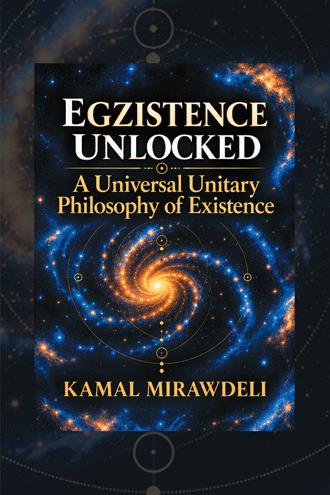
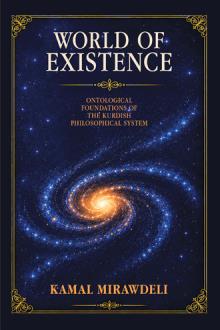
This book presents a comprehensive and original metaphysical system called the Kurdish Ontological Philosophy of Existence, developed by Kamal Mirawdeli. It articulates existence as a self-giving, cyclical, and renewing process grounded in the phonetic/phonemic affinity and semantic structures of the Kurdish words Xoda and Ezda. The system integrates ontology, epistemology, ethics, language, consciousness, cosmology, culture, and identity into a unified framework that challenges Western metaphysical paradigms by rooting existence in phonetic reality of lived experience rather than abstract conceptualism or theological constructs. Foundations of Kurdish Phonetic Ontology At its core, the ontology begins with XODA, the self-giving being, composed of "xo" (self) and "da" (to give), which signifies existence as continuous, unconditional givenness without intention or design. This principle replaces the idea of a creator deity with an ontological ground where being and giving are identical. The fundamental act of Da is the primordial event that allows anything to appear, preceding space (Dan), structure (G), motion (Z), life (J), consciousness (EZDA), and renewal (Zawûzê) . The ontology unfolds through a sequence of interrelated principles: Kurdish Ontological Concept Core Function Comparable Western Concept Philosopher Xoda Self-Giving Being Substantia Baruch Spinoza Da Giving / Manifestation Energeia Aristotle Ezda Conscious Existence Dasein Martin Heidegger Zan / Zandan Knowing-as-Being Logos Plato Mak Measure / Order A priori forms Immanuel Kant GZ (Soul-Motion) Self-Moving Life Conatus Baruch Spinoza Zawûzê Eternal Regeneration Becoming (Werden) Friedrich Nietzsche Asa / Asha Ethical Order Natural Law Classical Philosophy Soz Relational Bond Eros / Agape Greek & Christian Ethics Xwe Self / Measure Ipseity Modern Phenomenology This table illustrates how Kurdish phonetic concepts correspond to and expand upon classical Western philosophical ideas, yet remain distinct in their grounding in phonetic ontology . Ontological Principles and Processes Da: The Origin of Giving Da is the unconditional openness that allows existence to manifest. It is amoral and continuous, giving life and death without intention, and forming the ethicalbasis of care, justice, and harmony through shared givenness . G: The Structure and Identity of Being G functions as the silent architect of existence, providing form, coherence, boundaries, and continuity. It shapes biological, cognitive, cosmological, and ethical dimensions, stabilizing the dynamic forces of existence . Z: The Pulse of Life and Becoming Z represents motion, birth, activation, knowledge, and transformation. It animates structure, driving growth, emergence, and intensity. Z is morally neutral and requires ethical balance to prevent destructive outcomes . J: Lived Experience and Embodied Life J transforms aliveness into embodied experience, desire, emotion, and biography. It grounds ethical life in care (Soz), justice (Dad), measure (Asa), and cosmic truth (Asha), connecting intimately with meaning and narrative . Mak and Dan: Form and Space Mak is the crystallized form of life, thought, culture, and identity, while Dan is the structured, meaningful space that hosts forms. They are mutually constitutive, exemplified by phenomena such as the womb (Zêdan), where form and space co-adapt. The dynamic interplay of Mak and Dan underpins language, culture, consciousness, and ethics . Zawûzê: Eternal Regeneration Zawûzê is the cosmic principle of renewal, rebirth, and transformation that ensures existence is an eternal cycle. Death is not negation but transformation, opening pathways to continuous becoming across cosmic, biological, cultural, and ethical realms . Knowledge, Language, and the Reciprocal Creation of Space The principle of Zanning–Danning describes the co-creative loop where knowledge (Zanning) births new existential space, and new space (Danning) generates further knowledge. This recursive process drives evolution, culture, consciousness, and ethical development. Language (Ziman) is both a form and space of knowledge, with grammar corresponding to structure (G) and speech to motion (Z). Metaphor embodies linguistic renewal (Zawûzê), enabling conceptual innovation . Consciousness, Selfhood, and Ethics X: Awareness and Meaning X is the inner light of consciousness, selfhood, measure, and interpretation. It illuminates existence, making life meaningful and ethical by integrating self-measure (Xwê/Xud), love (Xoshewistî), learning, and restraint. It completes the triad with structure (G) and motion (Z) to transform life into purposeful being . Xwê/Xud: The Dynamic Self The self is a dynamic architecture arising from G, Z, X, knowledge, and ethics. It contains layers of self-being, self-knowledge, self-will, and self-restraint. Social relationships and language shape identity, while trauma can fragment the self. Healing through reflection and narrative expands Xwê/Xud and supports ethical life . Ethical Foundations Ethics emerges intrinsically from the structure of Being and awareness, grounded in five interdependent forces: • Soz: Care and relational warmth • Xwê/Xud: Self-measure and balance • Dad: Justice and fairness • Asa: Natural order and ecological proportionality • Asha: Cosmic truth and universal alignment These ethical pillars regulate existence’s dynamic forces, sustaining harmony and flourishing . Life, Memory, Time, and History Life (Jiyan) is the experiential actualization of Being, encompassing sensation, desire, joy, suffering, love, and struggle. Death (Mrîn) completes life’s cycle, leading to renewal. Memory is ontological persistence across biological, emotional, cultural, and cosmic layers, essential for coherent identity and culture. Time arises relationally from structure, motion, and awareness, unfolding in a helical spiral rather than linear fashion. History is the narrative of Being’s becoming, shaped by human consciousness. Trauma disrupts memory and shrinks temporal space, while healing restores renewal . Culture, Community, and World-Making Culture is a collective architecture of meaning formed by structure, motion, awareness, language, shared space, and identity. Community is a living field of Being with shared memory, ethics, and narratives. Language is the foundational world-maker enabling concepts, laws, and identity. Rituals (Destur) synchronize emotion, memory, and ethics, creating sacred time and space. Cultural trauma, language death, and spiritual exile collapse these structures, but renewal is possible through language revival, memory reclamation, and ethical restoration . Symbolism, Ritual, and Sacred Space Symbols are ontological openings condensing layered truth, emotion, ethics, and cosmology. Rituals choreograph communal meaning, creating sacred time (Kairos) distinct from chronological time (Chronos). Sacred spaces, including natural sites and the body, embody and expand ontological depth. Prayer and myth encode collective memory and ethical principles. Desecration of sacred sites is metaphysical violence, while renewal (Zawûzê) ensures continual sacred rebirth. Death, Dream, and Transformation Death is dissolution of form and release of motion, enabling transformation and renewal. Dream is the unconscious reorganization of memory, desire, and identity, preparing the self for renewal. Dream and death mirror each other as phases of transformation. Trauma disrupts dreaming, but healing restores symbolic coherence. Transformation is guided by ethics to prevent destructive change. Cultural dreaming through myths fosters collective renewal.
Formats




Book Details
About the Book
This book presents a comprehensive and original metaphysical system called the Kurdish Ontological Philosophy of Existence, developed by Kamal Mirawdeli. It articulates existence as a self-giving, cyclical, and renewing process grounded in the phonetic/phonemic affinity and semantic structures of the Kurdish words Xoda and Ezda. The system integrates ontology, epistemology, ethics, language, consciousness, cosmology, culture, and identity into a unified framework that challenges Western metaphysical paradigms by rooting existence in the phonetic reality of lived experience rather than abstract conceptualism or theological constructs. At the heart of this philosophical project lies Phonetic Ontology—a groundbreaking framework establishing that language is the self-given articulation of existence itself. Mirawdeli has also developed Poesophy as a new creative form of poetry based on ontological union between philosophical language and poetic language.
About the Author
Kamal Mirawdeli is a Kurdish poet, philosopher, and writer whose work explores the intersections of language, existence, identity, and freedom. He holds degrees in English Language and Literature (BA) from Baghdad University, Philosophy and Literature (MA and PhD) from the University of Essex, and Political Economy (MSc) from the London School of Economics. He has published extensively in Kurdish and English across poetry, philosophy, linguistics, literary criticism, and cultural history. His major English works include the following: • The Archaeology of History—PhD thesis on Western Orientalist and colonial discourses. • Ibn Khaldun’s Philosophy of History: A Reconstruction—philosophical re-reading of Ibn Khaldun’s thought. • Love and Existence translation and philosophical analysis of Ehmedê Xanî’s Mem û Zîn. • Kurdish Odyssey—poetry collection on love, exile, and alienation. • History of the Present: Kurdistan in the 21st Century—a 612-page collection of analytical essays. • Modern Kurdish Poetry: An Anthology — co-translated with Stephen Watts. • Unlocking Existence in a Grain of Salt- Philosophical Study on Kurdish Phonetic Ontology. • Poesophical Vision and Works- Anthology- theory and poetry on unity of philosophy and poetry • Water Whispers—Poesophical poems and exegeses