
The Long Way Home!
The Story of My Grandfather’s Return to His Roots in Ghana and My Return to My Roots in Trinidad
by
Book Cover & Preview Text
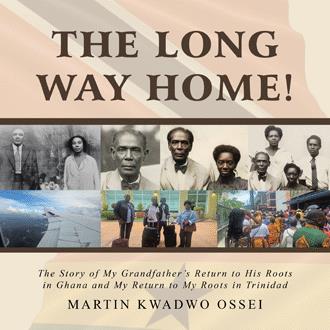
In 1920, a black agriculturist was sent from the British colony of Trinidad, in the Caribbean, to work in agriculture and help develop the botanical gardens in Aburi, Ghana, in West Africa. This would have been an emotional journey as he had grown up in a family of former slaves. Most of the black people in the Caribbean at the time were descendants of slaves, shipped from West Africa to work on farms in the Americas. Although the capture and shipment of slaves was started by the Portuguese in the 15th century, direct shipment of West African slaves to the Americas began in 1518 and continued for more than 300 years. Joseph Adolphus Pat-Williams from Trinidad, would have been excited and emotional on this posting to Ghana, West Africa. He was about 40 when he undertook this pilgrimage back to his roots in Africa. He had grown up in a different culture, but his heart was African. His culture was Trinidadian, a mix of African, European and Asian cultures. His language, education, clothes and way of life had been influenced by his Trinidadian culture and slave ancestry. He was therefore a mix of cultures from around the world. Joseph looked forward to his posting to Ghana, West Africa. Although he was born 40 years after freedom was granted to slaves in the Caribbean, the effects of slavery would have been very real to him. The greatest desire of every slave, whether in a physical, mental or spiritual context, is freedom, and nowhere feels and smells of freedom like home. Africa was home. It had been a long time since Joseph’s ancestors left Africa as slaves and so he had no specific family he could identify as direct blood family in Africa. He had lost any direct family contact as his ancestors would have left Africa hundreds of years before, as slaves. However, he embraced all of Africa as his family. He looked African, had an African identity but had lived all his life in a place where he was treated as a foreigner and a second-class citizen. He looked forward to starting his own nuclear family in Ghana, with his root firmly fixed in the land where his ancestors were forcibly uprooted from. All of Africa was home and he was going to embrace his new destination, Ghana, as his family home. Africa was waiting to welcome Joseph Pat-Williams as the long-lost brother who was coming back home. Many African families must have wept and felt helpless as they witnessed slave raiders with superior financial and military muscle, capture members of their families as trophies of war and articles of trade, to subject them to the pains of slavery, far away across the Atlantic Ocean. The tears continued through the centuries of slavery. Lots of tears and heartbreak would have been experienced in Africa and the Americas during the slavery years. God created every person with a freewill to make personal choices so the most humiliating and painful experience for any human being, would be to have this God-given freewill forcibly taken away. Apart from a few greedy ones who were partakers in this ugly trade for their own selfish profit, the heart of Africa has always been ready to welcome their brothers and sisters back home. Also, from the slave fields across the Atlantic, the hearts of the Africans in forced labour, were longing to be back home in Africa. This book is about Joseph Adolphus Pat-Williams, a descendant of slaves, who returned to his roots in Ghana; his life as a Trinidadian, living in Ghana, the family he raised in Ghana, and the return pilgrimage of one of his Ghanaian grandchildren, Reverend Martin Kwadwo Ossei, back to Trinidad in search of history. This pictorial book combines captivating history captured in two stunning countries. Enjoy the themes of travel, biography, family, geography, history and cultures in one book.
Formats

Book Details
About the Book
This book is about Joseph Adolphus Pat-Williams, a descendant of slaves, who returned to his roots in Ghana; his life as a Trinidadian, living in Ghana, the family he raised in Ghana, and the return pilgrimage of one of his Ghanaian grandchildren, Reverend Martin Kwadwo Ossei, back to Trinidad, in search of history. This pictorial book combines captivating history captured in two stunning countries. Enjoy the themes of travel, biography, family, geography, history and cultures in one book.
About the Author
The author, Reverend Martin Kwadwo Ossei, is a preacher of the Gospel of Jesus Christ and a historian.