
Humor as Survival Training for a Stressed-Out World
The Coping Humor Training Program
by
Book Cover & Preview Text
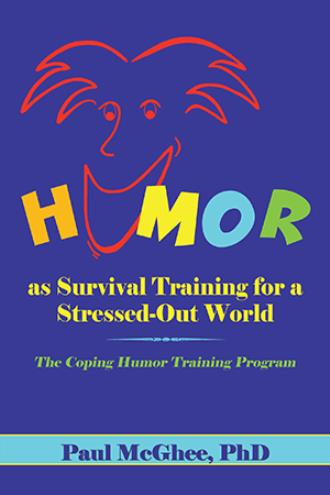
More than ever before, we all increasingly need special skills that give us the emotional resilience we need to survive in an increasingly stressed-out world. Your sense of humor is one set of skills that are essential to meeting the challenges to your emotional survival that you’re sure to encounter in the days and years ahead. This book shows you how to develop the basic humor habits and skills required to use your sense of humor to cope. There is considerable research on the many physical and mental/emotional health benefits resulting from humor and laughter. These benefits include such general health-promoting mechanisms as a stronger immune system, reduced blood levels of stress hormones and pain reduction, as well as documented health benefits in connection with specific diseases—including coronary heart disease, asthma, chronic obstructive pulmonary disorder (COPD), arthritis, skin allergies and diabetes One thing is certainly clear: humor’s capacity to generate positive emotion and substitute a positive emotion for a negative one when you’re angry, anxious or depressed, plays a key role in all of the health benefits provided by humor—supporting both emotional and physical well-being. Numerous studies have shown that this Coping Humor Training Program does work. People who spend eight weeks doing the Home Play do improve their sense of humor and do improve their ability to use humor to cope with stress. These studies have also shown that completing this Coping Humor Training Program reduces stress and negative mood (including depression) and increases one’s daily positive mood (including cheerfulness and a general playful attitude; remember that a playful attitude is the basic foundation for your sense of humor). The Training has also been shown to increase optimism, a perceived sense of control over one’s internal states and degree of satisfaction with one’s life. All of these additional benefits of the Training clearly go a long way toward boosting one’s emotional resilience in facing the mounting challenges we face in a stressed-out world. Variations of this Coping Humor Training have also proven effective in reducing depression and anxiety among clinical samples of psychiatric patients suffering from major depression or schizophrenia. The first six Steps of the Coping Humor Training are designed to build up key humor habits on your good days—when you’re not under stress—to the point that your sense of humor no longer abandons you in the midst of a high-stress day. Step 1 is to simply start building more humor into your daily life. While doing this . . . you will gain an initial understanding of your current humor strengths and weakness, as well as the influences that produced them. The Second Step does not involve humor per se, but is actually the key to your success in the rest of the Training. It involves simply cultivating a playful attitude within yourself, so that you have access to this attitude when you need it. This is the basic foundation out of which your own natural sense of humor emerges. Humor is actually a form of mental play, so when you become more comfortable with being playful in general, your mind is just naturally more ready to find and enjoy humor. Step 3 is to make a conscious effort to laugh more often and more heartily than you usually do—especially if you are someone who typically does not laugh a lot. Again, this is not a humor skill; it is more a matter of emotional expression. It is included here because there is good reason to believe that some of the health and coping benefits of humor may well come from the physical act of laughter, and there are many who read this book who—either because of their temperament or past personal experiences—are simply not very good at real belly laughter. Step 4 focuses on the first true humor skill you’ll work on—learning to play with language. You’ll first build your skill at telling memorized jokes and funny stories. This will start tuning you in on the different techniques that are involved in verbal humor, giving special attention to puns. You will then start extending this skill to creating your own verbal humor . . . and practicing this until it begins to become available to you as a spontaneous habit. A guy walks into a fancy bar, but they won’t let him in without a necktie. So he gets his jumper cables out of his car and ties them around his neck. He goes back to the bar and says, “OK, can I get in now?” They answer, “Well, all right, but you better not start anything.” Step 5 focuses on finding a light side of the things that happen in your own everyday life. This is an essential tool for learning to use humor to manage stress. You'll see as you work on Step 5 that you're exposed to opportunities for humor every day, but just have not seen them. You’ll be asked to start actively looking for humor every day, which—if practiced regularly—will eventually generate a lasting habit of noticing funny things without actively trying to do so. You'll learn how to see funny and think funny. Step 6 builds up your ability to laugh at yourself. You will learn to poke fun at your own mistakes and qualities of yourself that you don't particularly like. You'll learn to stop taking yourself so seriously, even as you continue to take your work and responsibilities seriously. Finally, Step 7 focuses on having access to all the humor skills and habits you’ve cultivated to this point when you’re having a bad day. This final (most challenging) Step asks you to work on applying your now-strengthened abilities to create verbal humor, find humor in everyday situations and poke fun at yourself in the midst of stressful situations in your life. If you have done a good percentage of the Home Play for all 6 prior Steps to this point, you will already have begun to make progress in having access to your sense of humor in situations where it used to abandon you.
Formats


Book Details
About the Book
The research evidence is now in. Studies over the past three decades have shown that humor and laughter are, indeed, good medicine for both body and soul. Humor as Survival Training for a Stressed-Out World: The Coping Humor Training Program shows how to get the emotional and physical health benefits of humor into your own life. The book contains the first-ever Humor Skills Training Program with evidence from multiple countries documenting its effectiveness in first strengthening your sense of humor and then learning to use humor to cope with the stress in your daily life. This Humor Training begins by building key foundation humor skills to the point that they become daily habits—a new part of your personality. You strengthen one skill/habit at a time, but don’t start applying the skills to daily stressors until the different humor habits are well-developed. The initial focus is on becoming a more playful person in general (humor is actually just another form of play—mental play or play with ideas). It then focuses on learning to laugh more often and more heartily, building verbal humor skills, finding humor in everyday life and laughing at yourself. Only then does the Training shift to using these humor skills to cope with daily stress. Research has documented the Humor Training’s ability to increase life satisfaction, increase your ability to control your own internal emotional states and boost optimism and reduce depression and anxiety among clinically depressed individuals. The Training’s effectiveness has been documented across all ages from college students to adults in their eighties. These findings with seniors make it clear that it not too late for YOU to start reaping the benefits of building more humor into your own life. This book provides the path for learning to do that.
About the Author
Paul McGhee, PhD, is a psychologist, and is one of the world’s foremost authorities on the benefits of building more humor and laughter into your life. He is internationally known for his own humor research, having spent 20 years conducting research on humor and laughter while teaching at the university level. He has published 17 books on humor, along with many scientific articles and chapters in edited books on the topic. This Humor Training was previously referred to as the 7 Humor Habits Program or 7HHP (McGhee, 2010). It is now called the Coping Humor Training Program. It was the first research-based program designed to boost your ability to cope using your sense of humor. Its effectiveness has been documented on three continents. Dr. McGhee resigned from his full professor post to work full time as a professional speaker in 1990. He has provided keynotes and workshops on humor in 11 countries. For the next 30 years, his keynotes and workshops were most often for corporate and healthcare organizations. These presentations are currently restricted to early childhood educators. He was long at the cutting edge of the movement to bring a lighter attitude to the workplace, while maintaining high standards of competence and professionalism. His keynotes most commonly focused on how keeping your sense of humor provides the emotional resilience required to work effectively (and provide quality care in healthcare settings) in the midst of mounting work demands and job-related stress. Workshops (based on the Training presented in this book) focused on learning to use humor to cope with stress. Dr. McGhee’s work has been featured in The New York Times, USA Today, Newsweek, Scientific American Mind, GEO (in Europe), and many other American and European magazines and newspapers. He has also been featured on the Learning Channel, National Public Radio, PBS television, and other American and European television and radio programs. He has received lifetime achievement awards from Oakland University, the Assn. for Applied and Therapeutic Humor and the International Society for Humor Studies. A special issue of International Journal of Humor Research (a “Festschrift”) was published in 2018 honoring his lifetime of humor research.