
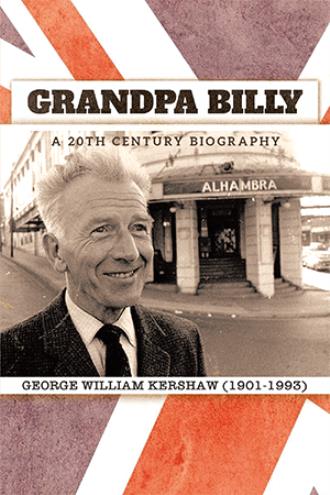
Grandpa Billy
A 20th Century Biography
by
Book Cover & Preview Text
Mick, though basically good-natured, was dangerously irresponsible. He was probably a bit ‘bombardment happy’. He once gave me the biggest fright of my young life, and deliberately came within a hair’s-breadth of messily ending it. He was giving me some instruction on the rifle – for my own good, he said, “This war’s never going to bloody end,” he asserted, “So they’ll get you before so bloody much longer. Remember what I’m telling you now, and you’ll be a corporal before your number’s dry.” He went through the naming-of-parts ritual and explained the bolt action and the function of the safety catch. Taking a clip of ammunition from one of the pouches which were lying on his palliasse, he pressed it into the magazine, and snapped the bolt forward. We were in the billet, and the few men about, who had been taking no notice up to now, began to look rather anxious. Stepping back a few paces he took careful aim at my forehead and began to put the safety catch on and off with the approved thumb motion, his finger hovering round the trigger all the time. By this time the other fellows were looking decidedly worried, and I was petrified with fear. I knew that a careless slip of his finger would have blown my head off. The shell-shocked Arnold, was signalling to me not to move and, it seemed to me, to put a bold face on it. Whether I succeeded in this deception or not I don’t know, but big, stupid Mick did lower the rifle, apparently well satisfied with his little joke. After this incident I didn’t need Arnold’s admonition to “Keep out of their way, they’re both bloody loopy.” Some time after this, the two other Irishmen were involved in a more serious incident owing largely to their mutual antipathy. Paddy, the nasty little wasp, had accused Mick of pinching a packet of tobacco from him, and had been glowering around for a day or two threatening what he would do to him, if he could prove it. Mick had been strenuously and equally violently denying it. One evening, when I was messing around in their billet as usual, with the two Irishmen and some of the men upstairs reading or resting on their beds, I heard their voices raised in loud altercation, but felt pretty assured that I was prudently keeping out of their way. Suddenly there was a loud report, quickly followed by the sound of heavy and hasty footsteps rushing down the stairs. Arnold popped his head round the door and urged, “Come on, get out of here, Mick’s gone bloody mad.” I hurried outside after him; we ran through the stackyard and took cover round the corner of a cart-shed. Still trembling, and giggling rather nervously, Arnold told me what had happened. “I was lying on my palliasse, reading. I could hear those two silly sods arguing the toss, when there was this sudden bang, and a trickle of plaster sprinkled over me and the book. I didn’t stop to see where the bullet had gone but scarpered as quick as I could. He’ll have a clip in the magazine, so we’d better wait here to see if he looses any more off.” Even as he spoke there was another bang, outside, this time. “That leaves him three more, doesn’t it?” I ventured, airing my knowledge of the short muzzle Lee Enfield. The next shot sounded nearer, and Arnold, who was no longer trembling, being prepared now, took a cautious peep round the corner of the building. “The stupid bastard, he’s firing up at the door of the Jerries’ billet now.” We waited until he had emptied his magazine, and after a further pause, warily emerged and slowly returned to the house, joining several of the other men similarly appearing from their various cover points. Mick was back in the house sitting on a form with his head in his hands. Luckily no one had been hurt, but he knew he was in trouble. “Arra! I’m a bloody fool,” he kept groaning, with which opinion everybody whole-heartedly agreed. There was no guardroom and so no actual facilities for placing him under arrest. He mooned miserably around the place until the officer from Shrewsbury made his weekly inspection of the camp and the guards before paying them. Even if a cover-up had been possible, nobody there would have helped him, so the reason for the missing five rounds was revealed. The young lieutenant at once put Mick under formal arrest and detailed one of the guards to accompany him back to Shrewsbury as escort. I can’t remember by what means the officer made the journey from his headquarters, but the final stage of it, up to the Hill House Barn, entailed a tramp up a narrow, overgrown green lane and across a field; the last I saw of Mick was his disconsolate back as he and his escort disappeared into the tangle of the old lane. My only regret was that Paddy was not with him. As to the prisoners’ spare time activities, very soon after their arrival they improvised an orchestra of sorts, although the only legitimate instrument in it was the smallest horn that I have ever seen. Its owner was known to his fellows as Napoleon, but whether this derived from his instrument or not I don’t know. Several had mouth organs, and one had fashioned himself an untriangular triangle from an odd piece of steel bar he had found, but the show piece, for me, was a crudely-constructed rhythm instrument. The body of this instrument consisted of a tree branch, still green and springy, to which was nailed a corn beef can as a bridge, and stretched across this, slightly bowing the branch, was a length of heavy gauge wire. A number of tin lids were nailed loosely on the top end of the branch, and a notched stick acted as a bow. The player drew this across the wire, or struck it, as appropriate, at the same time stamping the contraption on the ground. Practised combination of these movements, together with the jingling of the tin lids, produced some very effective rhythms. Years later, memories of a spirited rendering of “Under the Double Eagle” inspired me to make one of these instruments myself, and in those days of homemade entertainment, it gained an impressive degree of popularity for me among my friends. At the time, it seemed to me that the prisoners were far more adaptable and enterprising than their guards. Maybe some German lad in a similar situation in the Fatherland, was thinking the same about British prisoners of war. Although we were leading such a peaceful rustic life, the war was by now hanging over us like a depressing cloud. It seemed as if it would never end. Just as we had all been completely unaware of the slaughter of the Somme, so were we, in late 1917, blissfully ignorant of the ghastly shambles of Paschendaele, and yet in some indefinable manner it almost seemed that the helpless despair and misery that hung over that battlefield were shared to a very slight degree by the folks at home.
Formats

Book Details
About the Book
Born in 1901 to a couple of music-hall performers, his father being one of a pair of “musical comedians” billed as the Wedburn Brothers, and his mother being what was termed a ‘Soubrette’ (a lively and flirtatious Soprano). An ordinary man "doing his bit," for Queen and Country, Billy lived entirely inside the 20th Century. He lived through five British Windsor Monarchs, and nineteen British Prime Ministers! Always with an active interest in current affairs, and world events, his prestigious titles included ‘Camberwell Beauty,’ ‘Mill Operative,’ ‘Grocery Warehouseman’ aka Vostizza Bill, ‘Butcher Boy,’ ‘Dance Band Banjoist,’ ‘Husband and Father,’ ‘RAF Corporal,’ ‘Pops,’ ‘Engineering Inspector,’ and latterly ‘Grandpa Billy.’ From tiddlywinks to armouring Spitfires, Billy was survived by five grandchildren, and four great grandchildren, this is a fascinating and highly interesting story told in his own words - well worth a read!
About the Author
Jamie was born in York (1978), and has spent most of his life in Yorkshire and the North-East of England. Raised in the Ryedale villages of Beadlam/Nawton, he has lived and worked in Scarborough since 2007. “Grandpa Billy” was typed-up as amanuensis to Billy’s own work. The main purpose of this was to create a “Tribute to Honour an Ancestor.” We hope that this work will be of significance to those interested in Historical Biographies, and/or the older generation with their own stories to share. There are also further projects in mind.