
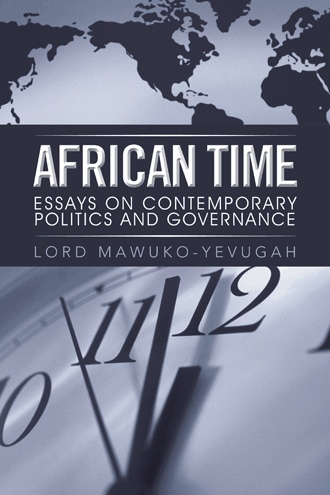
AFRICAN TIME
ESSAYS ON CONTEMPORARY POLITICS AND GOVERNANCE
by
Book Cover & Preview Text
“Can Africa claim the 21st century?” This was the key question on the lips of many African watchers, scholars and indeed anyone who cared or pretended to care about the continent’s future, at the dawn of the new millennium in early 2000. In the 20th century, the continent was defined by nationalist activism and struggles for political liberation, culminating in the attainment of political independence after decades of colonialism and imperialism. Thus with the attainment of black majority rule in South Africa in 1994, effectively marking the end of the obnoxious and racist apartheid system, the continent had truly freed itself from foreign domination, and thus ushering in a new era of hope and optimism. But the 20th century for Africa also became synonymous with broken promises and the betrayal of the independence struggle due to what became known as the continent’s post-colonial crisis, defined by bad governance, underdevelopment, civil wars and poverty. At the global level, the last decade of the 20th century represented the end of the Cold War and realignment in global politics defined by the mainstreaming of Western ideas such as liberal democracy, good governance, and market-led economic globalization and integration within the new global political economy. In particular, the new emphasis on good governance and democratic reform became very important for Africa where these became preconditions for Western aid and development assistance. The 1990s were also marked by a growing local and global call for democratization and good governance both globally and on the African continent resulting in multi-party elections and transitions to democratic and constitutional rule underpinned by the rule of law, freedom of the press and popular participation in the choice of leaders. These developments provided a great source of renewed hope for Africans as they tried to put the disappointments of the “lost decades” of the 20th century behind them. Similarly, the winds of change and political reform blowing across the continent also gave cause for hope and provided the basis for much optimism at start of the new millennium. At the continental level, the emergence of a new breed of leaders began a process towards the reinvention of the continent in order to reposition it as a key player in global affairs. Their efforts culminated in the transformation of the much vilified and moribund Organization of African Unity (OAU) into the African Union with an unequivocal commitment to good governance, economic development, peace and security. Essays gathered in this volume, thus, explore some of the key developments within the African continent and in Ghana at the beginning of the 21st century. Having led the continent towards political liberation during the second half of the 20th century under its charismatic, visionary and Pan-African leader, Osagyefo Dr Kwame Nkrumah, Ghana also became a symbol of Africa’s spectacular post-independence failure. However, a series of peaceful electoral transitions of power since 2000 between the two major parties, the National Democratic Congress (NDC) and the New Patriotic Party (NPP) has earned the country much praise. This present moment of a resurging, stable and democratic Ghana, at the forefront of what some have called, “Africa’s Third Liberation” also coincides with fresh attempts, from the beginning of the 21st century to reinvent Pan-Africanism and African Unity in the form of the transformation of the Organization of African Unity (OAU) to the African Union (AU) and the mainstreaming of good governance and democratic reform on the continental agenda. Thus, recent strides by countries like Ghana as well as the renewed sense of optimism about Africa’s future provide the context to critically engage contemporary African politics and governance: What are the prospects and implications for an African renaissance in the 21st century? How can political reform and democratic governance provide the framework for Africa to reinvent itself and to recapture the promise of the liberation struggle epitomized by the vision of Nkrumah and his generation? Part One of the collection explores key events and developments within the African continent at the beginning of the 21st century both at the level of inter-African state relations and within specific African states. Essays in Part Two focus on the challenges of political transition and governance in Ghana after the country’s historic transfer of power in 2001. Part Three builds on some of the themes raised in Part Two focusing on the political economy and developmental challenges faced by the country and debates around the new government’s ability to live up to its electoral promises. The Final Part focuses on challenges involved in building and sustaining both the idea and the physical structures of democracy.
Formats

Book Details
About the Book
In this wide-ranging collection of essays, Mawuko-Yevugah explores the challenges of political reform and democratic governance in Africa at the beginning of the 21st Century, focusing largely on Ghana’s experience. The inspiration for the title of the collection, AFRICAN TIME, comes from Kwame Nkrumah’s pan-African optimism as well as from recent discourses around “African Renaissance”, “Africa’s Century”, “Africa Rising”, etc. At Ghana’s founding in 1957, Nkrumah proclaimed: ‘Our independence is meaningless unless it is linked up to the total liberation of the African continent. Today, from now on, there is a new African in the world…That new African is ready to fight his own battles and show that after all, the black man is capable of managing his own affairs’. That historic declaration, Mawuko-Yevugah argues, did not only set the tone and direction for Ghana’s pan-African foreign policy but it has also made the country a reference point for Africa’s postcolonial tragedy in the form of political instability and economic decay. Exploring Ghana’s recent strides in democratic consolidation within the context of fresh attempts to reinvent pan-Africanism and mainstream good governance on the continental development agenda, this book offers incisive, critical and a rare reflection on the changing landscape of contemporary African politics and governance through the eyes of a political journalist.
About the Author
A former Ghanaian Political Journalist and Policy Analyst, Lord Mawuko-Yevugah currently lives and works in Johannesburg, South Africa as a Lecturer in International Relations at the University of the Witwatersrand. He graduated with a First Class Honors Degree in Political Science from the University of Ghana, and also studied for a Master's Degree in Development Studies as a Commonwealth Scholar at the University of Cambridge (Downing College), United Kingdom and a Doctorate at the University of Alberta, Canada with a specialization in International Relations and Comparative Political Economy.