
Haunted by the Holy Ghost
Memoirs of a Reluctant Prophet
by
Book Cover & Preview Text
But there was always the need for a prophetic role. If the Lord’s prophets in the Old Testament frequently found themselves at odds with kings we should not expect it to be much different today. Worship of Mammon is probably the besetting sin in the church, followed closely by identification of the national interest with the will of God. While we were at Arco one of the not-infrequent calls for a constitutional amendment banning flag burning came up. The editor of the local paper waxed hot with the remark that if anyone burned a flag around Arco vigilantes should be coming with a rope. That sounded like the Ku Klux Klan and a lynching party. I denounced the editorial in the next Sunday’s sermon. I did not advocate flag burning; to the contrary I said that I get a lump in my throat when the national anthem is played at a public event. The editor was quite popular, and I received negative feedback within the church. With some public and private sessions I was able to talk about the dangers of inflammatory language, potentially inciting violence over such emotional issues. The editor spoke publicly, and so did I. I could have spoken with the editor privately, but it was important that the issue be addressed publicly. The most serious disagreements concerned Gulf War I, known as Desert Storm. I felt that it was far short of just war criteria, and said so publicly. One of the deacons remonstrated with me very vociferously in a deacons’ meeting. Later, when he was on his death bed in the local hospital, I performed the priestly function of visiting and praying with him. He thanked me profusely; he was a choir member who loved to sing, and began to sing his gratitude. Desert Storm was a heavy burden for me. It was during Lent and the season of sacrifice and cross bearing. One night I lay myself down with a prayer turning my burden over to God. I went into a peaceful sleep, but before long I was awakened by a voice, “No, this one’s yours. You carry it.” American Baptist churches are independent. Each congregation is self-governing. But American Baptists are very connectional, with local districts, areas, regional conventions, and the national body, American Baptist Churches USA. Each local church is free to participate in these connectional bodies at whatever level it chooses. There are no set dues, but most American Baptist churches support denominational missions and programs financially. I was always eager to attend area and regional conferences, and was frequently honored with a speaking role. The Northwest Region had several small churches that could not afford a full time pastor. With the blessing of the region but without financial support our Area Minister Dwight Neuenschwander instituted a regional Lay Ministry Training Program. The faculty served without pay. I was privileged, and I use the word advisedly and seriously, to help organize the program and serve on its faculty. We had several students who worked in their churches strictly as lay people. We had two students who went on to become pastors of small churches. One has since retired; the other is still serving a small church near Salt Lake City. Due to financial and personnel constraints, the program did not survive long. A couple of serious, yet humorous notes: At Arco we had an annual Sunday School picnic in the park . One year on the Sunday before that picnic I preached from Luke 14:12-14: When you give a luncheon or a dinner, do not invite your friends or your brothers or your relatives or rich neighbors, in case they may invite you in return, and you would be repaid. But when you give a banquet, invite the poor, the crippled, the lame, and the blind. And you will be blest, because they cannot repay you, for you will be repaid at the resurrection of the righteous In the sermon I asked everyone to invite someone who could not return the favor to our Sunday School picnic, like some of the little urchins that walked the streets of Arco. At the picnic I spotted this unkempt little boy who never came to Sunday School or church. I went to him, and said, “I’m so glad you came to our picnic. By the way, who invited you?” “Miss Mary Mae,” he replied. Miss Mary Mae was one of the church matriarchs, very prim and proper, well known and well like around town. I went to Miss Mary Mae and thanked her for inviting little Johnny to the picnic. He was exactly the kind Jesus said we should invite. “I didn’t invite the little scamp to the picnic. I invited him to Sunday School, and he didn’t come.” Jesus’s instructions are so plain, yet we so readily miss them. One of Patricia’s Episcopal friends dreamed that she, Patricia, and their Roman Catholic colleague had started a .private school, but they argued whether to say trespasses or debts in the Lord’s Prayer. “He who sits in the heavens laughs. . . .” (Psalm 2:4), and also sheds an occasional tear over the foibles of those created in God’s own image.
Formats

Book Details
About the Book
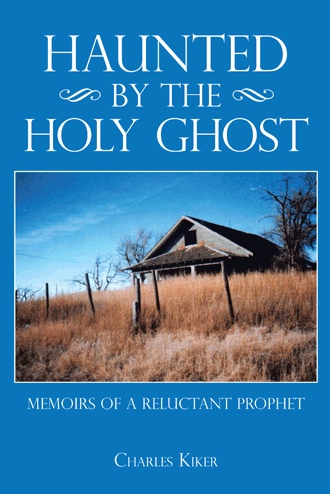
Haunted by the Holy Ghost is a geographical, chronological and spiritual autobiography. The author describes the place of his birth: a farm in semi-arid Swisher County in the Texas Panhandle in depression/Dust Bowl days. He describes his schooling at a two-room rural school through elementary years, and his years at a small town high school. The author reflects upon the richness as well as the poverty of those days. He describes his struggles with his call to ministry as a haunting by the Holy Ghost. The reader is taken on a travelogue of the places in which the author and his wife ministered. The spiritual aspect of their lives is always on or just below the surface. At times the author waxes homiletical and theological, with occasional narrations of humorous incidents.
About the Author
Charles Kiker is a child of the depression. He grew up on a hardscrabble farm in the Texas Panhandle during Dust Bowl days, and attended a small rural elementary school before moving up to a small-town high school. He wanted to be a farmer, but from his earliest memories felt the call of God to be a minister. He farmed for nine years out of high school before embarking upon education for ministry. Kiker earned a Ph.D. in Old Testament from The Southern Baptist Theological Seminary. He has taught Old Testament Hebrew as well as general religion courses at seminary and college levels, and has served as minister of several churches. He is married to his childhood sweetheart, Patricia.They have lived in Tulia, Texas since his retirement in 1999. They have two daughters, five grandchildren, and two great grandchildren.