
The Twenty-Five Cent Gamble
by
Book Cover & Preview Text
I didn’t think that anything would really come of this matter and I didn’t know anything about printing anyway. In fact, looking back, I can’t believe I was so bold since I knew very little about any of the testing procedures. A year went by. My grandfather had died, and I came back from the funeral to find in the mailbox an order for 20,000 of one of the tests from Kansas City, Missouri. Needless to say I was on the spot then. I thought the world was coming to an end since I had to tell my husband. He criticized me and told me he would probably lose his job as a result. So I was on my own. I took June in a go-cart and walked down the street to find a printer. We got a second mortgage that paid for the first 20,000 tests. The tests were printed, and they were delivered at our house and put in the garage. Shipping was another part of the procedure I knew nothing about so I simply wrapped the tests and put them in a great big old piano box. I accomplished this with my mother’s help. Our inexperience really showed when the bottom then fell out of the box because we put too much weight into it and we had to start all over again. Finally they were shipped and on their way. When Willis was asked about how he felt when he found out that Ethel had contacted his boss about getting printing plates for his tests, he responded, “I was kind of dubious about what she was getting into and about what my future would be as a result. I didn’t have anything much to do with CTB until about 1944, which was about 20 years after she got the thing going, although I always knew what was going on around the Test Bureau.” No orders came in for a long time after the initial order from Kansas City. Dr. Thomas MacQuarrie, who was president of San Jose State College, contacted Ethel about a test of mechanical ability he had developed and asked whether Ethel would publish it. “Of course, I agreed.” said Ethel. “With that I realized that I had to get out of a residential area and open an office someplace else which was zoned for business.” The "MacQuarrie Test for Mechanical Ability" was a huge success as a predictor. At a later date it played an important role in the history of the company. Ethel said: "I believe it was in the year 1929 when I was determined to go into the printing business but there were other problems. We sold our house near Normandie Avenue School where June was attending and moved to Alta Vista Boulevard right off of Beverly Boulevard and I rented half of a small building. The printing press was a little Miehle press. In order to purchase the press we had sold our first house, got a mortgage on our new house, and a second mortgage. The first name of the company was Research Service Company. It was a terrible name, but anyway that was the name I chose. Getting started was very difficult. I had only two employees, a printer, Wesley Burley, and a bookkeeper by the name of Sullivan. One day the phone rang and it was Claude Owen of the Placement Bureau at Los Angeles City Schools. He stated he had a young man from Indiana who needed work and could I give him a position. I told him I couldn’t even feed myself. The answer is ‘no.’ The first thing I knew Maurice showed up at the office. That was in 1929. I said I had no work for him, but if he wanted to sit out back on a nail keg and paste labels on packages of tests he could. "One very amusing thing is the way Maurice came to get into the accounting business. Sullivan, the bookkeeper, had a very bad habit of getting drunk all the time. One particular morning was pretty bad. He was drunk and lying on the couch in our little reception room. A customer came in and after she left, I said to Sullivan, ‘Come into the office. You’re fired.’ He came into the office and then said a nasty word, and I picked up the telephone and threw it at him. The only reason it didn’t kill him was the extension cord wasn’t long enough. He ran. I still remember the look on Maurice Wilson’s face and Burley’s when I came in from chasing Sullivan down the alley. I said to Wilson, ‘Do you want to be a bookkeeper?’ As a result an auditor from the city schools came out at night and coached him. That’s how Maurice got into the accounting work." Ethel’s original intention was just to print tests. However, in order to keep things going, she was determined to increase the family income, so she aggressively pursued other ways to bring in money. To stay in business, she took on letterpress work, printing stationery, business cards, brochures, and posters for small businesses. Among Willis’s contacts were people who wanted to have published the educational aids they had prepared. So Ethel began to develop a small catalog of those educational materials in addition to the tests. Meanwhile Little June, or LJ, the sobriquet my parents dubbed me with, was playing a role in the development of the company too. I became of special interest to Willis as a convenient subject for a variety of testing experiments, ranging from eye-hand coordination to test item selection…
Formats

Book Details
About the Book
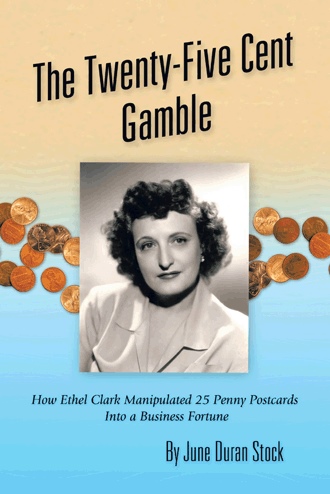
This story is a true, revealing, and sometimes shocking insight into the little known world of educational test publishing and the gamble that led the flamboyant Ethel Clark to become one of the industry’s major players. How she grew the business (once known as California Test Bureau, now CTB/McGraw-Hill) and dealt with the IRS, the unions, the U.S. Army, and her scholarly husband, Willis, was far from traditional, and her personal life was often scandalous. Ethel’s drive to “be somebody,” her disregard for conventional behavior, and her foresight in adopting leading-edge technology contrasted sharply with the persona of her husband Willis Clark, Ed.D. Willis was a pioneer in educational testing, who dedicated his life to the development of many nationally used educational tests and always emphasized the importance of designing tests with results to “help the teacher help the child.” Ethel and Willis greatly influenced the growth and prominence of one of America’s significant but controversial industries. An Appendix highlights test development from conception to the application of test results.
About the Author
The author, June Duran Stock, is the Clark’s daughter. Her entire career has been associated with the testing industry from test development to legislative and legal matters. An Assistant Vice President of CTB/McGraw-Hill she also served for five years as chair of the Test Committee of the Association of American Publishers. June is on the board of the Willis W. and Ethel M. Clark Foundation and is listed in Who’s Who in America. She lives in Pebble Beach, California.