
Scattering the Proud
Christianity Beyond 2000
by
Book Cover & Preview Text
Formats

Book Details
About the Book
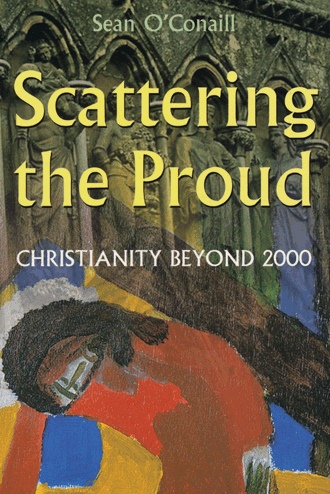
In this radically original and optimistic reflection on the future of Christianity in the Western world, Sean O’Conaill starts from the conviction that the life, ministry, and death of Jesus of Nazareth were a deliberate reversal of the human “heroic” journey to adulation and influence, which has caused violence, tyranny, and injustice in all epochs. He did not identify with, or seek to emulate, the powerful and the influential; he sought out the outcasts and taught that every person was of equal worth in the eyes of God. In the end, he exalted the person who was most despised—the victim—by accepting an ignominious death. O’Conaill argues that, even since the earliest times, Jesus’s followers have been tempted to rejoin the “upward journey” toward power and influence—a journey which inevitably creates “pyramids of esteem” or “hierarchies of respect,” which glorify individuals and elites at the expense of majorities. The development of the relationship between Christianity and the political establishment, in the fourth century, soon associated Christ himself with coercion and led, in the end, to the schisms between East and West, Protestant and Catholic, and between Christianity and liberal secularism. It is also at the root of the “silent schism” within the Catholic church today. The future of Christianity then lies in its willingness to abandon this “upward journey” and to return to the essence of the gospel message, not only institutionally, but personally in the lives of all Christians. This return to a countercultural stance will aim to raise the disadvantaged and to secure the future of the global family and its environment.
About the Author
Born in Dublin in 1943, I studied English and History at University College Dublin in the early 1960s. Developing a deep interest in the European Enlightenment - the historical origin of modern secularism - I was also fascinated by the Second Vatican Council of my church, the Catholic Church, ongoing in those years. My abiding intellectual fascination has been the problem of reconciling faith and personal freedom. For thirty years a teacher of secular history in Catholic schools in Northern Ireland, I retired from teaching in 1996 to write on the gathering crisis of church and culture in the West. Since the 1960s I have been increasingly concerned about the failure of the Catholic leadership in Ireland to realise the Vatican II vision of the church as the 'people of God'. The parallel rise of secularism in Ireland has flowed from the continued identification of 'church' with clergy - an identification that is all the more troubling as the mean age of priests now rises almost year-on-year, and younger generations abandon religious practice. However, secularism has not overcome its own crisis of confidence, so poorly named by the term 'postmodernism'. It is my deepest conviction that the Lord of the Gospels speaks to this crisis also, and that the salvation of western Christianity will lie in discovering the voice and the lifestyle through which he can do so. This tends to be the theme of much of what I write - especially of the short reflection on western history Scattering the Proud (1999). Essentially I am arguing that we need to reconnect our understanding of good and evil with the most constant theme of the scriptures - the dramatic conflict between humility and vanity. Vanity or 'egotism' arises out of our human insecurity. Uncertain always of our own value we typically look for the approval and admiration of others. From this springs our tendency to mimic the desires and the lifestyle of others - the foundation of most culture. This is the simple source of social hierarchy, of injustice, of tyranny and of all violence - including the violation of our own environment. But these afflictions compel us always to seek a deeper source of inspiration and self-validation. The source we find in many different ways speaks to us of the need for humility - self-unconcern and concern for others. This source found its most obedient servant in Jesus of Nazareth, and speaks to us most powerfully through him . Although the long association of the Catholic church with political power has unfortunately compromised its ability to convey this truth, the Gospels, and the continuing tradition of renewal and reform, convey it to us - and call us now to find a mode of life that can respond to the crisis of secularism.