
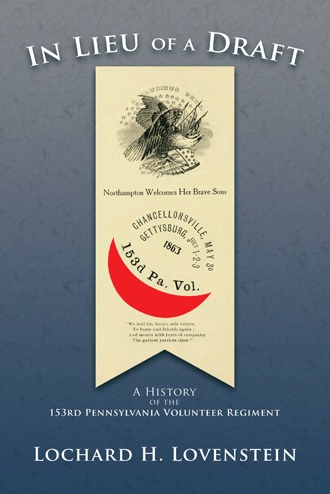
In Lieu of a Draft
A History of the 153rd Pennsylvania Volunteer Regiment
by
Book Cover & Preview Text
While Von Gilsa men ate, Stonewall Jackson had succeeded in stealthily getting his men into position. At approximately 5:20 p.m., mounted on his sorrel, “with visor low over his eyes and lips compressed,” Jakson took his watch in hand and simply turned to Rodes and asked: “Are you ready General Rodes?” Rodes responded, “Yes sir!” Jackson replied, “You can go forward then,” at which point Rodes turned to Major Blackford and signaled him to unleash his skirmishers. The clarion call of the bugle set into motion the assault that would crush the right of Hooker's line. “The first notice our troops had of [Jackson's] approach,” wrote General Abner Doubleday nearly twenty years later, “did not come from our pickets - for their retreat and his attack were almost simultaneous - but from the deer, rabbits and other wild animals of the forest, driven from their coverts by his advance.” “The commands of the Confederate officers, and the yells of the advancing columns could be distinctly heard,” recalled Simmers and Bachschmid, “and when the bugle called them to the charge, they rushed upon us with impetuosity and contempt of death, truly admirable and worthy of a better cause.” Rodes, Colston and Hill, some twenty -six thousand men, struck in three successive waves. Rodes men were the first to confront Von Gilsa's Brigade. Twenty-eight year old Theodore Miller (Co.B) witnessed the confederates approach, “So suddenly and unexpectedly…that some of our men were shot in the back while sitting on their knapsacks.” Lieutenant Wade H. Rieves (Co. D) 12th South Carolina Regiment of Samuel McGowan's Brigade, saw Von Gilsa's men “drawing rations and cooking when we fired into them, their guns in stocks, cartridge boxes hanging on their guns, also their coats.” Chaplain Melick, Assistant Surgeon Stout and Major Frueauff were standing near the medical tent, 200 yards to the rear of the abatis, when the attack commenced. Colonel Glanz and Private Levin J. Boerstler were also in the rear, discussing the oat supply for the officers' horses. Colonel Glanz hurriedly drew on his gloves, and then rode down a newly cleared road leading from the hospital tent to the vicinity of the abatis. Glanz had had the road cleared earlier in the day. Company A, had been placed in reserve to guard this road as a possible avenue of retreat. Glanz formed Companies C, A, H, E, K, G, & B into two ranks behind the abatis, which according to Major Rice “foiled” the initial rebel attempt to breach it, but the enemy quickly renewed the attack, enveloping the regiment's right, after the 54th New York panicked and abandoned its position. The rebels “poured a maddened storm of lead” over the abatis, in what private Stryker Wallace later described as an “iron hail,” that “fell thick and fast” as the roar of artillery, and crack of musketry was heard along the whole line.” Lieutenant Colonel Dachrodt took command of Companies F, D, and I on Glanz's right, which were quickly outflanked, and no longer protected by abatis. Dachrodt ordered the battalion to fire from a prone position to avoid being hit, but it proved too difficult to reload from this position. Private Abraham J. Benner (Co.F) got shot in the shoulder as he stood up to ram a stuck cartridge down the barrel of his gun. Dachrodt “severely wounded' handed over command of the battalion to Owen Rice. Rice immediately ordered companies F & I to refuse in order to prevent a complete envelopment. As this maneuver was being performed, what was left of the 45th New York - situated to the left of the 153rd - “gave way in precipitated retreat.” According to Private William Marstellar (Co. F), Corporal Andrew Siegler was the first man killed in the regiment. Marstellar managed to fire five rounds before retreating. In Company D, Second Lieutenant W.H. Beaver witnessed Private Walter Rutman get “shot through the leg…” Rutman had to be left behind, and “laid three days on the field before he was picked up.” (After the battle The Philadelphia Examiner mistakenly listed Rutman as killed in action. Since casualty lists often took days to reach home, inaccuracies in reporting often had devastating effects on soldier's families). Corporal John B. Bens fell, not far from Rutman, “but was unable to bear him any assistance.” Bens suffered a fatal gunshot wound to the head, leaving him “delirious until death but an end to his suffering.” Private Francis Stofflet had his hat shot off, narrowly escaping death and suffering only a minor scalp wound. At the abatis First Lieutenant Christian H. Rehfuss (Co.E) recklessly exposed himself by stepping on top of a tree stump so he could “overlook the enemy,” while directing his men's fire. Second Lieutenant Lawrence Dutot (Co.K) recalled his company held its ground until the rebels got “within twenty-five feet of us, then we fell back.” “They kept up a steady fire of shell,” noted Dutot, and their infantry “had us in a cross fire. The bullets came worse than a hail storm that drove us back more than one mile, when our noble battery opened on them.” Lieutenant Colonel Ashby of the 54th, having regrouped nearly two hundred of his men, repositioned them to the right of the 153rd. Since the 153rd constituted the largest of Von Gilsa's regiments, the Sons of Northampton formed the majority of 1,000 men left on the right.
Formats

Book Details
About the Book
In Lieu of a Draft: A History of the 153rd Pennsylvania Volunteer Regiment documents the daily chores of camp life and the long hours spent waiting to engage the enemy, Historian James I. Robertson, Jr. has noted that soldiers spent “more time in camp than on marches and in battle combined.” This book presents the uncensored story and explores the deep political divisions within the regiment. William R. Kiefer, the regiment's historian, admitted that many incidents recorded in diaries had to be omitted, because they dealt with “certain personal matters,” offensive to some of the survivors, but which admittedly “would otherwise have added relish to the stories.” Kiefer also had to exclude material he felt was “heavily tainted with odium cast upon certain officers” and “written in such partisan style” that the reader would find it unacceptable. The battles of Chancellorsville and Gettysburg are retold through the eyes of the 153rd volunteers as only they could have seen and experienced them. Every effort has been made to present this story as a chronological narrative of their service.
About the Author
Mr. Lovenstein graduated from Temple University in 1972 with a Bachelor of Arts Degree in Psychology and is a member of the Northampton County Genealogical Society. He has been an avid collector of Civil War memorabilia for over 30 years. As a lifelong resident of Northampton County, he began researching the history of the 153rd Pennsylvania Regiment, when he procured a rare book on the subject written by Ethan Allen Weaver, son of Sergeant Henry Weaver, who served in the regiment. Weaver corresponded with many members of the regiment and compiled a memorial album dedicated to his father. Mr. Lovenstein is a Program Analyst for the Curtiss Wright Engineered Pump Division in Phillipsburg, New Jersey and resides with his wife in Easton, Pennsylvania.