
Ora's Boy
by
Book Cover & Preview Text
The car pulled up in front of the dark blue clapboard three storied building on Lake Avenue. My mother took my small suitcase out of the trunk, told my sisters to wait in the car, and walked with me up the steep concrete steps to the entrance of this ominous looking building. I looked back at my sisters, as my mother rang the old-fashioned cranking bell. Overhead, in gold trim on a black background read the sign: “Saint Vincent de Paul School.” An old nun answered the ring and swiftly escorted us to the main parlor. My mother kissed me on my forehead, turned, and quickly darted out the front door. I cried out, “Mom, where are you going? Where’s Claudie and Lorraine? Don’t leave me. Please, please, don’t leave me here.” Tears were streaming down my face. She was gone. Nobody but the old nun was there to hear my pleas. I could only wonder, what was happening to me. Where were my sisters? I was confused and abandoned. What was I doing there? At that very moment, I was scared out of my wits. The place was eerie. I stood there alone. Silently stood there, knowing full well that I was on my own. That I had to carefully avoid any dangers in my new surrounding at this place called St. Vincent de Paul. My very own mother lied to me. She brought my sisters along so I would think they’d be with me. That was never her plan. Lorraine immediately realized this was not the type of private school she was led to believe. When she returned to the car, Lorraine pleaded with my mother, “Mom, this is a scary place. You can’t leave Sonny there. Go back and get him.” That fell on deaf ears. I’ll never know the real reason she sent me there, but I’ll always remember it as the most traumatic experience in my young life. What had I done to deserve this punishment? It’s cruel to deceive a child; it’s even crueler to be deceived by your very own mother. The nun took my hand and walked me down a long narrow hall to what would become my home for the next school year. We went to another building, attached to the rear of the long hallway. There, she walked me up a flight of stairs to a room full of neatly arranged metal cots. There were three rows of cots in that room. We walked through that room to a smaller room, where there were some eight or ten more metal cots. She pointed to one of them and told me, “That’s your bed.” While I slid my little suitcase under the cot, she began to tell me my new daily routine. We woke up to a loud bell and the overhead lights were turned on at 5:00 a.m. We then proceeded to the bathroom at the end of the larger room. We only had a short time to make our beds, dress in our school uniform, and line up for early mass or prayer in the chapel. After morning religious service, we quietly marched, in pairs, to the cellar for our breakfast meal. We sat at long tables that filled the room and a nun monitored us during meals. We couldn’t speak to anyone the entire time. That was supposedly some sacrifice we made to God to become better Catholics. These new rules happened so fast I didn’t have time to react. I just followed the other boys to the evening meal. It was there, I noticed that I was probably the smallest boy in the school. There weren’t any girls there. For the most part, these boys were ruffians and had a pack mentality about them. They didn’t come from loving, caring homes. They were mostly the abandoned children of French Canadian factory workers who slaved in the hosiery mills in Manchester. They were not like my classmates at St. Joseph’s. Theystared at me as if I were some kind of prey. That first night, I crawled into my cot, pulled the brown wool blanket over my head, and cried as softly as I could so none of the other boys would hear me. What I soon learned is that St. Vincent’s was actually an orphanage. It was the 83rd institution founded by the Sisters of Providence, whose motherhouse was located in Montreal, Canada. The house opened their doors to 12 orphans (7 boys and 5 girls) on December 19, 1882. It was the main depository in the state of New Hampshire for French Catholic children, abandoned by their parents. Most of the boys came from Manchester. That was the largest city in the state, with a population of around 50,000. Forty percent, some 23,000 residents of Manchester were French speaking Canadians. In my suitcase was a school uniform. We wore black wool blazers with black matching short length pants. We also wore long light brown full-length stockings, held up by garters attached to the front and back of our underwear. Under our blazer, we wore a white shirt and black tie. We wore that outfit every day. The second day, I watched the other boys dress and immediately followed their lead. I don’t even recall being introduced in class. There were some thirty boys at the orphanage and we gathered in two classrooms. For all I know, I may have been in a classroom with sixth graders. That didn’t matter. I found refuge in burying myself in learning. It didn’t take much effort to excel in the classroom. These boys were like zombies in class and didn’t care if they learned anything. I had to be careful not to act too smart even though I was by far the smartest boy in the class. At around three in the afternoon, we went outside to play in the schoolyard. I simply followed the bigger boys out there. There wasn’t any grass, swings, or anything to play on. It was a big empty concrete yard, enclosed by a six-foot tall wooden fence. There was no way to escape. I was alone in a corner when I heard a boy call out, “Hey, there’s the new kid. Let’s get him.” The next thing I knew, five or six boys formed a circle around me and began taunting me for no reason. A big kid punched me and said, “C’mon, put em’ up sissy. Whatsa matter? You afraid to fight?” I wasn’t a fighter. That angered them even more. Suddenly, I felt a sharp pain across my nose and blood poured freely from my nostrils. Then, they hit my face and body with more blows, coming from all directions. After I was down, they kicked me in the abdomen. I had no choice but to take the blows. As more boys gathered, that must have drawn the attention of one of the nuns inside. My head was spinning as I heard the whistle and saw the nun coming to my rescue. When she asked me who hit me, I suddenly became aware of the jungle I was in. I didn’t even know these kids, so how could I even point them out? Nobody was reprimanded and I was brought inside to be cleaned up. I passed the first test of survival at St. Vincent de Paul: Don’t squeal on anybody. From that day on, I dreaded going out to the schoolyard in the afternoon. I was the new kid on the block. Consequently, I didn’t have any friends. I didn’t speak to anyone and nobody spoke to me. I simply stayed as close to the door as I could and apprehensively waited for the next attack. The bigger boys constantly threatened me. I lived a life of fear. Every night I imagined the big boys holding me down in bed and beating me up. They were capable of beating me up without the nuns ever knowing they did. One night, I was constipated and had to go to the bathroom to relieve myself. However, I was too scared to walk down the dark hall to the toilet. I couldn’t restrain myself any longer. So, I emptied my bowel in my hand and quietly wiped it on the underside of the metal frame of my cot. I closed my filthy hand and stayed awake until the next morning when I could wash it away.
Formats

Book Details
About the Book
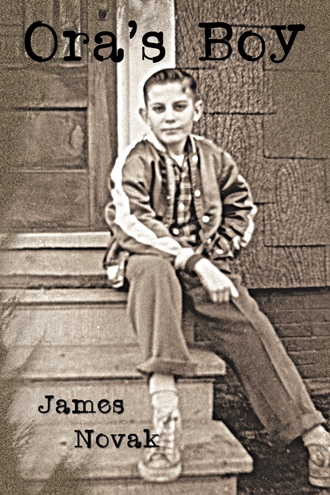
Ora’s Boy is a true story of a boy’s struggles to survive growing up with the prejudices of a small New England mill town in the 1940s and 50s. Abandoned by his father and rejected by his mother was only the beginning of his struggles. Born in a highly conservative French Canadian Catholic community, he has to overcome inordinate bigotry to gain acceptance and approval from the very community in which his mother is ostracized and scorned for violating the tenets of her church….not once, but three times. The book also rekindles old memories of historical events and changes that happened during that era, such as; World War II, the Korean War, President Eisenhower’s election, the famous Boston Brinks robbery, the Civil Rights movement, and the advent of Rock N’ Roll, to name a few, as the author takes you on a journey full of twists and turns he encountered in his young life, as he overcame obstacle after obstacle, hurdle after hurdle, setback after setback, in his never ending will to survive….and succeed. A truly remarkable, heart-warming, inspirational story.
About the Author
Finally, after 60 years, the author exposes the raw truth of his hidden past that laid buried all that while in the subconscious of his soul. In this most-revealing autobiography, he exposes the inner-struggles of his youth, as well as his innate drive to succeed and overcome overwhelming circumstances. Upon graduating from high school in Laconia, New Hampshire, he enlisted in the United States Air Force, where he proudly served his country for the next 23 years. While in the Air Force, he went to college at night and eventually earned dual degrees in Business Administration and Economics. He graduated magna-cum-laude from Park College in 1970 and earned his Master’s degree in Public Administration from the University of Oklahoma in 1977. Among his military accomplishments, he graduated 3rd in a class of 1,200 from Officer Training School and was selected as the Air Training Command “Outstanding Procurement Officer of the Year” -not once, but twice. After retiring from the military, he held several management positions with the Lockheed Corporation. He has traveled extensively all over the world and currently resides with his wife in Bluffton, South Carolina.