
Civil Partnership
by
Book Cover & Preview Text
‘God said the meek would inherit the Earth, not the poor and could you imagine the working classes getting their hands on it?’ Another social observation was being made with prescription and in earnest at the dinner table of Dr Max Hubbard-White in his late Victorian home amongst the safety of his closest friends. The room which was modest for the elegant and well researched abode contained a circular table from the late Georgian period with the chairs, early Victorian. They blended very well. They had been purchased in Chiswick which, as an elegantly suburban area so west of central London it was considered practically Bristol by the inhabitants of Mayfair, gave them added kudos in suburban Cardiff. Max’s objective had been to create a forum for stimulating conversation without the need to lean, making his guests comfortable and at ease. It had worked. The table, in Canadian red mahogany shone and shimmered in the candle light making the room glamorous and his friends enhanced. He would smile inwardly as his friends gasped in horror as yet another hot dinner tureen was placed on the highly polished wood. ‘Max the dish will stain!’ exclaimed Simon, ‘put a place mat under it.’ Simon was Max’s close friend. Half British and half Italian on his father’s side he was an architect and loved the idea of preserving everything, even himself. A devotee of the gym and the gin, he had reached an age of forty seven when, as a gay man, he had the vanity to maintain regular workouts but the sense to realise that it offered only limited redress against mother nature. ‘Its late Georgian,’ continued Simon. ‘So it’s old’ countered Max dismissing his friend’s concerns about the table. ‘In any event its better it looks used, people will think I’m the type of man who throws gregarious parties where people’s comfort is placed before the safety of the furniture. I’m not materialistic’ All the friends laughed heartily at this which hurt Max a little though he didn’t give anything away. Dr Max Hubbard-White was an academic lawyer. This meant that he had no rights of audience in any court at all except that of any ordinary citizen but could debate long into the early hours on political and socio-legal issues affecting the kingdom, of both God and the United. He was also a gay man. Forty two, slim yet comfortably cushioned, broad shouldered (he had once stood behind Gavin Henson in the local Spar and was impressed that the rugby star was smaller although more beautifully formed) and loved entertaining his closest friends. ‘Max, didn’t God mean the poor when he said the meek?’ asked Charlotte, a very elegant lady who lived with her husband and fellow guest Andrew in an even larger Victorian house than Max. ‘Well He may have but after the affects of universal suffrage and the X Factor programme I doubt it. I think it’s only our affectation with material wealth that makes the assumption that poor and meek mean the same thing. We look at a poor person and we think they have a hard life but take away their benefits and they are no less selfish about it than a Duke who might be losing one of his castles to inheritance tax. No, meekness I think transcends economics and frankly there isn’t enough of it.’ ‘Max you are terrible, the poor person needs his benefits to live’ offered Sion, Simon’s handsome, understated and solid partner of eight years. ‘The Duke is obviously rich enough to loose his castle if he has to pay that much inheritance tax.’ Sion, as a very able accountant, had a point. ‘Yes but Sion who would be the one to bleat about it to all and sundry? I suspect our kinsman on benefit would open every conversation he had with his awful prospect while the Duke may just accept that he had no way of planning financially for the demise of his young and prematurely dead father’ Max explained. ‘Who is the meek one there?’ Max felt a speech within him. ‘we don’t live in a country that was established in 1832 (he wondered if they would understand the reference to the Great Reform Act and the enfranchisement of the middle classes) and for a Duke to loose his home to inheritance tax is for him the same as I loosing my Victorian semi to mortgage arrears or the Irish.’ ‘The Irish?’ enquired Simon. ‘Well give them a chance don’t they want revenge? As a nation we are next to them. We’re supposed to be a cordon sanitaire against the English but will they see it like that as they river dance up my erring bone garden path with me throwing potatoes at them saying, ‘look we’re terribly sorry.’ I doubt it.’ Max thought himself very good at remaining value neutral considering that his background was working class, but also Welsh. This meant that you were poor, but you read books, saw education as the best way of talking to English people and being convincing and that in spite of any financial disadvantage that could beset you, you always knew that the Jews were fooling themselves and that the Welsh were actually God’s chosen people, He having a county home near Abergavenny but kept quiet about it because of the press. Being Welsh had proven an issue for Max and as he reached middle age he realised more and more that the prejudice instilled in him as a boy towards the English was both unfounded and illogical. His great grandfather had been a hill farmer near Pontypool and only spoke Welsh but his grandfather had married a woman from Bristol and an Anglican. Grandfather being a Congregationalist meant their marriage had been ‘mixed’ and frowned on by everyone in 1924. For Max, Wales was enduring an identity crisis. He believed the last line of the anthem which states ‘We hope the old language endures’ but did not see why that meant over one hundred million a year should be paid from the public purse to support a television channel the viewing figures of which were just under two per cent of the total viewing figures for Wales and at a time when Welsh was now compulsory in schools. He was a valleys boy and for him the effects of post industrialism were still far more important an issue for the country than the promotion of the Welsh language. He was, as most were, an English speaking Welshman which meant he was also British and part of a United Kingdom. Unity implies diversity otherwise what would there be to unite he would muse to himself and anyone else who would listen yet he saw those with an obsession with the Welsh language as prone to separatism and xenophobia and this he believed was undermining that union. He understood the linguistic persecution which the Welsh language had endured in the nineteenth century but Wales had experienced an industrial and social revolution since then and frankly it was time to move on. English was no longer the language of England but was the UK’s best export. The idea of being able to go almost anywhere in the world, except sadly Paris, and people could understand you was a remarkable achievement. Welsh would never have the same international kudos and was for Max an expensive but yes an important indulgence. He was thinking about this while eating his beautifully prepared dinner when he was distracted. ‘Why is the X Factor a reason for the poor to loose their inheritance?’ Charlotte asked Max. ‘Well its obvious isn’t it? such an exclusive programme. The first thing that you must have to audition is absolutely nothing to loose. Well frankly that disenfranchises everyone in this room.’ The group laughed at that and Max sensing that he was gathering momentum continued. ‘You also have to have a recently dead relative. It’s essential. I thought of crooning a few old Cole Porter numbers at one of its auditions but try as I might I could not get mother to take the pills.’ Howls of controlled laughter at this. Max started laughing himself on the inside but keeping a Mona Lisa front on it all. ‘So you see for those who have already achieved something in their lives, the need to preserve precludes them, and we, from diversifying into the mysterious
Formats

Book Details
About the Book
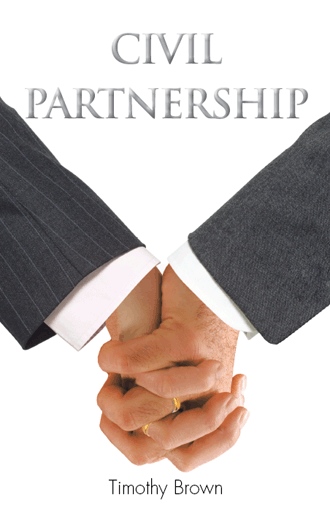
Max Hubbard-White is a middle aged and well preserved gay man who has very clear views about society, his country and his sexuality. At forty one, he and his partner Cameron have decided to enter a civil partnership. They tell their close friends and family and spend the summer preparing for the ceremony in the backdrop of reality television coming to their home and Max reflecting on his brief liason with drugs which ended with a gun man entering his home. This novel explores the positive in life and the strength of humanity to conquer prejudice and addiction. As Max and Cameron experience life altering commitments they show that the universal concept of 'marriage' has now been given a new lease of life as they enter their civil partnership.
About the Author
Timothy Brown is a senior lecturer in law at the University of Glamorgan where he specialises in company law and trusts. Born in the Welsh vallies he has successfully completed a PhD on the subject of directors' duties and published widely on this topic. He currently leads post graduate research studies at the university and published his first novel 'Civil Partnership' in Autum 2011. His experience in the law as well as his experience as a gay man have been welded to produce a witty, poignant and engaging novel looking at the events leading up to his own civil partnership in the summer of 2010.