
Son of Sassamansville
by
Book Cover & Preview Text
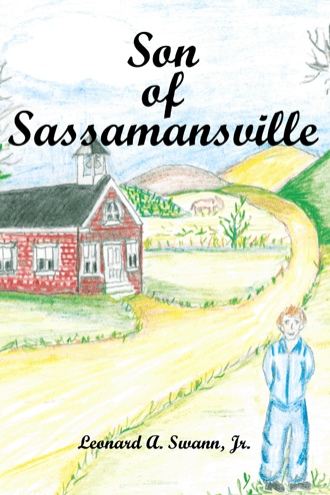
School Days, Chapter 1 There I was, more Tom Sawyer then Holden Caulfield, beginning my first day at Hoffmansville School. Located on Hoffmansville Road, half-way between Route 663 on the east and Sassamansville on the west, the school house was a 1-1/2 story, red-brick building, with a bell tower over the front door and two outhouses about 50 feet to the south. As you entered the vestibule, there was a water bucket for drinking water carried from a neighbor’s well and a storage area for our lunch bags on the right side; and a large coal-fired potbellied stove stood on the left. The front wall was covered with blackboards; and the teacher’s desk was located front and center. Tacked above the blackboards was a lithograph of the Gilbert Stuart portrait of George Washington. There were about 26 wooden desks for the eight grades of mixed-age students. The Swann family had a history at this rural Hoffmansville School. In the early 1920’s, my Uncles Jim, Joe, Sidney, and Jack attended that school together making up 15 percent of the student body. Their teacher was Stanley Bauman, whose family owned the Bauman’s Apple Butter and Cider Factory in Sassamansville. And in the late 1920’s, Uncles Vernon and Dick plus my Dad were students there at the same time. Thus, a total of seven Swann boys received the first eight years of their formal education at Hoffmansville School; and as number eight, I carried on the Swann legacy. A short, burly woman, Mrs. Weber, our teacher, epitomized that old country joke – “she was so fat that when they said haul ass, she had to make two trips.” Or you stared at her and saw Abie cake and shoofly pie. After she stoked the fire in the potbellied stove, Mrs. Weber rang the bell in the tower to indicate school was in session. She grouped the kids by grade, about three to a grade, and assigned a wooden bench-desk to each one. She explained that she would teach us the three R’s – readin’, ritin’ and ‘rithmetic. There would be 15-minute sessions on each subject for each grade. When she was not talking to your grade, you were to stay at your desk, silently study and do your practice work. There would be two 15-minute recesses and a 30-minute lunch break. Then Mrs. Weber pulled a large hickory stick from under her desk and, waving it like a baton, broke into song. “School days, School days, dear old golden rule days. Readin’ and ritin’ and ‘rithmetic, taught to the tune of the hickory stick.” She warned us that she would tune her hickory stick on any lazy or rowdy student and by rowdy she meant talking without raising your hand, messing with the pigtails of the girl sitting in front of you, using your penknife to carve your initials in the desktop or – horror of all horrors – letting lose fart bombs. Mrs. Weber was a dedicated but overwhelmed teacher. She labored on teaching us the alphabet, and then how to print letters, to write in cursive, to read the Dick and Jane textbooks ̶ “See Spot Run” ̶ to construct simple sentences with subject, verb and predicate; to conjugate the verb “be” – “I am firm…you are stubborn…he is pigheaded” ̶ to memorize significant dates and events in American History now that our fathers and relatives were fighting a foreign war; to perform the simple math of addition, subtraction, multiplication and division. As Mrs. Weber taught the three R’s, I learned by my three R’s – rote, recitation, and retention. I repeated the multiplication tables so many times that I felt like an altar boy reciting the rosary. Teaching 15-minute sessions of different levels of the three R’s to eight different grades offered an advantage. In this open classroom, a caldron of chaos, if I listened closely, I could process and learn the entire curriculum of all eight grades. By the end of second grade, I felt confident that I had absorbed everything academic that Mrs. Weber had to offer. But social advancement was another story. I found recess time very boring. What fun was it to run around the school building to play tag? How dumb was it to watch the girls skip rope? And who wanted to hang out at the stinking outhouse, see the older farm boys flash their tools and hear their bragging about the sixth-grade girl they had convinced to flash back her secrets. Lunch time was especially boring. My Mother’s idea of lunch was a sandwich of one slice of bologna on dry white bread and a scrawny apple. The sight of that bologna sandwich made me nauseous. So every day on my walk home from school, I took that bologna sandwich, still wrapped in wax paper, pretended it was a bomb blowing up Japs and tossed it into a culvert, about one block south of our house. Some days, I recited a takeoff of the Catholic prayer “Ashes to ashes, dust to dust” with my version, “Shit to shit, crap to crap.” I secretly shook my head every morning as Mother prepared my lunch bag. Then one winter day, the culvert overflowed, creating an icy hazard across Route 663. The Township Highway Crew responded to the emergency call to correct the condition and discovered that the culvert was clogged with hundreds of bologna sandwiches, wrapped in wax paper. Penultimate Days, Chapter 11 There I was, in 2010, after seven decades, in Shakespeare’s Sixth Age of Man “with spectacles on nose and pouch on side,” trying to remember the nebulous events that made me feel old, alone, lonely, useless and redundant. Perhaps it started with recognizing that my favorite mug read: “I suffer from C-R-S… Can’t Remember Sh--.” It might have erupted when my breakfast was a cold slice of Papa John’s pizza and a stale Krispy Kreme doughnut. Maybe it began with my sostenuto dress down from Gucci loafers and Lucchese cowboy boots to SAS tripad comfort shoes. It might have been announced when my rote answer to a waitress’ inquiry “How has your day been?” was “Terrible, horrible, no good, very bad day.” It might have crystallized when the lyrics “Momma said there’d be days like this, days like this Momma said” became my anthem. Perhaps it struck me when I had two weeks of excruciating pain from kidney stones and scheduled myself for surgery before anyone noticed. Possibly it came into focus when our Granddaughter Hannah, at age 9, gave me a shatter-proof page magnifier. Conceivably, it might have been when our Granddaughter Gabby, at age 11, challenged me to an oxymoron contest; she then pecked away on her Blackberry to win with 57 phrases, while I scratched with a pen on the back of a used envelope with my last two entries ̶ “Sand-crab Swann” and “Intelligent Grandpa.” Perhaps it was the parochial parade of other people’s preposterous pretensions, physical ailments, pill regimes, proprietary procedures, phenomenal grandchildren and precious dogs. Ping-ponging from my subconscious were random events. At Gayle’s High School Class Reunion, called “A 60th Birthday Party,” the class lothario, who flew in from Kentucky, wearing his white Kentucky-colonel hat and Kentucky-Fried-Chicken outfit, and drinking his Kentucky bourbon directly from the bottle, started flirting with Gayle. Instead of my physically popping up to his provocation and propelling myself into the poacher’s path, I propositioned Gayle’s friend, Lana, with a Benjamin Franklin to knee him in his precious, private parts. “I can’t because I just had a knee replacement,” Lana replied, “but I will use my other leg and kick him in his ‘cannoli’ for a Ulysses S. Grant.”
Formats

Book Details
About the Book
Leonard A. Swann, Jr. in his memoir, Son of Sassamansville, traces his humble childhood in rural Pennsylvania, education in a one-room schoolhouse, graduation from Muhlenberg College and Harvard University, experiences in the petroleum industry, bankruptcy and oblivion, rebirth as a producer of documentary videos, and surviving the loneliness of old age. Learn from Son of Sassamansville how to recognize and incorporate the hustle gene into an energetic approach to life. Witness how rural values and family experiences in childhood become important shields for the vicissitudes of adult life. Follow one man’s journey through William Shakespeare’s Seven Ages of Man to reinforce your own fortitude and protect your happiness in aging.
About the Author
Leonard A. Swann, Jr., a graduate of Muhlenberg College and Harvard University, is the author of John Roach, Maritime Entrepreneur; numerous magazine articles, and 40 scripts for documentary videos in the Sirocco Historical Doll Series and the Sirocco Master Artist Series. He currently resides in Norfolk, Virginia, with his wife and surrounded by 7 married children and 15 grandchildren.