
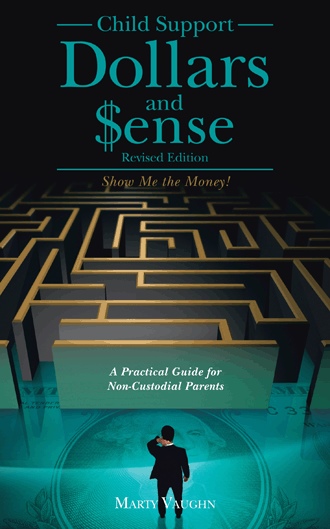
Child Support Dollars and $ense
Show Me the Money!
by
Book Cover & Preview Text
Case Summary #7
Occupation: Salesman
Problem: Multiple tax refund interceptions and closing out of state case with arrears.
Alleged Arrears: $2,882.76
Mr. Dudley signed a Consent Agreement with an out of state child support enforcement agency. We will call this agency no.1. The agreement stated that he would pay $150 per month for current support, and an additional amount of $23 per month to satisfy arrears totaling $546.25. The arrears were due to the state for reimbursement of welfare benefits the CP and child received. Mr. Dudley’s total obligation of $173 per month was made by wage garnishment. A year later, there was a crisis in his family that required Mr. Dudley to relocate to his home state. Upon his return, he was unable to secure employment right away, so his child support fell about four months behind. That’s where his problems began. The following year, around February, Mr. Dudley received a letter from agency no.1 indicating that he owed $1,719.43 in child support arrears. He knew that there were lapses in payments due to his change in employment a year earlier, so he did not bother to question whether or not the amount of arrears indicated was accurate. The following month, Mr. Dudley received a notice from the IRS stating that $450.00 had been intercepted by a local child support enforcement agency in the state where he lived for a past-due support obligation. We will call this agency no. 2. Assuming that agency no. 2 was acting on behalf of agency no.1’s interstate child support order, he chose not to question this action either. He was expecting a tax refund check soon (estimated at $1,391) and was just happy they weren’t taking it all. Unfortunately, in the same week, he received two more interception notices; one was for $560, the other $381. Both interceptions were made by out of state agency no. 1. Just when Mr. Dudley thought it couldn’t get any worse, he received another letter. This time, it was from agency no. 2. The letter stated that his child support was overdue by another $617.08. Mr. Dudley was frustrated and contacted his caseworker at agency no.2 for help. She promised to do what she could to resolve the matter. However, she reminded him that the arrears to agency no.1 would still have to be paid. For months Mr. Dudley and his caseworker tried to settle the matter, but nothing was resolved. Agency no.1 informed Mr. Dudley that the case would not be closed, and that even if it could be closed, the arrears would have to be paid in full. In January of the following year Mr. Dudley received a letter from agency no.1. It wasn’t another notice, but was quite unusual. It was a letter inquiring of the whereabouts of the mother of Mr. Dudley’s child. It stated that they were holding money that was due her, but did not know where she was. At that point, Mr. Dudley sought help outside of the child support enforcement agency. He called his attorney who then contacted me to consult and investigate the case.
Findings:Mr. Dudley was aware that the CP and his child had recently relocated to the state where he lived. However, he was not aware that she had sought public assistance and thereby assigned support rights to both agency no.1 (out-of-state) and agency no.2 (local). Not only was agency no.2 collecting on the URESA Order for agency no.1, but it was doing so for itself also. A detailed findings report was prepared, and copies were sent to both agencies along with the current address of the CP.
Results:Agency no. 1 corrected their information, properly credited all payments, and Mr. Dudley’s case was closed without further incident. Mr. Dudley was issued a reimbursement check for overpayment of obligation in the amount of $2,385.00. This check was forwarded to Mr. Dudley’s local child support enforcement agency – agency no. 2 – and they adjusted their records. After deducting what Mr. Dudley really owed in arrears he received an unexpected reimbursement check in the amount of $1,969 for overpayment of obligation. Mr. Dudley’s accurate amount of arrears was only $453, not $2,882.76 as stated by the child support enforcement agencies. The reimbursed amount did not include funds previously mentioned that were held for the CP as they were disbursed to her directly. BELIEVE IT OR NOT!
CHAPTER 7 WAGE GARNISHMENTS & ARREARSWage Garnishment, Order to Withhold Income, Administrative Writ of Withholdings, Writ of Garnishment, Payroll Deduction Notice, etc., no matter what they are called, they all involve deductions made from an individual’s earnings. According to labor law, wage garnishments do not include voluntary wage assignments made by an employee to an employer1. Earnings are any wages, salary, commission, bonuses, or other income2. Earnings also include payments from pension or retirement programs as well. Tips are generally not considered earnings for the purposes of the wage garnishment law, which “applies to all 50 states, the District of Columbia and all U.S. territories and possessions3.” The portions of earnings that are subject to garnishment are called “disposable earnings.” Disposable Earnings are the employee’s earnings remaining after legally required deductions are withheld for Federal income tax, social security taxes, state and city tax, unemployment insurance and deductions required under state employee’s retirement systems4. Other deductions which are not required by law (e.g. union dues, health and life insurance, charitable contributions, etc.) are not subtracted from gross earnings when calculating the amount of disposable earnings for garnishment purposes. However, a state may choose to make deductions for these items when calculating a support obligation.
Garnishment Limitations
CCPA (Consumer Credit Protection Act) limits the amount of individuals’ disposable earnings which may be garnished for any work week to a maximum of 25%or 30 times the minimum wage (whichever is less) for commercial (ordinary) garnishments5…
Formats

Book Details
About the Book
“Fiscal year 2010: over $175 million” in child support payments could not be distributed to the children for whom they were collected! How big are undistributed collections this year? Is it possible that some of your child support payments ended up there? Where does the money go if not to the children? Show Me the Money!
In Child Support Dollars and $ense – Show Me the Money! Author Marty Vaughn addresses ongoing issues faced by many non-custodial parents as they pay support for their children. Issues include but are not limited to: overpayment of support, missing payments, arrears, improper tax refund interceptions and more.
- Learn why…
- Author Marty Vaughn also offers…
- Ask yourself the following questions.
Are you absolutely certain that…
When was the last time you checked your personal child support case? Three years ago? Last year? Never? “If you are making child support payments you should consider those payments as important as you do deposits made to your bank account.”
About the Author
Marty Vaughn is an author and former business owner and has worked as a contractual Intermediary Research Agent and paralegal for a law office in her home state of Georgia. She has over 25years experience troubleshooting child support cases for Non-Custodial Parents (NCPs) with problems ranging from overstatement of arrears to improper tax refund interceptions and treats every case as if it were her own. Marty is committed to educating NCPs on the importance of personally monitoring their child support cases and properly tracking the payments they make. This revised edition of Child Support Dollars and $ense drives straight to the heart of the matter. Simply put, “information is the key. Non-custodial parents who are armed with information can avoid the child support case nightmares that arise as a result of negligence, oversight and misinformation.” Marty lives in Augusta, Georgia, with her husband and children. She is a mentor, tutor and poet. She loves writing, cooking, sewing, gardening, crafts, and spending quality time with her family, especially her grandchildren.