
Attila and the Battle Cruiser
by
Book Cover & Preview Text
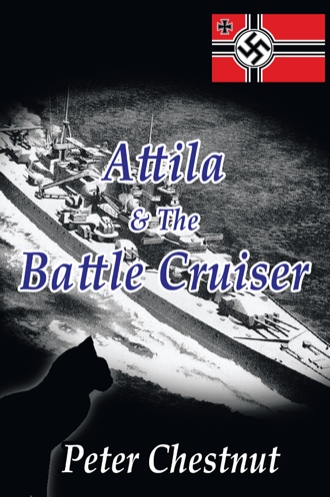
Scharnhorst smartly elevated her gleaming, brass-tipped six inch guns and slowly tracked the plodding merchant marine oil tanker that lay silhouetted just at visibilities edge; seven thousand meters to the West and waited. The wait was not to be very long. Captain Peter Kastanien gently, but with an ingrained firm conviction spoke the single, simple word that carried an almost certain death sentence. “Fire.” The great battle cruiser heeled slightly as four projectiles belched from the gracefully tapered six-inch barrels. Then for an instant, the cordite and smoke from the port twin double turrets partially blinded Scharnhorst. In less than two seconds, the stinging, pungent stench of the strong charges that had hurled the twenty-five kilogram explosive shells cleared. On the bridge, anxious eyes snapped the huge Zeiss binoculars upwards, glued them into their eye sockets and waited. The wait was short, as was the first shot from the forward six-inch turret but the second shell slammed like a small sleek meteorite right into the heart of the rolling tanker. A second later the aft six-inch turret’s first shell also came up a bit shy. The aft’s number two shell clipped the foredeck and plunged into the inky black sea before exploding and creating a violent water volcano reminiscent of a miniature Vesuvius. The huge glass eyes that seemed physically attached to Scharnhorst’s watchers stared, and then the tanker’s midsection puffed up a little in size and caught fire. The blast seemed surrealistic in the darkened twilight, and then the minor shock wave hit the Scharnhorst like a tiny tap from a rubber hammer. Just seconds before the brilliant flash of the fireball, the almost invisible dim lights of another ship was spotted by the uncannily sharp eyes of the lookout on the bridge tower towards the North East. The shape was very faint and only a slightly darker black against the night sky and being at a fairly long distance, he could not make out exactly what sort of ship it was; just that there was a dim light and shape where there wouldn’t be any, if the ocean was empty of human incurrence. Then the slight concussion hit him and he was short of breath for several seconds. When his breath returned, lookout Heinz Alder immediately called the bridge and reported to Commander Herman Gott. Scharnhorst’s Captain was at once informed. Captain Kastanien instantly called the radar room. “Mr. Molter. Do you ‘see’ any other ships on your machine?” “Yes Sir. I have just this minute picked up a very tiny blip that could be a ship or a surfaced submarine. I will inform you as soon as I can ascertain a better idea of what we have here.” “Thank You Molter. I want the information as soon as you can make a better estimation.” Kastanien replaced the intercom and pondered a brief moment. “It could be another ship in convoy.” Captain Kastanien spoke aloud to no one in particular but the bridge officers knew that he was thinking hard and did not want any opinions at this time. “And then again, in these northern waters, far from the normal convoy routes, maybe a horse of a different breed.” Captain Kastanien then turned his gaze back to the burning merchant ship. “She doesn’t seem to be slowed down much and the fire is small. Let us wait a few more moments. Close up to three thousand meters.” Kastanien said with his normal quiet authority. With almost twenty knots superior speed Scharnhorst closed the four-kilometer gap in only twelve minutes. The merchant was still plodding along, her speed apparently hampered only slightly and the fire was nearly out. The Scharnhorst was now slightly ahead of the merchant ship on her starboard side and sliding by fairly quickly. “Open fire with the aft eleven inch turret when ready.” Kastanien ordered. The long, very long barrels of “C” turret affectionately called “Caesar” in all German Navy capitol ships made only slight adjustments as they had been tracking the vessel all the while and three nearly four hundred kilogram shells blasted from the rear of the ship. At only three thousand meters, it was virtually point blank range for the incredibly accurate gunnery of the gun crews, headed by gunnery officer Erwin Rost. The first shell slammed into the merchant just a few centimeters above the waterline and exploded in the boiler room. Shells two and three slammed into the deck just aft of the bridge structure and the innards of the merchant ship blew into the darkened sky like Chinese fireworks. The mortally stricken ship immediately lost steerageway and rapidly slowed to a stop. With alarming speed, the huge gaping hole at the waterline flooded the ship and within three minutes, she was listing to starboard over fifteen degrees. Kastanien then turned away from the doomed ship, faced his First Officer Gott and snapped a quick order. “Change course to 45 degrees and let us close the gap on our new found friend before she gets too far away for our radar to track in the night. Full ahead. We will shadow her until dawn and then see what we shall have for breakfast. We will hold station with her when we are twenty kilometers behind. Make sure that we are stay five kilometers off her starboard beam. We do not want to run into any nasty mines that they might be dropping off to deter us from our destiny.” The orders were rapidly repeated and the great battle cruiser healed into a sharp starboard turn and then settled into the light cross-sea at twenty-eight knots. The burning tanker illuminated the darkened, restless sea enough for Scharnhorst’s new night vision rangefinders to determine the prey’s course to be East-North East. When Kastanien was obviously finished giving orders, Commander Hermann Gott informed him that the radar operator had just confirmed that the vessel was well on the radar screen and on a heading of fifty degrees with a speed of about twelve knots. Kastanien called the radar room and received further confirmed that the ship was on a heading of fifty degrees and plodding along at about twelve knots. He requested to know what the distance was but the radar operator apologized for not having that information yet, but would inform him the instant that he knew. After a minute or two of deliberate calculation the radar room called back that the ship was thirty two kilometers distant. The night vision rangefinders had also estimated this same distance a few second before. “Steer course Oh-Five-Oh. Maintain full ahead until we are in the proper position, twenty kilometers behind her. Also make sure that we are five kilometers off her starboard side. Then hold that position until further orders. Secure from battle stations and do not darken ship, repeat do NOT darken ship. I want our friend up ahead to know that we are here.” Captain Kastanien ordered. Then, glancing towards Lieutenant Commander Schmidt he said. “Executive Officer Schmidt, you have the ship. I will be in my cabin shortly. If anything about this vessel’s actions strikes you as rather unexpected or odd, fetch me at once.” “Yes Captain.” replied the Executive Officer in an almost revered tone to the hero that Kastanien was to him. Then Captain Kastanien turned and strode towards the passageway that led to his cabin. “Second Officer Mueller, please fetch Attila from his battle station and bring him to my cabin.” Kastanien quietly asked his Second Officer. Kastanien’s orders were always delivered in a tone more like a request than a military order. However, not a single crewmember ever thought his standard gentle way of command was a sign of weakness. Rather, they revered him for his humanity and unwavering respect for all the officers and crewmembers alike. “Might I remind all of you that Scharnhorst and Gneisenau have been at sea for nearly six weeks and have been sighted only by their victims? Then they disappear, yes gentlemen, disappear. The North Atlantic is a very large body of water that has a rather nasty disposition quite a lot of the time, especially n
Formats

Book Details
About the Book
A high-tension sea chase set in early 1941 that pits the warships of the British against the German battle cruisers “Scharnhorst” and "Gneisenau" which have been able to escape trap after trap. What makes the British most frustrated is the fact that their enemy has on board a large Siamese cat named Attila, who provides his shipmates with extraordinary accomplishments that has enabled the German’s to escape time and time again. The German’s are wrecking havoc on British shipping and Winston Churchill has demanded that they be sunk before their toll on merchant shipping brings England to the brink of disaster.
About the Author
World War II history buff. I wrote a newsletter for many years and have been published in many photographic magazine. I was born in Toronto, Canada. Graduated from Ryerson University in 1959 and moved to Dallas, TX in 1962 where I began my professional Photolab career. I founded several Pro labs in Dallas and Atlanta and now live in Las Vegas and work as an account rep. for a photographic imaging co. I still enjoy photography and go scuba diving when I get the chance.