
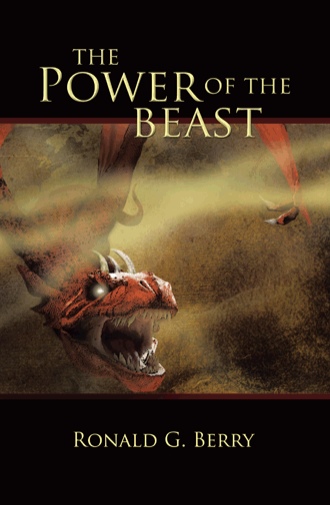
The Power of the Beast
A Commentary on the Book of Revelation
by
Book Cover & Preview Text
Introduction
The Book of Revelation
This book could more accurately be called “The Revelation of, or from, Jesus Christ.” The last book of the New Testament and the end product of biblical prophecy tells us what is ultimately to happen to mankind, mainly with events that will occur prior to the Second Coming of Christ. It also talks about the establishment of the millennial kingdom and the new heavens and the new earth.
An uninformed person might liken the book to a puzzle. This is the viewpoint of many of today’s Christians, who are confused by the symbolism and even scared by the portrayals of destruction. For this reason, some believers avoid a serious study of the book. John Calvin, unexplainably, wrote no commentary on Revelation, although he wrote one on almost all the other New Testament books. A former Presbyterian once told me, “We avoided Revelation like the plague.”
There is no question of the interest in the future today. There is a booming business in fortune-telling, science fiction, tarot cards, horoscopes, and “certified psychic” hotlines. Many become deeply involved in the occult, all in an effort to find out what will be or to ultimately influence events in the future. But the future is only known and declared by God, who “declares the end from the beginning” (Isa. 46:10).
The name of the book in Latin is revelatio, an unveiling, and in Greek, apokalypsis, the removing of a veil. If the veil is removed, what is under it can be seen. So God intended for us to understand this book. Some call it the Revelation of Saint John. It is actually “the Revelation of Jesus Christ.” It is the unveiling of his intentions both for the earth and heaven for his redeemed saints for time and eternity. The book has been unsealed according to Revelation 22:10. A distinct blessing is promised to the person who reads and to those who hear the words of this prophecy (Rev. 1:3).
The figures and symbols of the book, which furnish the basis of its interpretation, are found elsewhere in divine revelation but can be understood only by comparing scripture to scripture. All the other lines of both Old Testament and New Testament prophecy seem to converge in the book of the Revelation. Four times, the writer identifies himself as John (1:1, 4, 9; 22:8). The early church believed it to be John the Apostle. A different style does not prove a different author. The nature of apocalyptic literature, the fact that the author was a prisoner on
Irenaeus, Justin Martyr, Clement of Alexandria, Origen, Hipolytus, Tertullian, and Vircotinus declared John the Apostle to be the author. During the second half of the third century, we find that Dionysius, the bishop of the church in
Building on Dionysius, Eusebius theorized that Revelation was written by a “John the Elder.” There is some dispute as to whether this person really existed. This rests on a controversial statement which Eusebius attributes to Papias.
The “differences in style” argument still forms the main objection today. No one denies that there are differences between the Gospel of John, the Johannine Epistles, and Revelation. But are they significant if one takes into account that the subject matter is so diverse? It might be possible to argue that the different literary style of Revelation could be attributed to John’s use of an amanuensis when he wrote the gospel and the epistles like Paul did (Rom. 16:11), something which would not have been possible in exile on
Commenting on the similarities between Revelation and John’s other writings, Guthrie writes, “It should be noted, incidentally, that in spite of linguistic and grammatical differences the Apocalypse has a closer affinity to the Greek of the other Johannine books than to any other New Testament book.”
As far as the date is concerned, there seem to be two theories: some date the book to the reign of Nero (ca. AD 68), others to that of Domitian (ca. AD 96). Some who adopt the preterist interpretation of Revelation hold to the earlier date. They rely on several passages, which they feel affirm their theory that this prophecy was for the period prior to the destruction of
The early church believed not only that John the Apostle was the author, but that he wrote it near the end of the reign of Domitian. Irenaeus is quoted as affirming this.
Others who believed Revelation was written during the reign of Domitian were the church fathers Clement of Alexandria, Victorinus, Origen, Jero
Formats

Book Details
About the Book
The Power of the Beast is a commentary on the book of Revelation. It ties to Daniel and numerous Old and New Testament books related to eschatology.
The book discusses such subjects as “the meaning of 666”, “the Mark of the beast”, “the anti-christ” and other things pertinent to studies of prophecy. Anyone interested in the future should read this book.
About the Author
Ronald G. Berry received his BSBA in Accounting from the
A Commercial pilot and former president of a Christian Business Men’s organization, Ron is an accountant by profession and an amateur theologian by choice. He lives with his wife in