
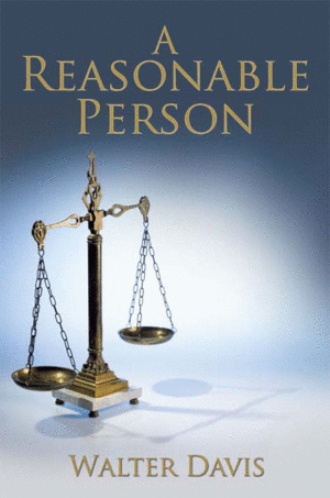
A Reasonable Person
by
Book Cover & Preview Text
“Mr. Boyle, you may now give your summation,” Judge Takai announces from the bench. It's the final day of trial and we all watch William Boyle, attorney for the plaintiff, walk to the lectern. Boyle has a reputation for being merciless in a courtroom and he has certainly lived up to that reputation during this trial. In his mid fifties with a full head of premature white hair, tall and distinguished, he's a complete gentleman outside of courtrooms, but turns into a vicious cobra the moment a trial begins. Without any notes, Boyle reconstructs what happened so vividly that all of us in the courtroom are able to visualize it. “It happened in a little house onMaui, a one story, single wall, wooden structure owned and maintained by Maui Sugar Company, one in a row of company owned houses occupied by employees and their spouses. It's an outdated custom so when both spouses die, the house is torn down. In this particular house, Irene Sato, sixty years old, petite widow of plantation worker, Taki Sato, lived alone.” Boyle is at pains to recreate the scene, even describing the interior. “It's modest but clean, freshly painted and well maintained. The furniture is plain but comfortable and sturdy. Pictures of the Sato family decorate the walls - the Satos, their son who was killed inVietnamand their daughter.” He wants the jurors to place themselves on the scene, and by elaborating and delaying the revelation of what is to follow he heightens tension and the shock of discovery. Even though the jurors already know what happened, their reaction will be far more intense if they are made to experience it vicariously. “And there is Irene, preparing lunch for herself and her daughter when she hears the knock on the door.” To make us all see her more clearly, he even describes what she's wearing. “She's sixty years old, but hasn't lost her youthful figure, can still wear shorts and a navy blue tee shirt. Hearing the knock on the door, she's hoping it's the plumber she asked for. As she opens the door she sees a man with a tool box. He's an ordinary looking young fellow, tall and lanky, wearing khaki pants and a shirt with the words `Maui Sugar' embroidered above the left breast pocket. This reassures her, but more reassuring is the Marine emblem tattooed on his left arm with the words `Semper Fi' under it. Her fallen son had been a Marine.” `Hello, are you the plumber?' She asks. `Yes ma'am,' he replies. `I was sent over by my supervisor, Bob Lacey, to fix your commode.' He lifts the tool box.” “She smiles, opens the door and gestures for him to enter. `I know Bob,' she says. `I'll show you the bathroom.' Leading the way down a narrow hallway, she points out the bathroom and leaves him there, returning to the kitchen to finish preparing lunch.” “She's slicing tomatoes for sandwiches when she hears a sound behind her. Before she can turn she feels a strong arm squeeze her neck and a sharp object pressed between her shoulder blades. She drops her knife, gasping for breath. A voice whispers in her ear, “I've got a knife. Drop your shorts.” She obeys and is easily forced to the floor. “He tightens his grip on her neck and the kitchen turns into one big blur and rapidly turns dark. She can feel her panties being torn off. The last sensation she feels before she dies is being penetrated.” By now the jury is fixated on the horror of what happened. By pitching to their imaginations and creating immediacy, Boyle has virtually made them eyewitnesses to the crime, and he obviously hopes to focus their revulsion onto my client, who has employed the murderer. “Objection!” I almost shout the words as I rise. “All of this is mere speculation on the part of counsel.” Judge Takai looks annoyed as he says, “Objection overruled, please be seated Mr. Dorsey.” I sit. Boyle, unperturbed, continues. “This `plumber,' who had been working for Maui Sugar for a mere three days, had a dishonorable discharge from the marines for acts of violence and a police record for rape and assault with a deadly weapon. We've proven, ladies and gentlemen, by a preponderance of the evidence, not only was the defendant negligent, it was guilty of gross negligence in its hiring practices.” Again, I rise. “Objection, Your Honor. There's never been any allegation of gross negligence.” Judge Takai looks at me and almost sneers, “Objection overruled. Please continue Mr. Boyle.” Again, I sit. So far I have a perfect record with this judge. He's overruled every one of my objections and sustained all of Boyle's. Once again, I thank God for juries.
Formats

Book Details
About the Book
In 'A Reasonable Person', Mark Dorsey applies all of his legal skills in a parade of trials representing clients being sued in quest of insurance company dollars. The story centers on Dorsey's attempts to find harmony in his professional and personal lives. While facing a never ending trial schedule, he engages in dramatic relationships with his loving and supportive wife, his childhood sweetheart who has become a demanding mistress and his gifted and engaging but somewhat irresponsible partner. The story focuses on a series of cases each of which is an absorbing little drama, most of which are played out in courtrooms. As he meets with various challenges in his professional role, Mark also grapples with personal conflicts which threaten to destroy his marriage and his firm. As he is on the verge of making a potentially ruinous decision, a catastrophe occurs forcing him to see clearly what he must do. `A Reasonable Person' reveals the world of insurance litigation in which justice may prevail if it is not prevented by mendacity, prevarication or incompetence. We see how attorneys who have mastered the intricacies of insurance law and are willing to make the effort to apply them will succeed on behalf of their clients. But as Mark Dorsey has discovered, achieving victory as a “hired gun” in the courtroom is not always gratifying.
About the Author
Walter Davis is a graduate of UCLA School of Law, and In writing 'A Reasonable Person,' has drawn upon his experiences as a trial lawyer in Hawaii and as a deputy district attorney in Los Angeles. In addition, he has written a number of legal dramas for TV and has been a member of Writers Guild of America West.