
Christian Education Teaching Methods – From Modern to Postmodern
Teaching the faith to post-moderns
by
Book Cover & Preview Text
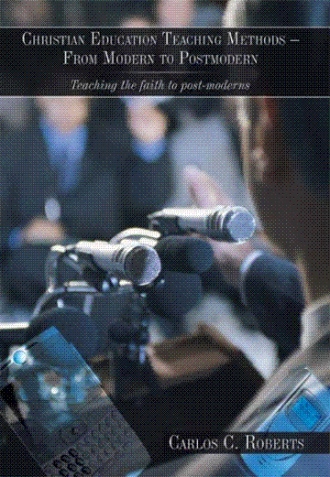
There are several models of the church. Each model leads to different ways of understanding theology and different aims in religious education; as well as the approaches and methods we should use in teaching religious education. Let’s take, for example, the model of the church as a Herald. A herald announces and proclaims to everyone who passes by. The herald reaches out to broadcast the news or whatever information one wishes to transmit. The objective is to get the information or news to all who care to listen. Every passerby is a target. A herald does not remain in one fixed location to await inquirers; instead the herald goes to wherever the audience is located, and boldly articulates the news.
The herald actively searches for every means to proclaim to the world the news or available information. The herald is an active carrier and proclaimer of the news not a passive bearer of information. The herald dynamically announces, proclaims or transmits the news. The herald is motivated to reach hearers through the spoken or written word. In post-modern times the herald will use all the tools or media of social communications to get the word out. In the case of the church it would be the Good News about Jesus Christ, so the word of God would be central to all activities of the church. One will use television, telephone, internet and cyberspace: blogs, pod-casts, web-casts, blackberrys, twitter, CDs, DVDs, videos, cassette recording, the written word, the painted or photographed image or picture, drama, art, music, oratory etc. Post modern society goes further by hiring telemarketers to reach consumers in the privacy of their homes and uses the mail to reinforce that bombardment.
When one visualizes the church as a herald, the dynamics of its communications and the channels and media through which the church will reach out and communicate will change from the passivity of the institutional church, which locates itself in a particular geographical place and invites or awaits people to come to that location to receive its message.
Under the Herald model, the church becomes very dynamic and proactive. It conceives of itself as servant of the word: flexible, mobile and ready to relocate to be present at venues where potential hearers naturally tend to congregate; at shopping malls, for example or recreation centres etc. It will therefore be geared to go out with its message into the busiest places where lots of people gather; for example, in shopping malls, shopping centers, recreation centers, community centers and leisure centers; and areas where the people on the fringes of society may gather – among the alienated, un-churched, poor, outcasts, underprivileged, lonely, destitute, oppressed and downtrodden. Under the herald model, the church adopts the theological orientation of a missionary church and its biblical role models would be Paul, Silas, Barnabas, John Mark, Apollos, Timothy, Phillip, the deacon and other missionaries and church-planters as noted in Acts of the Apostles. Under this model the church becomes an outreach church that gears its programs to reach people wherever they are, breaking through different cultures. Its programs will therefore be mission-oriented and one of its main tasks would be to evangelize through missionary outreach to all. A key controlling image for the Church as Herald will be the Acts of the Apostles. Proclamation of the word of God as found in the bible and particularly in the New Testament, will be at the center of all church activities.
What methods of teaching the faith will a Herald church develop and utilize? In a herald church model the main focus of religious education will be on proclaiming or preaching the Word of God – evangelizing and then deepening hearers in the faith. The aim of religious education will be to form disciples and catalysts for change; and like the early church as recorded in the Acts of the Apostles, religious educators will be actively engaged in follow-up ministries of organizing church communities and nurturing, strengthening, encouraging and confirming those communities after the evangelizers had done the initial preaching and church plantings.
The following is one proposed practical approach of the herald model of church for growing the church through outreach to outsiders or unchurched groups. If we believe the message of Christ is attractive and effective, then we will also believe that our church can grow because of just that – hearers of the message will be motivated to respond. We will therefore believe that parish growth is possible, and we will engage in developing specific strategies for church growth to attract and retain new comers. One of the first steps in this process is to train parishioners in understanding the herald church model and its roles as the proclaimer of a dynamic message. Then people must be encouraged to search themselves spiritually to zero in on experiences in their lives when and where they felt touched
Formats


Book Details
About the Book
This book provides pastors, professional teachers, students of religious education or Christian education, theological students and Sunday school teachers with methods of teaching the faith today and opportunities to reflect critically on the methods and approaches they use in the classroom, small group or ministry study group in the changed cultural context of our postmodern world. The book is the result of years of practical experience in the field of Christian education as a Director of Religious Education and head of a team involved in providing religious education training and producing teaching materials and textbooks for Sunday school and professional teachers of Christian education. This book proposes the Herald model of church and model of Christian education as a very helpful model for postmodern culture.
About the Author
Carlos C. Roberts is a priest and professional teacher for 33 years. For ten years as a Director of Christian Education, he worked closely with professional teachers and Sunday school teachers preparing teaching materials, writing and editing textbooks and training teachers and theological students in methods of teaching Christian education.